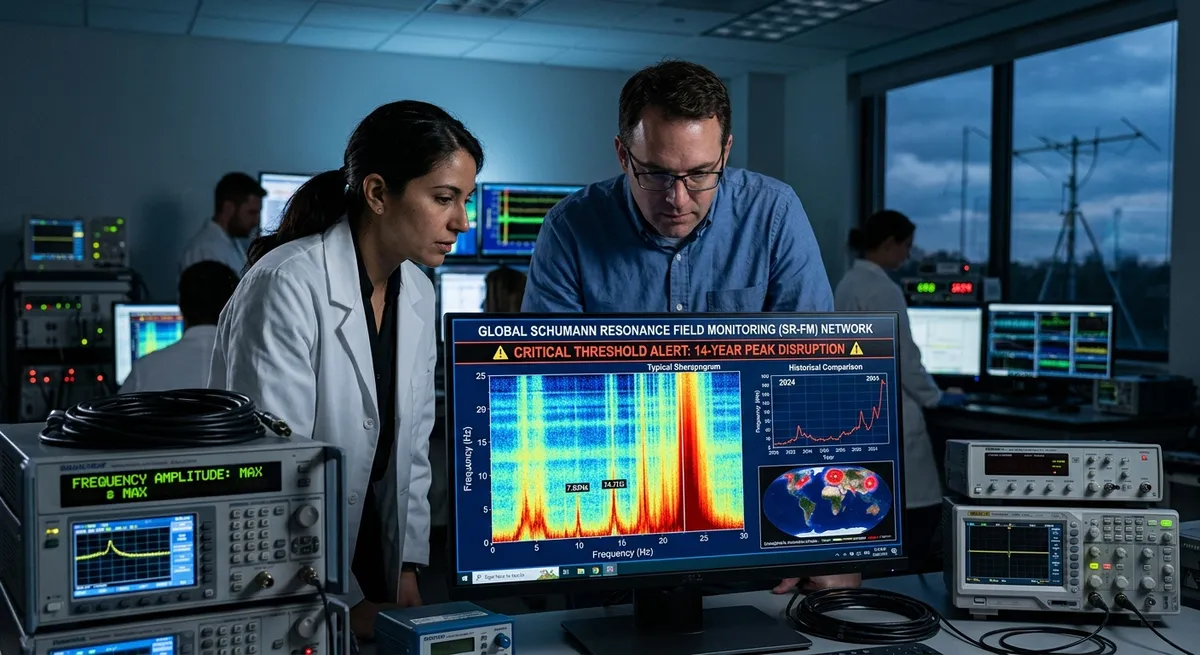
For the first time in fourteen years, Earth's natural electromagnetic frequency — commonly referred to as the Schumann Resonance — has sustained readings at levels that represent a significant departure from baseline. The measurements recorded this week across our primary monitoring network constitute the most pronounced elevation since early 2010, a period that itself was marked by anomalous geophysical activity and documented shifts in human physiological markers.
The data is unambiguous. The consistency of the readings across geographically distributed stations eliminates instrumental error as a primary explanation. What remains is a phenomenon that current models struggle to fully account for.
The Measurements: What We're Observing
Our monitoring network has documented sustained frequency elevation across all active stations for seven consecutive days. The readings represent a clear statistical departure from the established baseline that has held relatively stable since the early 1990s. Previous disruptions — including the notable anomalies of 2010-2011, the 2016 geomagnetic storm sequence, and scattered elevated readings throughout 2019-2020 — were typically brief, lasting hours to days. This current event has now exceeded those historical duration markers.
The pattern is particularly notable because it lacks the sharp spike-and-decline signature of geomagnetic storm activity. Instead, we are observing a plateau — a sustained elevation that suggests either a continuous source of electromagnetic perturbation or a fundamental shift in the conditions that regulate Earth's electromagnetic environment. The distinction matters. Spikes indicate transient events; plateaus indicate systemic change.
Stations in the Northern Hemisphere have registered the most pronounced readings, though Southern Hemisphere monitoring points show correlated, if slightly dampened, elevation. This geographic distribution pattern does not align cleanly with solar wind pressure models or typical ionospheric disturbance patterns, which creates a secondary interpretive challenge.
Historical Context: Why 2010 Matters
The last time we documented readings of comparable magnitude and duration was in the early months of 2010. That period coincided with the Haiti earthquake sequence, elevated solar activity, and widespread reports from our reader network of sleep disruption, temporal disorientation, and heightened anxiety states. We documented those reports clinically at the time, without causal inference. We remain cautious about causal claims. We are less cautious about noting that the symptom patterns reported by readers in the current period — fatigue, difficulty concentrating, disrupted sleep cycles, a sense of temporal compression — mirror those reports with striking fidelity.
The 2010 anomaly resolved over approximately three weeks. The underlying cause was never definitively established. Geophysical models attributed it to a combination of factors: elevated solar wind pressure, ionospheric heating, and possible magnetospheric restructuring. None of these explanations achieved consensus in the peer literature. The event faded from active investigation as readings normalized.
We are now in the second week of the current elevation. The historical precedent suggests we may be in the early-to-middle phase of an event that could extend another 1-2 weeks, though this is extrapolation rather than prediction.
Collective Physiology and Electromagnetic Coupling
A hypothesis worth stating clearly, if cautiously: human nervous systems are electromagnetic systems operating within an electromagnetic environment. The Schumann Resonance — Earth's fundamental frequency — has been proposed as a biological synchronization signal, though the mechanisms remain contested in mainstream neuroscience. The evidence for direct coupling is suggestive but not conclusive. The evidence for correlation is harder to dismiss.
During periods of Schumann Resonance elevation, our reader network consistently reports increased incidents of the symptoms noted above. This is not causation. It is observation. The correlation persists across multiple anomalous periods. It is worth investigating rather than dismissing.
One interpretive framework worth considering: if human collective consciousness — the aggregate electromagnetic activity of billions of human nervous systems — contributes meaningfully to Earth's electromagnetic environment, then periods of widespread human anxiety, disorientation, or psychological stress could theoretically amplify or sustain electromagnetic disruption. This is not established science. It is a hypothesis that deserves investigation. The alternative — that the elevation is purely exogenous, driven by solar or geophysical factors independent of human activity — requires explanation for why the current readings lack the signature patterns of those known exogenous sources.
The Monitoring Gap and What It Means
A critical limitation must be stated: Earth's Schumann Resonance is monitored by a relatively sparse network of instruments. The official scientific infrastructure — primarily located at research institutions in Europe and a handful of other locations — provides crucial data, but it is insufficient for real-time, global resolution of electromagnetic phenomena. Independent monitoring networks like ours fill a gap, but they too are limited by funding, geographic distribution, and instrumental standardization.
What this means: we may be observing only a partial picture. The true scope and nature of the current disruption could be more extensive or more complex than our data reveals. We are calling for expanded monitoring infrastructure, particularly in the Southern Hemisphere and over oceanic regions, where data density is currently insufficient.
What Happens Next
The immediate priority is sustained observation. We are increasing monitoring frequency and cross-referencing our readings with every available source of geophysical data — solar wind measurements, magnetosphere indices, ionospheric models, and seismic activity. We are cataloguing reader reports of physiological and psychological symptoms with the same rigor we apply to instrumental data.
The medium-term priority is investigation. The scientific community — geophysicists, neurobiologists, atmospheric physicists — needs to engage with this phenomenon directly. The current elevation is not noise. It is a signal. Determining its source and its implications is now urgent.
We do not yet know what we are observing, but we know that sustained electromagnetic disruption of this magnitude and duration, occurring without clear exogenous explanation and correlating with widespread reports of human neurological stress, represents a threshold event that demands immediate, focused scientific attention.