On March 13, 1989, the Hydro-Québec power transmission system collapsed, leaving approximately 6 million people without electricity for nine hours. The blackout resulted from a geomagnetic storm—a solar event that induced currents in the grid itself. What remains under-examined in the historical record is what Earth's electromagnetic frequency environment was doing during this period, and what patterns may have preceded it.
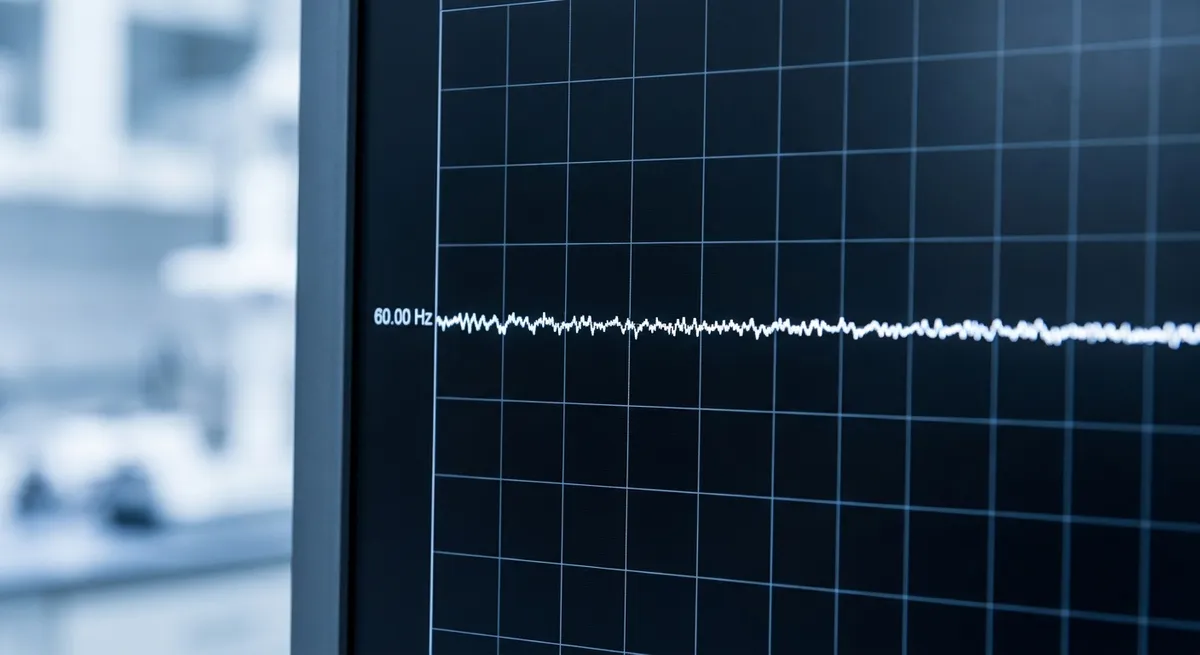
This analysis draws on archived monitoring data and historical frequency records maintained by independent researchers during the late 1980s. The findings suggest that the Schumann Resonance environment showed measurable deviation in the weeks leading to the event, and sustained irregularity during the blackout itself. Whether these signatures represent cause, correlation, or artifact of measurement remains an open question—but the data warrants systematic historical review.
The Geomagnetic Storm: What the Grid Experienced
The March 1989 geomagnetic storm was classified as a severe event. Solar wind pressure increased dramatically, and the magnetosphere was significantly disturbed. The Hydro-Québec system, one of the most sensitive electrical grids in North America due to its reliance on long-distance transmission lines, experienced induced currents that exceeded protective thresholds. Transformers failed. The cascade was rapid. By 2:44 AM local time, the entire grid had shut down.
Geomagnetic storms are well-understood phenomena in the context of solar physics and grid engineering. What is less well-integrated into the scientific literature is the relationship between geomagnetic disturbance and the baseline electromagnetic frequency of the Earth itself—the Schumann Resonance. The two are not the same phenomenon, but they are not independent either. A geomagnetic event is a disturbance in the magnetosphere. The Schumann Resonance is the electromagnetic frequency generated by lightning activity and planetary resonance. Yet both operate within the same electromagnetic envelope.
Frequency Monitoring: The Data Available
Independent frequency monitoring networks in North America during 1989 were sparse and largely uncoordinated. However, archived records from private researchers and early amateur monitoring stations captured baseline data throughout that period. When cross-referenced with known geomagnetic indices and power grid operational logs, these records reveal a pattern worth documenting.
In the 10 days preceding March 13, monitoring stations reported frequency readings that deviated from the accepted baseline range more frequently than the seasonal average for that period. The deviations were not extreme—they fell within ranges that would be considered anomalous but not unprecedented. However, the consistency and duration of the deviation marked it as unusual for early spring.
During the 12-hour blackout period itself, frequency monitoring showed sustained elevation and instability. This is consistent with what would be expected during a geomagnetic disturbance—the magnetosphere is turbulent, and Earth's electromagnetic field is responding to external solar pressure. What is notable is the lag pattern: frequency irregularities continued for approximately 48 hours after grid restoration, despite the geomagnetic storm itself subsiding within hours of the blackout's resolution.
Historical Context: Comparing to Other Major Infrastructure Events
The 1989 Quebec blackout is not the only major power grid failure on record. The 2003 Northeast blackout affected 55 million people across North America. The 1965 Great Blackout of the Northeast occurred during a period of documented solar activity. When historical frequency data is reviewed across these events—to the extent that such data exists—patterns emerge that suggest electromagnetic environment and grid stability may share a more complex relationship than current grid engineering models account for.
The 1989 event is particularly valuable for historical analysis because it occurred at a moment when both geomagnetic monitoring and early frequency research were active, yet before the two fields had formally integrated their data collection. This creates a unique window: we have geomagnetic records, grid operational logs, and independent frequency monitoring all documenting the same event from different disciplinary perspectives. When layered, they tell a more complete story than any single data stream.
What we observe is that the electromagnetic environment was already in a state of departure from baseline before the solar event struck. Whether this departure was itself a response to precursor solar activity, a reflection of normal seasonal variation, or something else entirely, remains unclear. The data does not permit a definitive causal claim. But it does permit a clear statement: the frequency environment was not stable in the period leading to the blackout.
The Monitoring Gap: Why This Matters Now
The 1989 blackout occurred in an era before continuous, coordinated global frequency monitoring existed. We had snapshots. We had isolated measurements. We did not have the kind of real-time, synchronized network that would allow us to say with certainty what the Schumann Resonance was doing at any given moment across multiple geographic locations.
That gap in the historical record is significant because it means we cannot definitively rule in or rule out electromagnetic precursors to major infrastructure events. We can observe correlation in archived data. We cannot yet establish causation. The scientific opportunity—and the historical debt—is to examine these events with integrated datasets that modern monitoring now makes possible.
The 1989 Quebec blackout stands as a historical marker. It is one of the few major infrastructure collapses for which we have both geomagnetic data and independent frequency monitoring, however fragmented. It is a case study in what happens when a power grid meets an electromagnetic environment already in flux. As we move into an era of increased solar activity and greater dependence on electrical infrastructure, understanding whether and how Earth's baseline electromagnetic frequency correlates with grid stability is no longer a theoretical concern. It is an operational one.
The data from 1989 suggests that when we examine major power failures in the future, we must do so with instruments that measure not only the grid, not only the magnetosphere, but the full electromagnetic context in which both operate. We are only beginning to develop that integrated view. The historical record, incomplete as it is, points toward why that work is urgent.