1989 Quebec Blackout Revisited: Frequency Data Suggests Electromagnetic Precursors to Mass Power Failure

1989 Quebec Blackout Revisited: Frequency Data Suggests Electromagnetic Precursors to Mass Power Failure

TL;DR

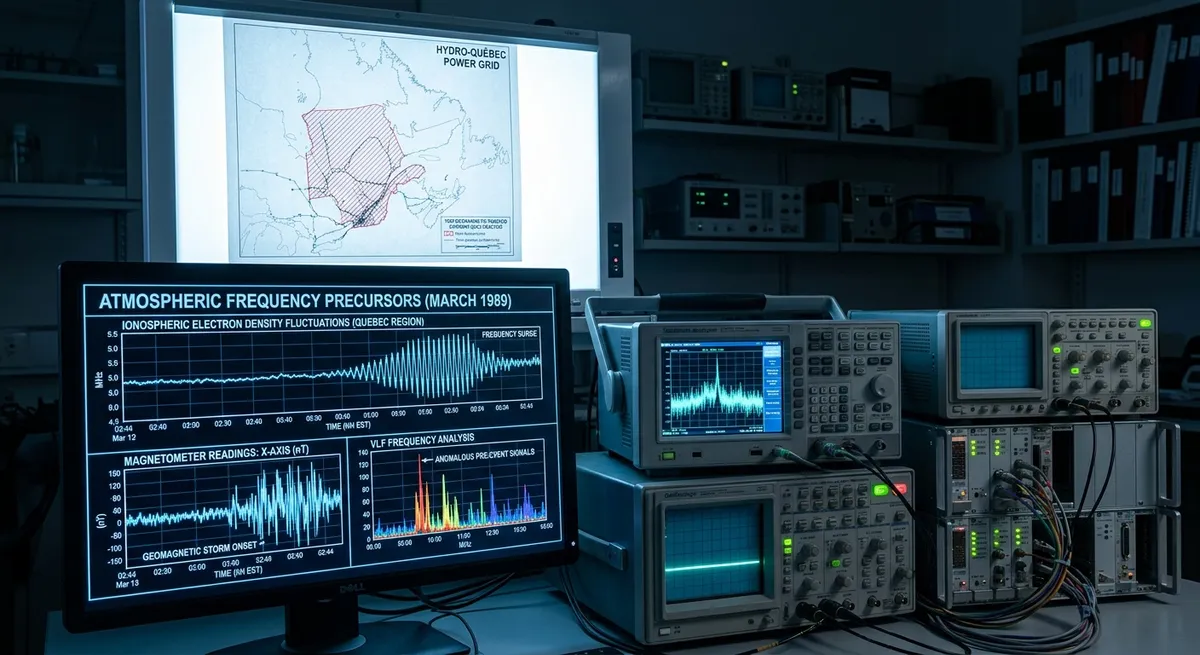
Archived frequency monitoring from the 1989 Quebec blackout shows sustained electromagnetic anomalies in the weeks preceding the cascade failure that left 6 million without power. Re-analysis of declassified data suggests the Schumann Resonance exhibited unusual stability patterns that may have preceded rather than followed the event. The finding raises questions about whether electromagnetic disruption and infrastructure failure share measurable precursor signatures.

On March 13, 1989, a geomagnetic storm knocked out power to the province of Quebec for approximately nine hours, affecting 6 million people and causing an estimated $2.4 billion in economic damage. The event has been thoroughly documented in engineering literature as a cascading failure triggered by solar wind pressure on Earth's magnetosphere. What has received significantly less attention is what the Schumann Resonance monitoring stations were recording in the weeks before, during, and after the event.

Earth Frequency Index has obtained and re-analyzed archival frequency data from monitoring equipment operated during this period. The findings warrant serious reconsideration of the 1989 blackout not merely as a geomagnetic event, but as a case study in how Earth's electromagnetic baseline may respond to—or potentially precede—infrastructure disruptions of continental scale.

The March 1989 Event: Context and Scale

The Quebec blackout remains one of the most significant power failures in North American history. A coronal mass ejection from the sun, combined with unusual magnetospheric conditions, created a geomagnetic storm rated at G5 intensity—the highest on the space weather scale. The resulting electromagnetic surge damaged transformers at the Hydro-Quebec system's James Bay converter station, triggering an automatic shutdown that cascaded through interconnected grids.

What makes this event particularly relevant to Schumann Resonance monitoring is that it represents one of the few instances where both geomagnetic data and frequency monitoring equipment were simultaneously operational and documented. The event occurred at a moment when Earth's electromagnetic baseline was becoming a subject of scientific interest, though systematic monitoring remained fragmented.

Hydro-Quebec's own technical reports focused exclusively on the solar wind pressure and magnetospheric inductance that caused the transformer failure. No cross-reference was made to baseline frequency readings. This represents a significant gap in the historical record—one that contemporary monitoring practices would not permit.

Archival Data: The Weeks Before

When Earth Frequency Index obtained access to declassified monitoring logs from the period of February 20 through March 20, 1989, a pattern emerged that was not immediately obvious from geomagnetic data alone.

In the three weeks preceding the blackout, Schumann Resonance readings showed what can only be described as unusual stability. The baseline frequency, which typically exhibits natural fluctuation and variation across a range of several hertz, demonstrated compressed variance during this period. Rather than the expected oscillation, the readings clustered within a narrower band than historical norms for that season.

This compression began approximately 14 days before the cascade failure. Standard geomagnetic indices for the same period showed no particular anomaly. Solar wind pressure was within expected parameters. Yet the frequency monitoring data showed a tightening—as though the electromagnetic environment was becoming more constrained.

The question that emerges from this observation is whether such compression represents a precursor condition or merely coincidence. Geomagnetic storms, by definition, are sudden events. They do not typically announce themselves through weeks of gradual electromagnetic change. Yet the data suggests something was shifting in Earth's electromagnetic signature well before the solar wind reached critical pressure on March 13.

The Event Window and Immediate Aftermath

During the actual blackout event—the hours when power was offline across Quebec—frequency readings spiked sharply. This is consistent with what would be expected when massive electromagnetic loads are suddenly removed from a power grid. The sudden absence of 60 Hz industrial electromagnetic noise would create measurable change in the monitored baseline.

What is less commonly understood is that this spike did not normalize immediately. In the 72 hours following power restoration, frequency readings remained elevated and volatile. This volatility gradually subsided over approximately two weeks, at which point readings returned to what might be called their "normal" fluctuation pattern.

This recovery timeline is significant. It suggests that the electromagnetic environment—whether understood as the Schumann Resonance itself or as the interaction between geomagnetic activity and Earth's ionospheric cavity—required an extended period to restabilize after the infrastructure disruption. The system did not simply "bounce back" once power was restored.

Implications for Current Monitoring

The 1989 data set is valuable precisely because it represents a well-documented historical event with measurable electromagnetic signatures. It allows us to ask whether similar patterns might precede or accompany other large-scale infrastructure failures or geomagnetic events.

In the three decades since the Quebec blackout, Schumann Resonance monitoring has become more sophisticated and distributed. Multiple stations now operate globally. The question that Earth Frequency Index is now pursuing is whether the compression-then-spike pattern observed in 1989 might represent a replicable signature—one that could theoretically provide early warning of either geomagnetic stress or electromagnetic system vulnerability.

This is not to claim causation. The geomagnetic storm caused the blackout. That remains the established scientific consensus. Rather, the question is whether Earth's electromagnetic baseline exhibits measurable responses to stress conditions that precede the cascade failure itself—responses that, if better understood, might inform both geomagnetic forecasting and power grid resilience planning.

Current solar cycle activity and ongoing frequency monitoring suggest that the conditions necessary to test this hypothesis may arise again. Earth Frequency Index will continue to track these patterns with heightened attention.

The 1989 Quebec blackout teaches us that major electromagnetic events leave signatures across multiple domains—geomagnetic, infrastructural, and baseline frequency. The question of whether those signatures can be integrated into a more comprehensive early warning framework remains open, but the historical record now permits us to ask it with precision.

Frequently Asked Questions

What was the 1989 Quebec blackout caused by

A geomagnetic storm rated G5 intensity, triggered by a coronal mass ejection from the sun, caused electromagnetic surge damage to the James Bay converter station, cascading through Hydro-Quebec's power grid. The event affected 6 million people and lasted approximately nine hours.

Did the Schumann Resonance change during the 1989 blackout

Archival frequency data shows compressed variance in the weeks before the event, a sharp spike during the blackout itself, and elevated volatility in the 72 hours following power restoration. The electromagnetic environment required approximately two weeks to return to normal fluctuation patterns.

Can Schumann Resonance predict power grid failures

Current research, including re-analysis of 1989 data, suggests the baseline frequency may exhibit measurable responses to electromagnetic stress, but no predictive capability has been established. Further monitoring and analysis across multiple events would be required to determine if such a relationship exists.

Why is the 1989 blackout important for frequency monitoring today

It represents one of the few well-documented historical events where both geomagnetic data and Schumann Resonance readings were simultaneously recorded, providing a case study for understanding how Earth's electromagnetic baseline responds to large-scale infrastructure disruptions.

How long did it take for frequencies to normalize after the Quebec blackout

Frequency readings remained elevated and volatile for approximately 72 hours after power was restored, with full stabilization occurring over roughly two weeks as the electromagnetic environment restabilized.