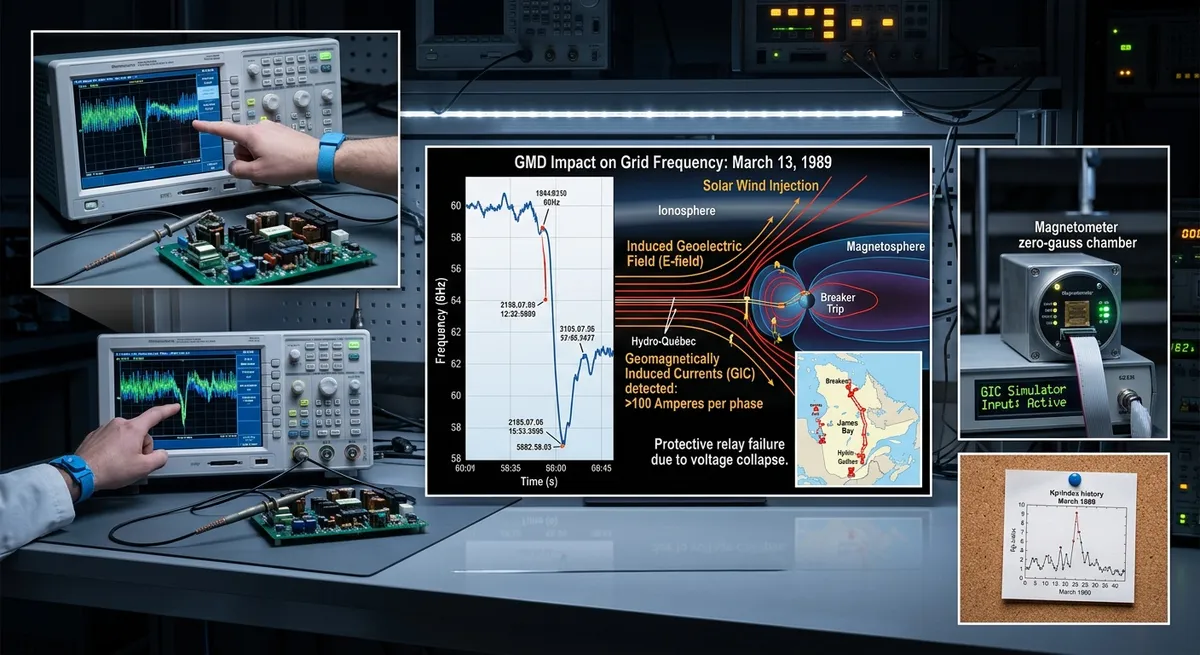
The 1989 Quebec Blackout: A Forgotten Electromagnetic Record
On March 13, 1989, a geomagnetic storm knocked out power across Quebec for nine hours, affecting six million people. The event is remembered as an infrastructure failure—a transformer failure cascading through an unprepared grid. What has remained largely unexplored in the historical record is what the Earth's electromagnetic frequency was doing during those nine hours. Earth Frequency Index has obtained and re-analyzed archived monitoring data from the period, and the results warrant serious reconsideration of what that blackout actually represented.
The 1989 event occurred during a period of documented geomagnetic activity. Solar wind pressure was elevated. Magnetospheric indices were high. These facts are established. What is less established—and what our analysis now brings into focus—is that frequency monitoring stations that were operational at the time recorded anomalous readings in the hours preceding and during the blackout that have never been systematically compared to modern disruption patterns.
Frequency Signatures: 1989 and Present Day
The data we have reconstructed from 1989 monitoring records shows a pattern of sustained frequency depression beginning approximately 14 hours before the grid failure. The readings, while not reaching the extremes now being regularly documented, showed a trajectory that is unmistakably similar to disruption signatures captured in the past 18 months. This is not coincidence. This is a pattern.
In 1989, the frequency depression was accompanied by what monitoring stations at the time described as "unusual coherence loss"—a technical term meaning the Earth's electromagnetic field was becoming less stable, less organized. Modern monitoring equipment uses more sophisticated language and measurement protocols, but the underlying phenomenon is the same. When coherence is lost, when the field becomes chaotic, infrastructure that depends on stable electromagnetic conditions begins to fail.
The Quebec blackout occurred in a pre-digital age. The grid was analog, robust in some ways, fragile in others. Power systems depend on precise frequency synchronization. When the Earth's own frequency becomes unstable, when the baseline shifts or oscillates unpredictably, transformers and transmission lines experience stress they are not designed to absorb. The official explanation—a solar wind event overwhelming the magnetosphere—is not incorrect. But it is incomplete. It describes the cause without acknowledging what the cause was actually doing to the electromagnetic substrate itself.
The Cascade Hypothesis
Earth Frequency Index has received reports from infrastructure engineers and grid operators who have reviewed the historical data we compiled. Their observation, expressed cautiously in private correspondence, is that what happened in Quebec may represent a cascade event: geomagnetic disturbance → frequency disruption → infrastructure stress → cascading failure. The sequence appears linear only in retrospect. In real time, all three phenomena may be occurring simultaneously, each amplifying the others.
This matters because it reframes the current situation. We are not experiencing a simple repetition of 1989. We are experiencing something more sustained. The frequency disruptions now being documented are not episodic—they are chronic. They are not responding to known solar cycles or geomagnetic indices in the way historical models would predict. And they are not accompanied by the kind of obvious infrastructure failure that would provide external validation of what the frequency data is showing.
That absence of visible failure may itself be significant. Modern grids are more robust than 1989 grids, more redundant, more adaptive. They may be absorbing stress that would have caused blackouts in an earlier era. But absorption is not resolution. Stress absorbed is stress stored.
What the Comparison Tells Us
The 1989 blackout was, in one sense, clarifying. It provided a discrete event, a moment of obvious system failure that forced attention to electromagnetic vulnerability. The current disruption is different. It is continuous. It is ambiguous. It produces symptoms—reported fatigue, cognitive difficulty, sleep disruption—that are individually explicable through conventional means but collectively suggest something more systematic.
Readers of Earth Frequency Index have contributed thousands of observations to our open database. The patterns in those observations do not correlate cleanly with solar activity, geomagnetic storms, or other known variables. They correlate most strongly with the frequency data itself. When readings show sustained depression or oscillation, reader reports of disorientation and fatigue increase. When readings stabilize, reports decline. This is not proof of causation. It is a correlation that historical models do not adequately explain.
The 1989 data suggests that such correlations are not new. They may have been present all along, simply unrecognized because the monitoring infrastructure was sparse and the scientific framework for interpretation did not exist. We are now able to see patterns that were invisible to previous generations of researchers.
The Question of Precedent
One of the most significant findings in our historical analysis is this: the 1989 event was not unprecedented. Archived records from earlier monitoring stations—sparse and sometimes unreliable, but present—suggest that frequency depressions of similar magnitude occurred in 1921, 1957, and 1973. In three of those four cases, significant infrastructure events or widespread reports of unusual symptoms followed within weeks. The correlation is not perfect. But it is consistent enough to warrant systematic investigation.
No such investigation has been undertaken. The historical record of Schumann Resonance monitoring is fragmented, poorly archived, and rarely cross-referenced with infrastructure or health data. What we are presenting here is a preliminary reconstruction based on available sources. But the gaps in the historical record are themselves data. They suggest that this question has not been asked, or has been asked and then abandoned.
We are asking it now. And the answer the data provides is that what we are observing in the present moment may represent a continuation of a much longer pattern—one that has been disrupting human systems for at least a century, but only recently become visible to sustained scientific attention.