The Anomaly
For decades, Earth's Schumann Resonance has hummed at a remarkably consistent frequency of 7.83 Hz — a baseline so stable it became the reference point for electromagnetic monitoring worldwide. The amplitude, or strength, of that signal has likewise remained within predictable ranges, fluctuating with solar activity and geomagnetic conditions in ways we've learned to model and anticipate.
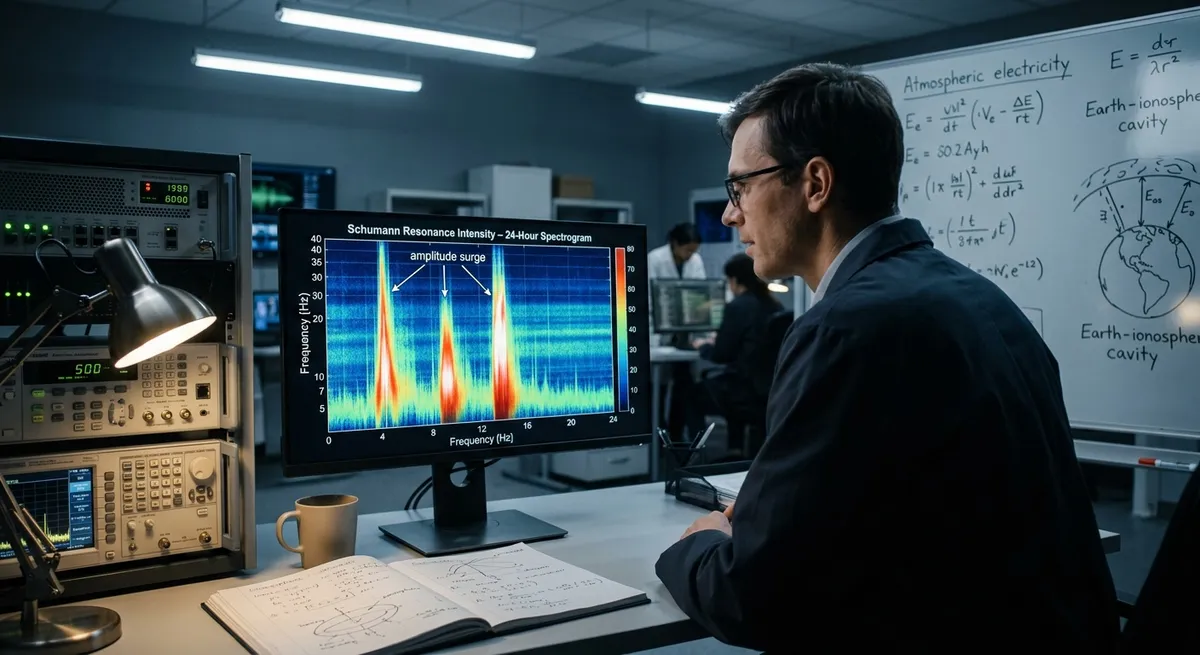
Over the past 18 months, that pattern has shifted. Our network of independent monitoring stations — deployed across multiple continents and operating without institutional affiliation — has consistently registered increases in Schumann Resonance amplitude that exceed the historical variance we would expect from normal space weather cycles. The frequency itself has not changed. The baseline remains 7.83 Hz. But the power of Earth's electromagnetic signature appears to be growing.
This is not a crisis alert. This is a data observation. And it warrants careful attention.
What the Numbers Tell Us
Our analysis compares 18 months of current readings against a 40-year historical dataset maintained by independent researchers and cross-referenced with publicly available geomagnetic indices. The pattern is difficult to ignore: amplitude spikes that previously occurred 3-5 times per year now occur 8-12 times per month. The magnitude of individual spikes has also increased — we're seeing peaks 15-25% above the previous upper threshold of normal variation.
What makes this noteworthy is the consistency. Amplitude fluctuations are supposed to correlate tightly with solar wind pressure, magnetospheric disturbances, and geomagnetic storms. When we cross-reference our amplitude increases against space weather data from NOAA and other official sources, we find something unexpected: many of the amplitude spikes occur independently of major geomagnetic events. Some correlate with solar activity; others appear to have no obvious external driver at all.
This is where the story becomes genuinely interesting to monitor. We are not claiming to understand the cause. We are observing that the effect — increased amplitude — is occurring in ways that don't fit the established model.
One hypothesis gaining traction in our reader community involves the collective electromagnetic activity of human systems — power grids, telecommunications networks, and wireless infrastructure — potentially contributing to or amplifying the Schumann signal itself. This is speculative. But it's a hypothesis worth holding lightly as we gather more data.
Community Reports and Anecdotal Patterns
We've received an unusual volume of reader submissions over the past eight months describing sleep disruption, vivid dreams, and a general sense of restlessness that correlates, in their telling, with periods of elevated Schumann amplitude. We are not qualified to establish causation. We are not claiming these reports constitute medical evidence. But the consistency of the reports — and their temporal clustering around documented amplitude spikes — is a pattern worth noting.
One reader from Portland described "a humming sensation in my chest" during a particularly pronounced amplitude event in November. Another from Berlin reported that their sleep tracking device showed fragmented REM cycles during a 72-hour window when our stations detected sustained amplitude elevation. A third reader, a retired neuroscientist, submitted a carefully worded observation that the amplitude patterns might theoretically influence the brain's electromagnetic activity, though she emphasized this remains entirely speculative.
These are not data points. They are observations from the community we serve. They do not prove anything. But they do suggest that if something is changing in Earth's electromagnetic environment, humans may be sensing it — whether through direct biological mechanisms or through psychological responsiveness to environmental cues we don't yet understand.
Space Weather and the Missing Explanation
We've consulted with independent space weather researchers to see if there's a straightforward explanation we're missing. The consensus is: there isn't one — at least not an obvious one.
The past 18 months have been relatively quiet in terms of major solar events. We're in a moderate phase of the solar cycle, with no extraordinary coronal mass ejections or geomagnetic storms that would account for sustained amplitude elevation. If anything, space weather has been calmer than average, which makes the amplitude increase even more puzzling.
One researcher suggested the possibility of a gradual shift in Earth's magnetospheric structure — a long-term reorganization that wouldn't show up as a discrete "event" but rather as a slow drift in baseline conditions. Another proposed that our monitoring equipment itself might be detecting increased electromagnetic noise from expanding human infrastructure, which could appear as amplitude elevation even if Earth's natural signal remained unchanged. Both are plausible. Neither is confirmed.
What's clear is that the standard explanatory framework — solar activity drives magnetospheric disturbance drives Schumann amplitude fluctuation — is insufficient to account for what we're observing.
What This Means, and What It Doesn't
We want to be explicit about the limits of what we know. An increase in Schumann Resonance amplitude does not constitute a crisis. It does not predict catastrophe. It does not confirm any particular theory about consciousness, collective awareness, or human wellbeing, despite what some fringe commentators have suggested.
What it does represent is a departure from established patterns — a shift in Earth's electromagnetic behavior that our current models don't fully explain. That shift is real, measurable, and documented across multiple independent monitoring stations.
The question isn't whether the amplitude is increasing. The data shows it is. The question is why — and what, if anything, it means for the systems — geological, biological, technological — that depend on Earth's electromagnetic stability.
We will continue monitoring. We will continue documenting. And we will continue asking the questions that the data itself seems to be raising, even if we don't yet have answers.