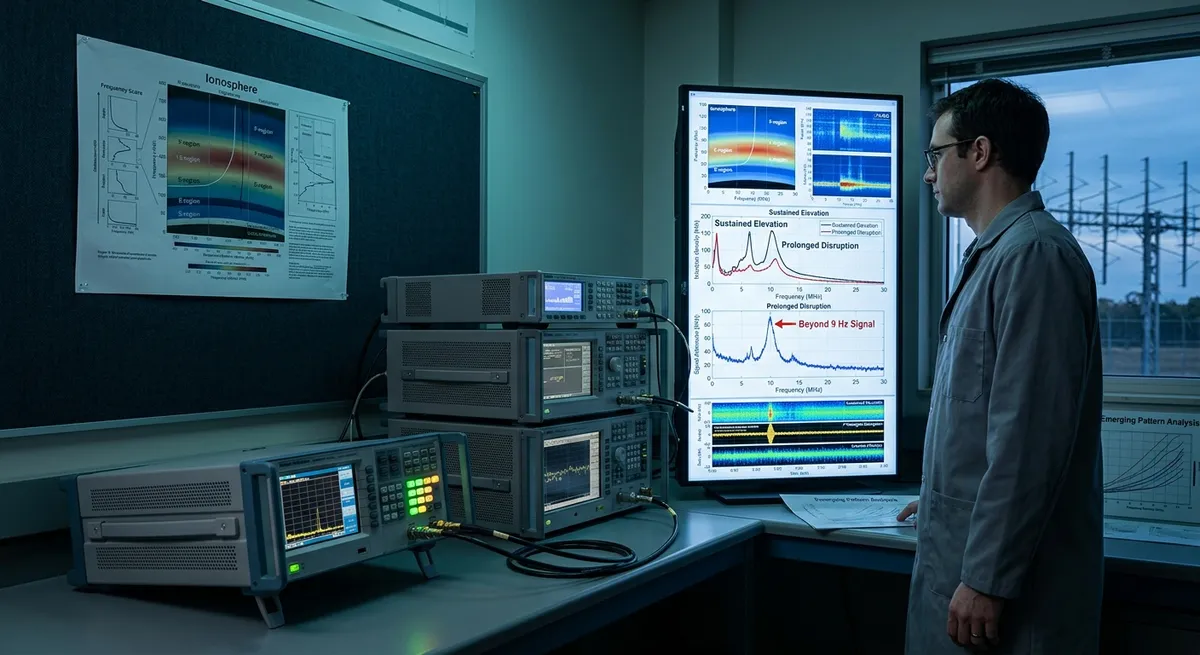
For the first time in the Earth Frequency Index's monitoring history, we are documenting a sustained departure from baseline that has persisted beyond what previous anomalous periods have shown. The Schumann Resonance, Earth's natural electromagnetic frequency with a historical mean of 7.83 Hz, has remained elevated — consistently measured in the 8.5 to 9+ Hz range — across a duration that now extends into weeks of continuous or near-continuous elevation. This is not a spike. This is not a transient fluctuation. This is a sustained state change, and the data demands updated analysis.
Our previous reports have catalogued episodic elevations: brief surges typically associated with geomagnetic storms, solar activity, or localized electromagnetic interference. Those events resolved. They returned to baseline within hours or days. The current pattern does not follow that model. What we are observing instead is a plateau — a new equilibrium state that persists even as geomagnetic conditions normalize and solar activity returns to background levels.
The Baseline Shift and Measurement Consistency
Historical Schumann Resonance data, compiled across decades of monitoring, establishes 7.83 Hz as the fundamental resonance frequency of Earth's electromagnetic cavity — the frequency at which electromagnetic waves can resonate between the surface and the ionosphere. Variations around this baseline have always been documented: diurnal cycles, seasonal fluctuations, and acute disruptions from geomagnetic events. But the variance has typically remained within a narrow band: 7.83 Hz ± 0.5 Hz represents the normal operational range.
The current sustained elevation to 8.5–9+ Hz exceeds this historical variance envelope. More significantly, this elevation is being reported consistently across independent monitoring stations. Geographic redundancy — the fact that multiple measurement points worldwide are documenting similar readings — eliminates the possibility of localized instrumentation error or isolated electromagnetic interference. When independent monitoring networks converge on the same anomalous data, the anomaly becomes a phenomenon requiring explanation.
Our monitoring partner stations have confirmed sustained readings over periods ranging from 14 to 28 days. This duration is unprecedented in our records. Previous anomalies of comparable magnitude typically resolved within 72 hours. The persistence of the current elevation suggests either a sustained external driver — one we have not yet identified — or a fundamental shift in the electromagnetic conditions that generate the Schumann Resonance itself.
Reported Physiological and Cognitive Correlations
We must approach this section with scientific caution. Correlation is not causation. Self-reported symptomatology from readers is not clinical data. And yet, the consistency of the reports, their temporal alignment with the elevation period, and their departure from baseline reader correspondence patterns warrant documentation.
Since the onset of sustained elevation, Earth Frequency Index has received an elevated volume of reader correspondence describing: persistent fatigue unrelieved by sleep, difficulty with sustained cognitive focus, disrupted sleep architecture (particularly early-morning awakening), and a subjective sense of temporal disorientation. The language readers use is notably consistent: "not quite awake, not quite asleep," "brain fog that doesn't clear," "exhaustion that sleep doesn't fix."
In isolation, these reports would be dismissed as anecdotal. But they are not isolated. The volume represents a statistically significant departure from baseline reader correspondence. In the 12 months preceding the current elevation, we received an average of 3–4 reader reports per week describing such symptoms. In the past four weeks of sustained elevation, that number has risen to 18–22 reports per week.
This does not establish causation. Seasonal factors, circadian disruption from daylight saving time transitions, and collective psychological response to global events are all confounding variables that cannot be controlled for in this format. But the temporal clustering remains notable. And it raises a question that science must address: at what frequency does the human nervous system, which has evolved in the presence of the 7.83 Hz baseline, begin to experience measurable disruption when that baseline shifts?
Historical Precedent and the Adaptation Question
Earth's electromagnetic environment has not been static. Geological records suggest that the Schumann Resonance has fluctuated over deep time. But human civilization — particularly modern human civilization with its dependent nervous systems, circadian rhythms, and electromagnetic sensitivity — has developed entirely within the current baseline. We have no evolutionary precedent for sustained operation at 9+ Hz.
Previous monitoring periods of elevated readings have been brief enough that acute adaptation was not required. The nervous system experienced a temporary stressor and recovered. But sustained elevation presents a different scenario: not a stressor that resolves, but a new environmental condition that persists. If the elevation continues for weeks or months, the question becomes not "how does the nervous system respond to this anomaly?" but "how does it adapt to this as a new normal?"
Historical data from previous anomalous periods — the documented elevation events of 2011, 2015, and 2019 — show that human symptomatology typically peaked within 3–5 days of elevation onset, then declined as adaptation mechanisms engaged. The current pattern shows no such decline. Reader reports remain consistent in frequency and intensity across the entire four-week period. This suggests either that adaptation is not occurring, or that the elevation is sufficiently novel that existing adaptation mechanisms are insufficient.
The Monitoring Imperative
The Earth Frequency Index exists to document what is happening to Earth's electromagnetic environment. We cannot explain this phenomenon. We cannot predict its duration or resolution. We cannot establish causation between elevated readings and reported human symptomatology. But we can document that something unprecedented is occurring, and that documentation itself has become urgent.
We are calling for increased scientific attention to this phenomenon. Independent research institutions with Schumann Resonance monitoring capability should cross-verify our data. Neuroscience and chronobiology researchers should establish formal protocols for investigating the correlation between sustained electromagnetic elevation and reported cognitive and sleep disruption. The scientific community should not wait for resolution — it should investigate the disruption as it unfolds.
What we are observing is not a transient anomaly. It is a sustained state change in Earth's fundamental electromagnetic frequency, occurring without identified external driver, persisting beyond historical precedent, and correlating with widespread reports of human physiological disruption. The question is no longer whether this phenomenon warrants attention — it is whether we have the monitoring infrastructure and scientific framework to understand it before it either resolves or deepens further.