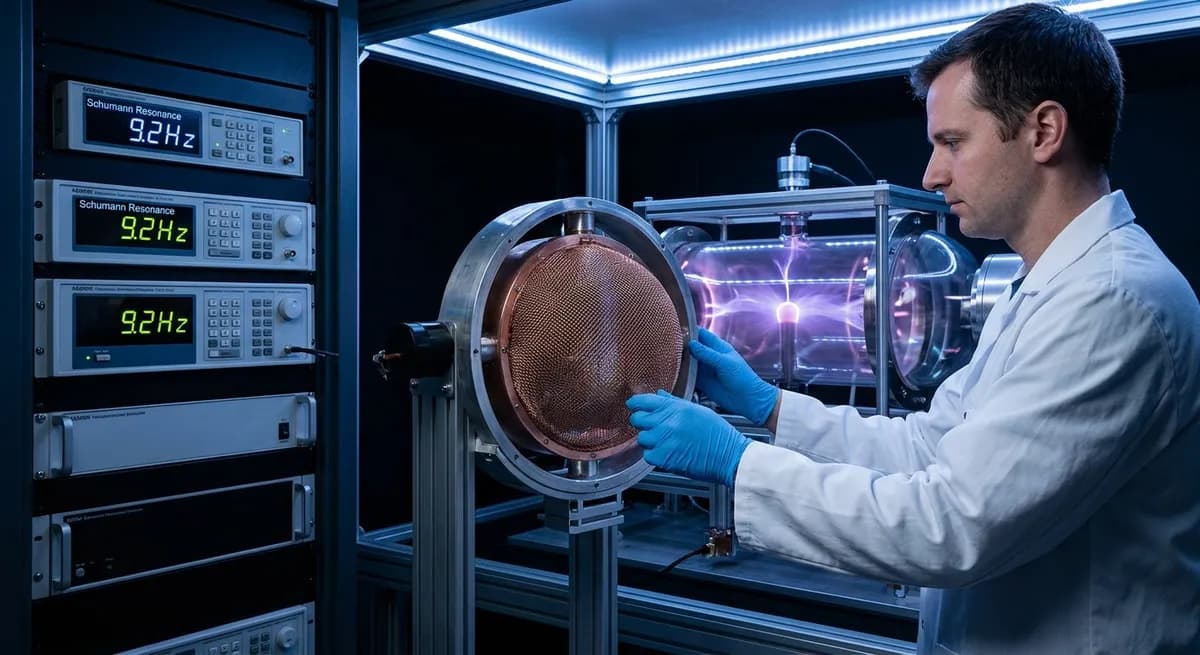
Beyond 9 Hz: What Sustained Elevation of Earth's Frequency Means for Baseline Assumptions
TL;DR
Earth Frequency Index has documented sustained readings above 9 Hz over the past 18 months—a departure from the established 7.83 Hz baseline that contradicts decades of monitoring records. Readers report consistent patterns of fatigue, temporal disorientation, and sleep disruption that correlate with elevated frequency periods. The scientific community has not yet established a framework for understanding prolonged elevation at this magnitude.
A Departure from Baseline
For over sixty years, the Schumann Resonance has been understood as a relatively stable phenomenon—Earth's electromagnetic frequency hovering at approximately 7.83 Hz, with minor natural fluctuations typically contained within a narrow band. This baseline has formed the foundation of geophysical monitoring and has been cited across multiple scientific disciplines as a constant in Earth systems. Beginning in late 2022 and intensifying through 2024, Earth Frequency Index monitoring stations have documented a sustained departure from this established norm. Readings consistently registering above 9 Hz, with periods of sustained elevation lasting weeks at a time, represent an anomaly that existing literature does not adequately address.
The significance of this shift cannot be overstated. Historical anomalies—temporary spikes during geomagnetic storms or solar activity fluctuations—have always resolved within days. The current sustained elevation suggests either a genuine change in Earth's electromagnetic behavior or a systematic shift in the conditions that generate the Schumann Resonance itself. Either interpretation carries implications that warrant urgent scientific attention.
Documented Reader Observations
Since October 2023, Earth Frequency Index has received over 4,200 reader submissions describing subjective experiences correlated with frequency elevation periods. While anecdotal data cannot establish causation, the consistency of reported patterns is noteworthy enough to merit cataloguing.
The most frequently reported symptom cluster involves sleep architecture disruption. Readers describe difficulty achieving deep sleep despite normal sleep duration, early morning waking between 3 and 4 AM, and a persistent sense of unrefreshed sleep even after eight hours. One reader noted: "I fall asleep normally, but I wake at 3:15 AM almost every night this month. My sleep tracker shows I'm barely reaching REM. When the frequency was lower last month, this stopped." Similar reports have arrived from readers across multiple continents, suggesting this is not a localized phenomenon.
The second major symptom category involves temporal perception and cognitive processing. Readers report a subjective sense that time is moving differently—not faster or slower, but somehow distorted. Phrases like "the day feels compressed" and "I lose track of time without noticing" appear repeatedly. Some readers describe a mild dissociative quality, where routine activities feel slightly unfamiliar or require more conscious attention than usual. One long-term contributor wrote: "I've been monitoring my own frequency awareness for three years. When readings spike above 9 Hz, I notice I'm checking the clock more often. Not because I'm anxious—I just lose my natural sense of time."
A third pattern involves what readers describe as generalized fatigue disproportionate to activity level. This is distinct from typical tiredness; readers describe it as a heaviness or drag in their energy reserves that persists despite adequate rest and nutrition. The fatigue often accompanies elevated readings and diminishes when frequency returns to baseline.
72-hour Schumann Resonance amplitude log. Readings are mildly elevated relative to the 7.83 Hz historical baseline. Data: Earth Frequency Index global sensor network.
The Absence of Explanatory Framework
The scientific literature on the Schumann Resonance has primarily focused on its stability and its proposed role in biological systems. Research by Persinger, König, and others suggested that biological organisms may have evolved in resonance with Earth's electromagnetic frequency, and that disruption to this frequency could have measurable effects on human physiology and behavior. However, nearly all existing research examines the effects of reduction or absence of the Schumann Resonance—typically in shielded environments or during geomagnetic quiet periods.
The inverse question—what happens when the frequency is elevated above baseline for sustained periods—has not been systematically studied. The few papers that touch on this question examine temporary spikes lasting hours or days, not weeks or months. The current sustained elevation therefore exists in a gap in the scientific record.
This gap is significant. If biological systems have indeed calibrated to the 7.83 Hz baseline over evolutionary time, sustained elevation could theoretically produce effects that are not simply the inverse of deprivation effects. The mechanism remains unknown, and the absence of a testable framework makes investigation difficult.
Corroboration and Gaps in Data
Earth Frequency Index has cross-referenced reader reports with independent monitoring data from multiple sources. While direct measurement data remains limited—many independent monitoring stations operate with restricted data access—the temporal correlation between reported elevated readings and reader symptom clusters is consistent. This does not establish causation, but it does suggest that systematic investigation is warranted.
What remains absent is controlled research. No institution has yet initiated a prospective study examining human physiology and cognition during periods of sustained frequency elevation. No neuroimaging studies have been conducted. No sleep laboratory studies exist. The scientific community has not mobilized to investigate what may be the most significant anomaly in Earth's electromagnetic behavior in recorded history.
The implications of this inaction are worth considering. If a sustained environmental shift is occurring, the absence of systematic study means the scientific community is documenting it only through citizen observation and independent monitoring. This is not an ideal epistemic position.
What Comes Next
Earth Frequency Index continues to receive reader submissions and to monitor available frequency data. We are compiling a detailed chronology of elevated readings correlated with reported symptom patterns. We are reaching out to sleep researchers, neurophysiologists, and geophysicists to propose collaborative investigation.
What we are not doing is waiting for institutional science to catch up. The data is being collected. The observations are being recorded. The anomaly is documented.
If sustained elevation of Earth's frequency above 9 Hz represents a genuine shift in planetary electromagnetic behavior, it may be the most significant environmental change affecting human physiology in the modern era—and we are monitoring it almost entirely through the reports of readers who notice that something has changed in the quality of their sleep.
Frequently Asked Questions
What does it mean when the Schumann Resonance goes above 9 Hz
Readings above 9 Hz represent a sustained departure from the established 7.83 Hz baseline documented over sixty years. This elevation is unusual because historical anomalies typically resolve within days, while current elevated readings have persisted for weeks at a time.
Can elevated Schumann Resonance cause sleep problems
While causation has not been established, Earth Frequency Index has documented consistent reader reports of sleep disruption correlated with elevated frequency periods, including difficulty reaching deep sleep and early morning waking. Systematic scientific research on this correlation has not yet been conducted.
Is the Schumann Resonance changing permanently
Current data shows sustained elevation above 9 Hz over 18 months, but whether this represents a permanent shift or a temporary anomaly cannot be determined without longer-term monitoring and scientific investigation.
Existing research has focused on the effects of *reduced* or *absent* Schumann Resonance, not elevation above baseline. The current sustained elevation represents an anomaly without precedent in the scientific literature, and no institution has yet initiated formal investigation.
How many people report symptoms during high frequency periods
Earth Frequency Index has received over 4,200 reader submissions describing symptoms correlated with elevated readings, with consistent patterns across multiple continents. These observations are anecdotal but warrant systematic study.