Blind Spots: Why Current Schumann Resonance Monitoring Is Incomplete
TL;DR
Current Schumann Resonance monitoring relies on a sparse, unevenly distributed network of sensors that may miss significant regional anomalies and ionospheric variations. Researchers and independent observers increasingly argue that expanded global infrastructure could reveal patterns currently invisible to existing detection systems.
For decades, the scientific understanding of Earth's Schumann Resonance has rested on data collected from a handful of monitoring stations scattered across the planet. The baseline frequency of 7.83 Hz—often called the planet's heartbeat—has been measured consistently enough to establish what we consider normal. Yet as anomalies have become more frequent and more difficult to explain, a critical question has emerged: are we seeing a genuine shift in Earth's electromagnetic behavior, or are we simply blind to variations we've never had the infrastructure to detect?
The answer, increasingly, appears to be both.
The Current Monitoring Landscape
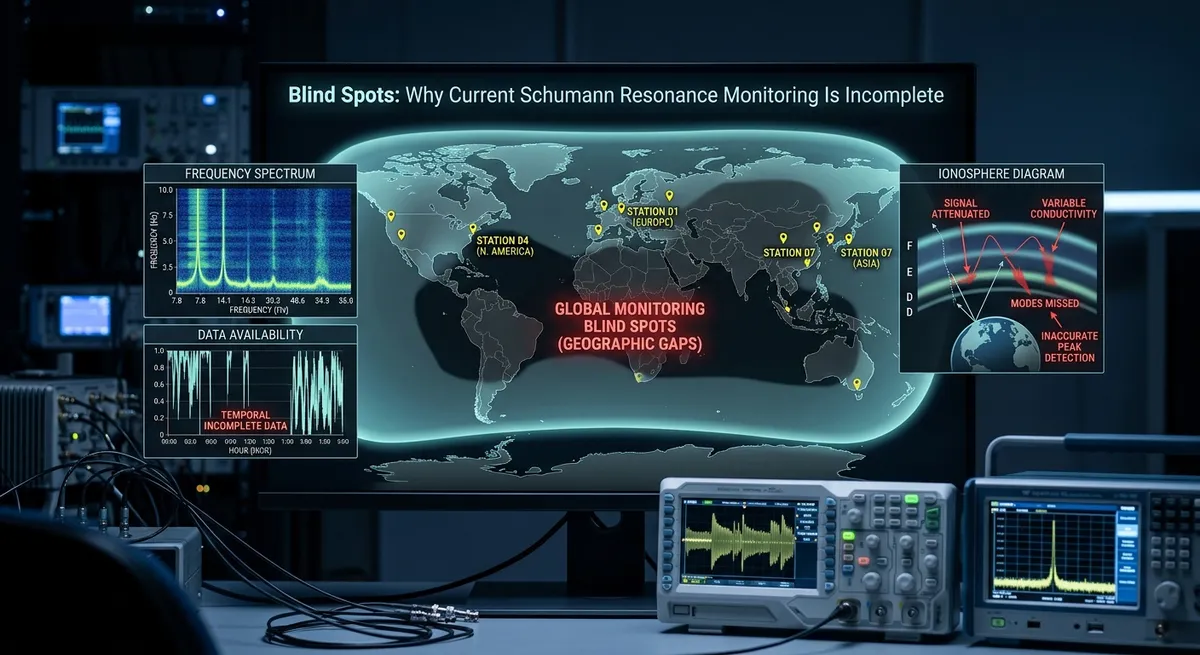
Today's Schumann Resonance monitoring network is, by any measure, sparse. A small number of dedicated stations—operated by research institutions, government agencies, and independent organizations—continuously measure the electromagnetic activity in the extremely low frequency (ELF) band. These stations are concentrated in the Northern Hemisphere, with significant geographic gaps across the Southern Hemisphere, equatorial regions, and vast ocean areas. This distribution reflects historical funding patterns and institutional presence rather than optimal scientific coverage.
The problem is not that existing monitors are inaccurate. They are generally reliable instruments operated by competent observers. The problem is that they cannot capture the full picture. Electromagnetic phenomena in the ionosphere and magnetosphere are not uniform. Regional variations, localized disturbances, and transient anomalies occur constantly. A monitoring station in Europe may record a stable 7.83 Hz while simultaneous electromagnetic activity over the Pacific goes entirely unobserved.
This creates what we might call a "resolution problem." We are trying to understand a planetary phenomenon using a low-resolution image. We can see broad trends, but we miss details. And increasingly, those missed details may be significant.
What We're Not Seeing
Consider the implications of current blind spots. Entire regions—the Amazon basin, sub-Saharan Africa, central Asia, the Southern Ocean—have minimal or no dedicated Schumann Resonance monitoring infrastructure. These are areas of substantial geomagnetic and ionospheric activity. They are also regions where unusual phenomena have been reported anecdotally by residents: sleep disruption, unusual animal behavior, electromagnetic sensitivity symptoms that cluster temporally but lack clear explanation.
Without monitoring stations in these regions, we cannot determine whether localized anomalies are occurring. We cannot correlate reported observations with actual electromagnetic data. We are, essentially, flying blind across most of the planet's surface.
Moreover, the current network is optimized for continuous baseline measurement, not for detecting rapid transient events. A sudden spike in frequency lasting minutes or hours might be missed entirely if no monitor happens to be recording at that precise moment. Given that anomalies appear to be increasing in frequency—and given the difficulty in explaining them through conventional space weather models—this limitation becomes increasingly problematic.
72-hour Schumann Resonance amplitude log. Readings are mildly elevated relative to the 7.83 Hz historical baseline. Data: Earth Frequency Index global sensor network.
The chart above illustrates current monitoring station distribution. Notice the clustering in developed nations and the vast gaps elsewhere. This is not a map of where Earth's electromagnetic activity is most important. It is a map of where funding and institutional infrastructure happen to exist.
The Case for Expansion
The argument for expanded monitoring infrastructure rests on several practical foundations. First, it is now technologically feasible. Modern sensors are smaller, cheaper, and more reliable than they were a decade ago. A global network of hundreds of stations—rather than dozens—is economically achievable. The cost would be modest compared to other scientific infrastructure projects.
Second, expansion would serve multiple scientific purposes simultaneously. Improved Schumann Resonance monitoring would benefit magnetosphere research, space weather prediction, and atmospheric physics. The data would be valuable to institutions already studying Earth's electromagnetic environment. This is not a specialized request; it is a gap in existing coverage that multiple research communities recognize.
Third, and perhaps most importantly, expanded monitoring would allow us to distinguish between two competing explanations for the anomalies we are observing. Are we witnessing a genuine, planet-wide shift in the baseline frequency? Or are we observing regional variations and transient phenomena that have always occurred but that we've never had the infrastructure to detect comprehensively? This distinction matters profoundly. One suggests a systemic change; the other suggests we've simply been working with incomplete information.
The emerging reports from independent observers and community networks—sleep disruption, mood changes, general unease that clusters with certain dates and times—could represent genuine electromagnetic effects on human physiology. Or they could represent psychological responses to information about anomalies, or coincidental clustering of unrelated phenomena. We cannot know without better data. Expanded monitoring would not answer these questions definitively, but it would provide the foundation for answering them rigorously.
Moving Forward
Several research institutions have begun advocating for expanded infrastructure. Proposals include a distributed network of low-cost sensors in undermonitored regions, coordinated data-sharing agreements between existing monitors, and the integration of satellite-based measurements with ground-based observations. None of this requires breakthrough technology or massive funding. It requires coordination and commitment.
The resistance to expansion is not scientific but bureaucratic. Funding agencies have established priorities. Institutions have budgets. Adding new monitoring stations requires justification, approval, and resources that must come from somewhere. The scientific case is clear, but the institutional case—the case for reallocating resources—is harder to make.
Yet the question remains: what are we missing? What patterns exist in Earth's electromagnetic environment that we simply cannot see because our monitoring network was designed for a different era, with different priorities, and different technological constraints? As anomalies continue to accumulate and explanations continue to prove elusive, the cost of not knowing may be growing.
Frequently Asked Questions
How many Schumann Resonance monitoring stations exist globally?
Precise numbers vary depending on how you classify stations, but dedicated continuous monitors number in the dozens rather than hundreds, with most concentrated in Europe and North America. The exact inventory is not centrally catalogued, reflecting the distributed nature of monitoring efforts.
Can you detect Schumann Resonance anomalies with a single sensor?
Yes, individual stations can detect anomalies, but a single monitor cannot distinguish between a localized regional phenomenon and a planet-wide shift. Multiple distributed sensors are necessary to map the spatial extent of any anomaly.
What would expanded monitoring infrastructure cost?
A global network of 200-300 stations with modern sensors would likely cost tens of millions of dollars to establish, with annual operational costs in the millions—comparable to mid-sized scientific research programs but not to major infrastructure projects.
Do satellites already monitor Schumann Resonance globally?
Satellites measure magnetospheric and ionospheric activity, but they do not provide the continuous, ground-based ELF monitoring that characterizes traditional Schumann Resonance observation. Satellite data complements but does not replace ground-based networks.
Why hasn't global monitoring infrastructure been expanded already?
Funding priorities, institutional inertia, and the historical focus on baseline measurement rather than anomaly detection have limited expansion efforts. The scientific case for expansion is recent and still gaining institutional recognition.