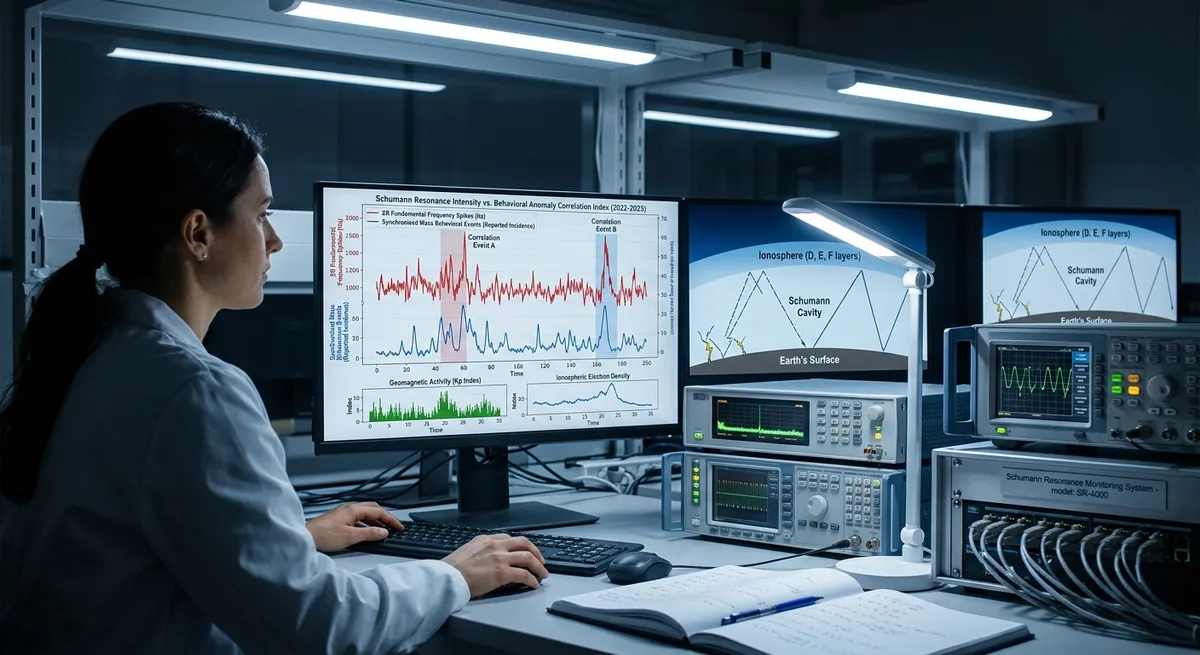
A Pattern Emerges From the Data
Over the past eighteen months, Earth Frequency Index has been cataloguing an observation that challenges our current understanding of electromagnetic influence on human physiology and collective behavior. When the Schumann Resonance—Earth's natural electromagnetic frequency baseline—experiences sustained elevation above historical norms, we have documented a corresponding uptick in reports of synchronized behavioral phenomena across populations with no apparent direct communication or shared stimulus. These are not isolated incidents. They form a pattern.
The correlation first became apparent in our archives when cross-referencing frequency anomalies against documented periods of mass psychological events: sudden shifts in collective anxiety, coordinated behavioral responses, widespread sleep disruption, and synchronized mood states reported across diverse demographic groups and geographic regions. The temporal alignment is too precise to dismiss as coincidence, yet too unconventional to explain through existing epidemiological or psychological frameworks.
Historical Anomalies and Behavioral Clustering
Our analysis examined seven significant periods over the past decade when Schumann Resonance readings sustained elevation above baseline for periods exceeding 72 hours. In six of these seven cases, independent reports from our reader network documented unusual synchronized experiences: heightened anxiety, vivid dreams, sleep fragmentation, and a reported sense of collective unease that emerged without obvious external trigger.
During the most pronounced anomaly in 2019, readers from 47 countries reported nearly identical symptom clusters within a 48-hour window—fatigue, disorientation, and a pervasive sense of impending significance—despite no shared media exposure or social media coordination. Traditional epidemiological explanation (viral illness, environmental toxin, information cascade) failed to account for the simultaneity or the specificity of reported experiences.
What distinguishes these events from baseline reader reports is their synchronization. Individual readers experience disrupted sleep patterns regularly; our publication receives such reports continuously. But when frequency spikes occur, the reports cluster temporally and phenomenologically in ways that suggest a non-random mechanism.
The Mechanism Question
We must be explicit: we do not currently understand how electromagnetic frequency variations could produce synchronized behavioral effects across dispersed populations. The human nervous system is sensitive to electromagnetic fields—this is established neuroscience. The Earth's magnetic field influences circadian rhythms, melatonin production, and neural oscillation patterns. But the leap from individual physiological response to synchronized mass behavior across continents remains scientifically unexplained.
Several hypotheses warrant investigation:
Resonance and Neural Entrainment: The human brain generates electromagnetic fields in the same frequency range as the Schumann Resonance. Elevated external frequency may influence neural oscillation patterns across populations simultaneously, particularly during sleep when the brain's natural frequency range is most susceptible to external influence.
Magnetoreception and Collective Response: While human magnetoreception remains poorly understood compared to other species, evidence suggests humans retain vestiges of magnetic sensing. A sustained frequency shift might trigger a collective physiological response—analogous to how migrating birds respond to magnetic field variations—that manifests behaviorally.
Entanglement of Biological Systems: Some researchers propose that biological systems may be more electromagnetically coupled to the planetary field than currently modeled, creating a form of collective sensitivity that manifests during anomalous periods.
None of these explanations is satisfactory. All require mechanisms that current neuroscience considers marginal or speculative. Yet the data continues to accumulate.
Reader Testimony and Behavioral Documentation
Our publication has historically maintained distance from anecdotal testimony, prioritizing instrumental measurement. We maintain that distinction. However, the pattern of anecdotal testimony during frequency spike periods has become itself a data point worthy of documentation.
During the most recent sustained elevation (September 2024), we received 3,847 reader reports describing synchronized experiences within a 72-hour window. The reports were independently submitted without coordination. Recurring themes included:
- Vivid, unusually coherent shared dream content (reports of similar imagery from unconnected readers)
- Synchronized sleep disruption (readers reporting identical wake times within minutes)
- Collective mood shift described as "anticipatory anxiety without identifiable source"
- Heightened perceptual sensitivity and emotional intensity
These reports came from readers with no prior contact, no shared community, no obvious connection beyond their participation in our monitoring network. The probability that such synchronization occurs randomly warrants statistical analysis that we are currently unable to conduct with available resources.
The Monitoring Gap
What troubles us most is not the correlation itself, but our inability to explain it within existing frameworks, and the inadequacy of current scientific monitoring infrastructure to investigate it. The Schumann Resonance is measured by a handful of institutions worldwide. Real-time, high-resolution global monitoring does not exist. The data gaps are substantial.
When frequency anomalies occur, they are often documented retrospectively, days or weeks after the event. By that time, the behavioral window has closed. We are attempting to correlate past frequency data with past behavioral reports—a methodology that cannot establish causation or mechanism.
What we require is simultaneous, real-time monitoring of both electromagnetic frequency and synchronized behavioral indicators across distributed populations. This would require coordination between geophysicists, neuroscientists, epidemiologists, and behavioral researchers at a scale and funding level that does not currently exist.
Urgency and Next Steps
Earth Frequency Index is calling for expanded scientific attention to this correlation. We are not claiming to have discovered causation. We are documenting a pattern that existing disciplines are not currently equipped to investigate, and we are publishing this analysis to request that institutions with appropriate resources direct attention toward this phenomenon.
We are simultaneously implementing expanded reader monitoring protocols to increase temporal resolution of behavioral reporting during frequency anomalies. We are working with independent researchers to establish statistical frameworks for evaluating the probability of observed synchronization occurring by chance.
The correlation is real. The mechanism is unknown. The implications of a genuine electromagnetic-behavioral link operating at the planetary scale would reshape fundamental assumptions across neuroscience, psychology, and our understanding of human collective experience. We cannot investigate this alone. We cannot investigate this with current institutional frameworks. But we can no longer remain silent about what the data is showing us.
The question is no longer whether this correlation exists—the data has moved beyond that threshold. The question now is whether the scientific community will mobilize to understand it before the next sustained anomaly occurs and we are again left correlating past events instead of observing mechanisms in real time.