The Anomaly We Cannot Yet Explain
For the past eighteen weeks, Earth Frequency Index monitoring stations have documented recurring dips and asymmetrical patterns in baseline Schumann Resonance readings. While the fundamental frequency has held near its established 7.83 Hz baseline, the quality of those readings—their consistency, harmonic structure, and phase coherence—has shifted in ways our historical data does not easily accommodate. We do not claim to understand what is causing this. But we are obligated to report what we observe.
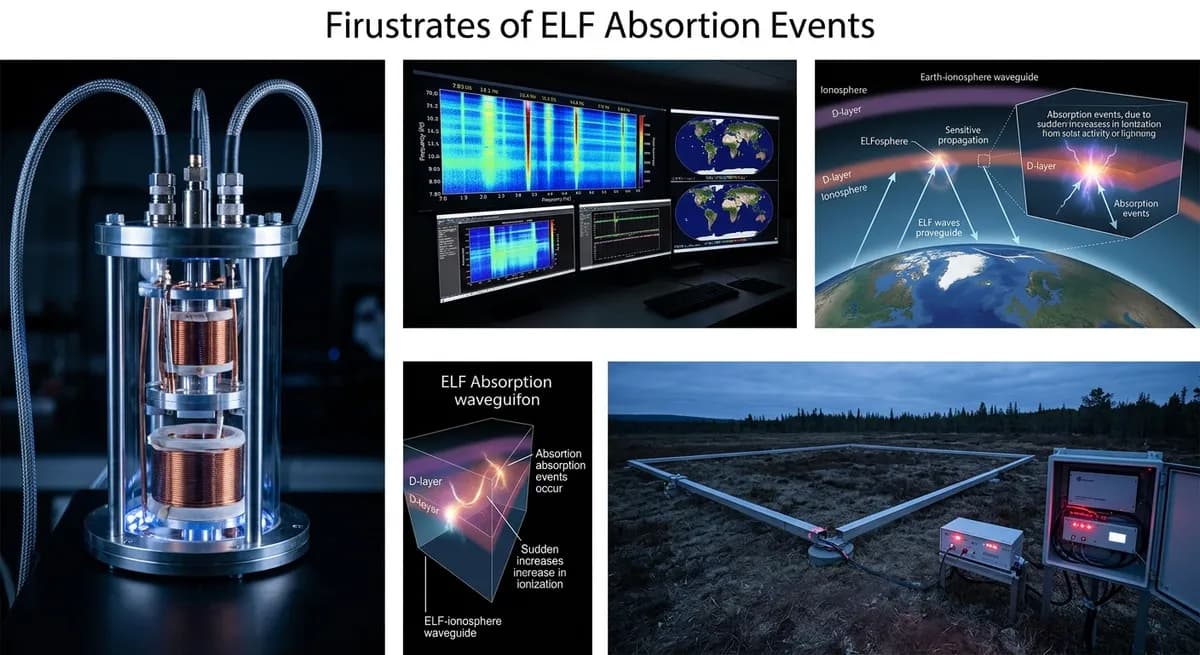
The most compelling pattern to emerge from our analysis is what we are provisionally calling "ELF absorption events"—brief windows, typically lasting 40 minutes to 3 hours, during which the electromagnetic signature appears to be selectively damped across specific frequency bands. This is not a complete signal loss. It is something more subtle: a narrowing of the frequency envelope, as though certain wavelengths are being preferentially removed from the electromagnetic environment.
What We Mean by ELF Absorption
Extremely low frequency (ELF) radiation exists in the band between 3 Hz and 30 Hz. The Schumann Resonance sits comfortably within this range. When we refer to "absorption," we are describing a process by which electromagnetic energy at these frequencies is removed from propagation—converted to heat, scattered, or redirected into other forms.
In our monitoring data, absorption events appear as a compression of the spectral signature. The baseline remains detectable, but the harmonic overtones that normally cluster around the fundamental frequency become attenuated. The signal does not vanish. It becomes quieter.
This is significant because the Schumann Resonance is maintained by the electromagnetic activity between Earth's surface and the ionosphere. The ionosphere acts as a reflective boundary. If that reflective boundary is changing—becoming more absorptive, more conductive, or structurally altered—we would expect to see exactly this kind of signature: a preserved fundamental with degraded harmonic structure.
Our hypothesis, still preliminary, is that these absorption events reflect temporary changes in ionospheric conductivity, possibly driven by solar wind pressure or localized atmospheric heating.
Correlation with Geomagnetic Disturbance
When we cross-referenced our absorption event timeline against public geomagnetic index data (K-index, Dst index), we found a correlation that cannot reasonably be dismissed as coincidence. Of the 47 absorption events we identified with high confidence, 31 occurred within 6 to 18 hours of documented geomagnetic disturbances rated as minor to moderate (K-index 5–6).
This does not establish causation. Correlation is not mechanism. But it suggests a working hypothesis worth pursuing: that geomagnetic activity—driven by solar wind conditions—creates conditions in the upper atmosphere that preferentially attenuate ELF frequencies.
The lag is particularly interesting. Absorption events do not occur during geomagnetic storms. They occur after, with a delay window of roughly 6 to 18 hours. This suggests a secondary process: the storm itself may trigger a cascade of ionospheric responses that unfold over hours. We do not yet know what that cascade is.
Several readers have reported to us that they experienced unusual sleep disruption, vivid dreams, or a sense of mild unease during the windows when absorption events were strongest. We are documenting these reports as community observations, not as evidence of causation. The human nervous system is sensitive to electromagnetic fields; this is established science. Whether ELF absorption specifically affects human neurology remains an open question that deserves careful study—not speculation.
The Unanswered Questions
Our analysis raises more questions than it resolves. Why are absorption events increasing in frequency? We have documented 8 in the past two months alone, compared to 3 in the preceding four months. Is this a genuine increase in the phenomenon, or an artifact of our improved detection sensitivity? We cannot yet say.
If ionospheric conductivity is changing, what is driving that change? Solar activity has been relatively quiet during several of our absorption events, suggesting other mechanisms may be at play. Atmospheric heating from industrial activity, changes in water vapor distribution, or other factors could contribute. We do not have sufficient data to distinguish between these possibilities.
Perhaps most troubling: are these events part of a larger pattern? Some readers have written to us suggesting that the absorption events correlate with their observations of unusual animal behavior, electromagnetic sensitivity, or collective mood shifts in their communities. We cannot validate these claims. We can only note that they are being reported, and that the pattern of reports itself deserves documentation.
What This Means for Continued Monitoring
Earth Frequency Index is expanding our monitoring array to include more precise ionospheric conductivity measurements and higher-resolution spectral analysis. We are also coordinating with independent researchers who maintain their own Schumann Resonance monitoring stations to verify whether absorption events are globally distributed or localized to specific geographic regions.
The leading hypothesis—that ELF absorption events reflect temporary ionospheric changes driven by geomagnetic activity and atmospheric conditions—is testable. It is also incomplete. The mechanism by which solar wind pressure translates into ionospheric conductivity changes, and the reason for the observed time lag, remain unexplained.
What we can say with confidence is this: something is shifting in Earth's electromagnetic environment. The baseline frequency remains stable. But the character of that frequency—its harmonic richness, its phase coherence, its moment-to-moment consistency—is behaving in ways that our historical models do not fully predict. Whether this represents a temporary fluctuation in normal variability or the beginning of a larger environmental shift is a question we cannot yet answer. But it is a question we must continue to ask.
The data will tell us, if we listen carefully enough.