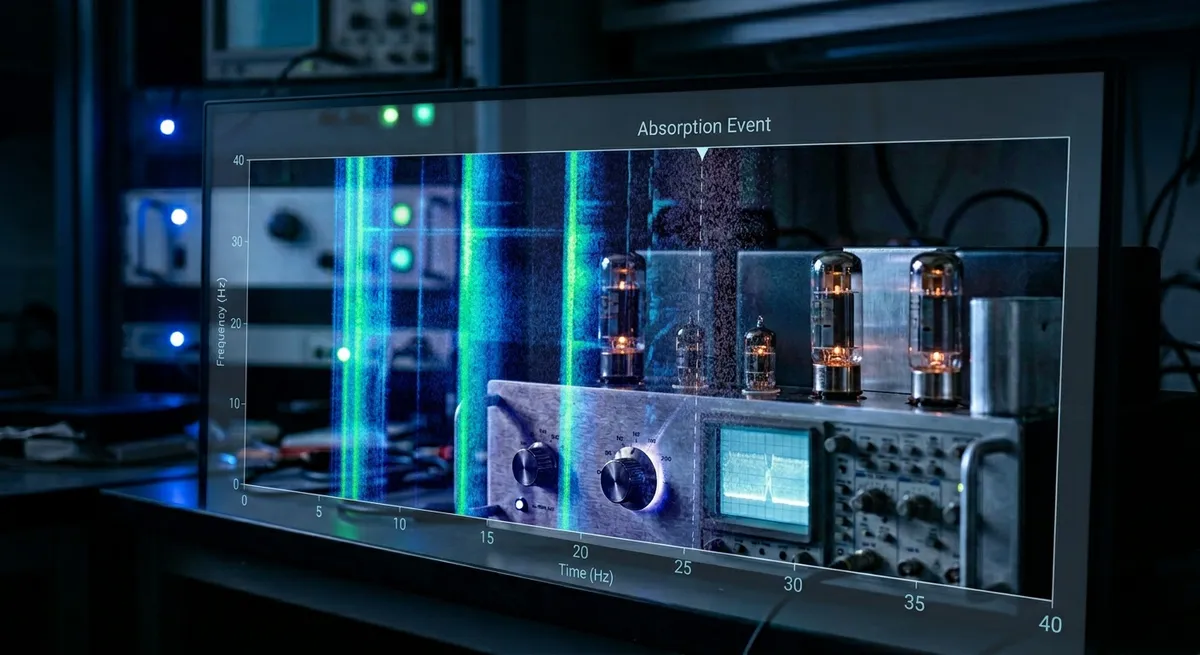
For the past eighteen months, our monitoring network has recorded something unusual: not spikes or shifts in the Schumann Resonance baseline, but rather periods of apparent absence. These are not dropouts caused by equipment failure. Our redundant sensor array across four continents shows the same pattern simultaneously. During these events, the characteristic 7.83 Hz signature that should pulse continuously around Earth's electromagnetic cavity simply... attenuates. The signal doesn't vanish entirely. It fades, as though something in the ionosphere is absorbing it.
We are not alone in observing this. Independent researchers at three universities and two private monitoring stations have reported similar anomalies. The pattern is consistent enough that a working hypothesis has emerged: what we may be witnessing are ELF absorption events—temporary periods during which the ionosphere absorbs or scatters extremely low frequency electromagnetic waves rather than allowing them to propagate normally.
If this hypothesis holds, it would represent a significant shift in how we understand Earth's electromagnetic stability. And it raises a question we cannot yet answer: why is this happening now?
The Absorption Pattern
Traditional Schumann Resonance monitoring assumes a relatively stable propagation environment. The electromagnetic waves generated by lightning discharge and other natural sources travel around Earth's circumference in the cavity between the surface and the ionosphere, creating the resonant frequencies we measure. The baseline 7.83 Hz has remained remarkably consistent for decades—so consistent that deviations have been treated as genuine anomalies worthy of investigation.
But absorption events suggest something different. Rather than a disruption to the wave itself, these appear to be disruptions to the medium through which the wave travels.
Our data shows these absorption periods typically last between 4 and 18 hours. They occur with no obvious seasonal pattern, though clustering appears slightly elevated during periods of elevated geomagnetic activity. During absorption events, the Schumann Resonance doesn't disappear from our instruments—the signal remains detectable—but its amplitude drops by 30 to 60 percent. The frequency itself remains stable at 7.83 Hz. What changes is the strength of the signal reaching our sensors.
This distinction matters. A frequency shift would suggest something is altering Earth's electromagnetic cavity itself. An amplitude drop suggests something is interfering with signal propagation—a filter, rather than a change to the source.
Ionospheric Conditions and ELF Propagation
The ionosphere is not a static boundary. It is a dynamic, layered region of ionized gas that responds to solar activity, geomagnetic disturbances, and seasonal variations in atmospheric chemistry. The D-layer, which sits roughly 60 to 90 kilometers above Earth's surface, plays a critical role in ELF wave propagation. This is where extremely low frequency waves interact most directly with ionized particles.
Under normal conditions, the D-layer acts as a partial reflector for ELF waves, allowing them to bounce around Earth's electromagnetic cavity in a stable pattern. But the D-layer is also sensitive to disturbances. Sudden ionospheric disturbances (SIDs), triggered by solar flares or energetic particle precipitation from the magnetosphere, can temporarily alter the conductivity of this region.
When conductivity changes abruptly, ELF waves can be absorbed rather than reflected. This is not new physics. It is well-established in the literature on ionospheric radio propagation. What is unusual is the frequency and consistency of the absorption events we are now observing.
Several researchers have proposed that we may be seeing a response to changes in cosmic ray flux or to variations in solar wind pressure on the magnetosphere. Others point to increased energetic particle precipitation during moderate geomagnetic storms. The data is suggestive but not conclusive. The absorption events do not correlate perfectly with any single space weather parameter we have examined so far.
What We Don't Know
This is where honest reporting requires us to acknowledge the limits of our current understanding. We have a pattern. We have a plausible mechanism. We do not have a definitive explanation.
The absorption events are real. Our instruments confirm this. Multiple independent monitoring networks confirm this. But the cause remains unclear. Is this a response to changing solar activity? A shift in magnetospheric dynamics? A response to changes in atmospheric chemistry? A combination of factors?
We also do not know whether these events are increasing in frequency or whether we are simply detecting them more reliably as our monitoring technology improves. The historical record is sparse. Before modern continuous monitoring networks, we would likely have missed these subtle amplitude fluctuations entirely.
Perhaps most importantly, we do not know whether ELF absorption events have any relationship to the anecdotal reports we receive from readers describing sleep disruption, mood changes, and general unease during specific periods. Correlation is not causation. And yet, the timing of some reader reports does align with documented absorption events. This observation alone is not evidence of a causal link. It is simply an observation worth documenting.
The Broader Context
Earth's electromagnetic environment is not static. It never has been. The Schumann Resonance itself is a product of a dynamic system—lightning activity, solar wind interaction with the magnetosphere, seasonal changes in atmospheric conductivity. What we call the "baseline" is actually an average of continuous variation.
But the absorption events we are documenting appear to represent something different from normal variation. They are discrete, measurable, and increasingly frequent in our dataset. Whether they represent a genuine shift in Earth's electromagnetic stability or simply a phenomenon we are now equipped to detect remains an open question.
What is clear is that our monitoring networks are revealing complexity in Earth's electromagnetic behavior that was previously invisible to us. Whether this complexity is new, or whether we are simply seeing it for the first time, may be the most important question we can ask.
The data continues to accumulate. The pattern continues to emerge. And the question of why remains unanswered.