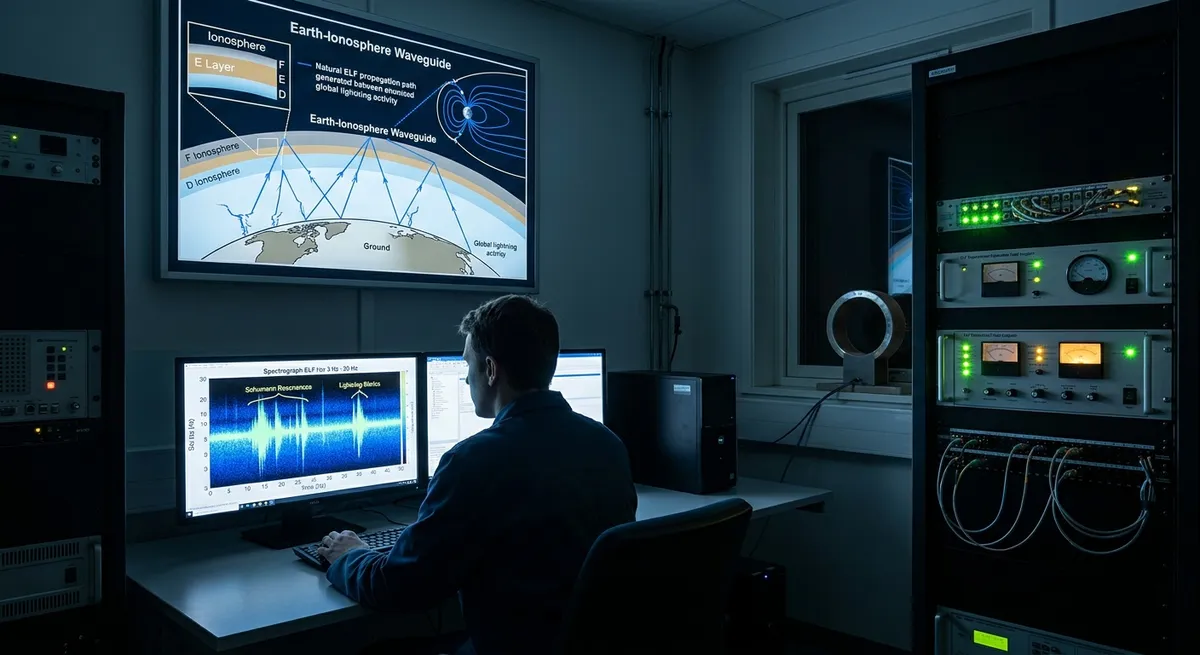
The electromagnetic environment surrounding Earth is far from silent. Across the extremely low frequency (ELF) spectrum—typically defined as signals below 3 kHz—a complex symphony of natural radio signals continuously emanates from our planet's atmosphere and ionosphere. These signals have existed for billions of years, long before humanity developed the technology to detect and measure them. Understanding their origins is fundamental to Earth frequency research and provides crucial context for distinguishing natural phenomena from artificial electromagnetic sources.
The Electromagnetic Spectrum and ELF Definition
Extremely low frequency signals occupy a unique position in the electromagnetic spectrum. With wavelengths ranging from approximately 100 kilometers to several thousand kilometers, ELF waves propagate through the Earth-ionosphere cavity—the region between Earth's surface and the ionosphere that acts as a natural waveguide. This cavity, first theoretically described by Winfried Schumann in 1952, creates resonant modes that amplify certain frequencies while attenuating others.
The ELF band is distinct from radio frequencies used in commercial broadcasting, which occupy much higher frequency ranges. This distinction is important because it means natural ELF signals are largely unaffected by human radio technology and represent genuine geophysical phenomena. The characteristic low attenuation of ELF waves in the Earth-ionosphere cavity allows them to propagate globally, making them detectable at monitoring stations worldwide regardless of their distance from the signal source.
Lightning: The Primary Natural Source of ELF Signals
Lightning is the dominant natural generator of ELF radio signals. Each lightning strike produces a broadband electromagnetic pulse that contains energy across multiple frequency ranges, including significant ELF components. Approximately 40 to 50 lightning strikes occur globally every second, meaning Earth's atmosphere is continuously generating ELF signals from thunderstorm activity.
When lightning ionizes the air column between cloud and ground, it creates a rapidly changing current that radiates electromagnetic energy. The ELF component of this radiation is particularly efficient at propagating through the Earth-ionosphere waveguide. These signals, called "sferics" or "atmospherics," form the background electromagnetic noise in the ELF band. The frequency content of lightning-generated signals spans from near-zero Hz up through the VLF (very low frequency) range, creating a continuous electromagnetic signature that varies with global thunderstorm patterns.
Researchers have documented that ELF signal intensity shows predictable seasonal and diurnal variations corresponding to thunderstorm activity. The peak in global lightning activity typically occurs in the afternoon local time, and seasonal patterns reflect the distribution of convective weather systems across hemispheres. This correlation between observable weather phenomena and measured ELF signals provides strong evidence for lightning as a primary source.
Solar Activity and Geomagnetic Influences
Beyond lightning, solar activity plays a significant role in generating and modulating ELF signals. Solar wind interactions with Earth's magnetosphere create geomagnetic disturbances that generate electromagnetic waves across multiple frequency bands. During periods of intense solar activity, such as solar flares or coronal mass ejections, the influx of charged particles can excite oscillations in the magnetosphere that couple into the Earth-ionosphere cavity.
Geomagnetic storms, measured on the Kp index, correlate with variations in ELF signal characteristics. The ionosphere itself responds to solar ultraviolet radiation and particle precipitation, changes that affect the reflective properties of the upper atmosphere. These variations influence how effectively ELF signals propagate through the Earth-ionosphere cavity. Solar activity thus creates a modulating influence on the electromagnetic environment, distinct from but complementary to the direct generation of signals by lightning.
The 11-year solar cycle, driven by the sun's magnetic activity, produces long-term variations in the ionospheric environment. These variations can subtly affect ELF propagation characteristics over timescales of months to years, providing another natural source of variation in measured frequencies.
Schumann Resonance and Modal Structure
Within the broadband ELF spectrum generated by lightning and modulated by solar activity, the Earth-ionosphere cavity exhibits resonant modes—standing wave patterns that are preferentially excited and amplified. The fundamental resonance, known as the Schumann Resonance, occurs at approximately 7.83 Hz. Higher harmonics exist at roughly 14.3 Hz, 20.8 Hz, and beyond, each representing a different standing wave pattern within the cavity.