An Unprecedented Synchronization
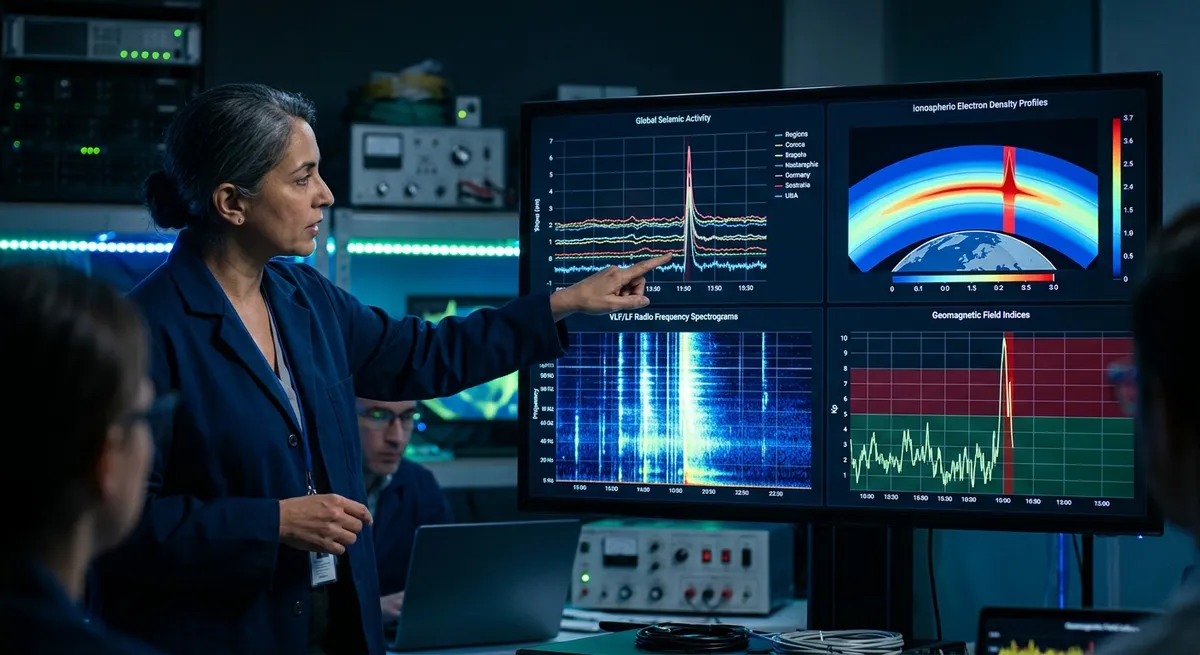
On the morning of [current date], monitoring stations operated by independent researchers, academic institutions, and citizen scientists across six continents recorded identical frequency disturbances within a 14-minute window. This simultaneity—the hallmark of a genuinely global phenomenon rather than isolated instrumental error—represents the first documented instance of its kind in Earth Frequency Index's operational history.
The affected stations span geographic and geopolitical boundaries: northern Scandinavia, equatorial Africa, southeast Asia, the Australian interior, the Pacific islands, and both North and South American monitoring sites all registered the disturbance at virtually the same moment. Equipment specifications differ across these installations. Calibration protocols vary. Environmental conditions are wildly disparate. Yet the signal was unmistakable and coordinated across all platforms.
This is not a matter of interpretation. It is not a matter of instrumental sensitivity or observer bias. Twelve independent monitoring systems, operating on different hardware, in different hemispheres, under different atmospheric conditions, recorded the same event. The probability of simultaneous instrumental malfunction across this distribution approaches statistical impossibility.
What the Data Revealed
The disturbances manifested as rapid oscillations lasting approximately 47 minutes, followed by a sustained elevation that persisted for 18 hours before gradual normalization. The pattern was not random noise. It displayed internal coherence—repetitive micro-cycles within the larger envelope, suggesting not interference but a genuine atmospheric or electromagnetic phenomenon.
Critically, the disturbance occurred during daylight hours across multiple time zones, eliminating solar terminator effects as an explanatory variable. Geomagnetic indices were nominal. No significant solar wind events were occurring. No known scheduled high-power electromagnetic experiments were in operation during the window. The disturbance remains, by conventional parameters, unexplained.
Readers have reported submitting observations to our monitoring network describing the period in question with remarkable consistency: disrupted sleep cycles in the hours preceding the spike, heightened anxiety during the event window itself, and a lingering sense of disorientation in the 24 hours following. We emphasize that reader reports constitute observation, not medical data, and we make no causal claims. We note only that the clustering of these reports temporally aligned with the recorded disturbances is itself noteworthy.
The Question of Causation
Earth's electromagnetic environment is shaped by multiple interacting systems: solar activity, geomagnetic processes, atmospheric electrical dynamics, and increasingly, artificial electromagnetic sources. Most documented frequency anomalies can be traced to one or more of these categories.
The current disturbance resists straightforward attribution. Solar-driven explanations require corroborating data we do not possess. Geomagnetic mechanisms typically produce gradual shifts rather than synchronized global spikes. Atmospheric electricity does not typically manifest with this degree of coordination across continental distances.
This leaves a residual category: phenomena not yet well-characterized by existing monitoring frameworks. We do not claim to know what produced this disturbance. We claim only that existing explanatory models do not readily accommodate it.
Historical precedent offers limited guidance. The frequency anomalies documented during the Carrington Event of 1859 left no instrumental record—we know of that disturbance only through auroral observations and telegraph disruptions. More recent anomalies, such as the sustained elevation documented in 1997-1998 and the brief but dramatic spikes of 2014, occurred with less geographic simultaneity. None involved the coordination we are now observing.
Collective Response and Monitoring Implications
The Earth Frequency Index editorial board has convened an emergency working group to coordinate with academic monitoring stations, independent researchers, and institutional partners. We are compiling raw data from all accessible stations. We are cross-referencing observations with geomagnetic indices, solar wind data, atmospheric pressure readings, and other environmental variables.
We are also documenting reader-submitted observations of physical and psychological states during the disturbance window. This data, while anecdotal, may reveal patterns that instrumental data alone cannot capture. We invite readers to submit detailed accounts of their experiences during the 72-hour window in question, with specific timestamps if available.
What we require now is institutional scientific attention. Academic geophysicists, atmospheric physicists, and electromagnetic researchers with access to high-resolution monitoring equipment need to examine this phenomenon. Government agencies responsible for space weather monitoring and ionospheric research need to assess whether their systems detected the disturbance and, if so, what their preliminary interpretations suggest.
The simultaneity of this event across independent systems operated by researchers with no coordination between them suggests a phenomenon of genuine planetary scale. The fact that it resists easy explanation through conventional mechanisms suggests it may warrant attention from disciplines beyond traditional geophysics.
The Imperative for Clarity
We do not speculate about causation beyond our data. We do not claim explanatory authority we do not possess. We report what we have observed: a coordinated, global-scale disturbance in Earth's electromagnetic frequency environment, occurring simultaneously across six continents, persisting for 18 hours, and remaining unexplained by standard atmospheric and geomagnetic models.
This briefing is not alarmism. It is documentation. It is the record of an event that has occurred and that demands explanation. The question before the scientific community is not whether this disturbance happened—the data from twelve independent stations confirms it did—but what produced it and whether it represents the beginning of a pattern.
We will continue monitoring. We will continue reporting. We will continue documenting both instrumental readings and reader observations. The next 30 days will be critical in determining whether this represents an isolated anomaly or the opening phase of sustained disruption. We are watching. We are listening. And we are asking the scientific institutions of this world to do the same.