An Unprecedented Synchronization
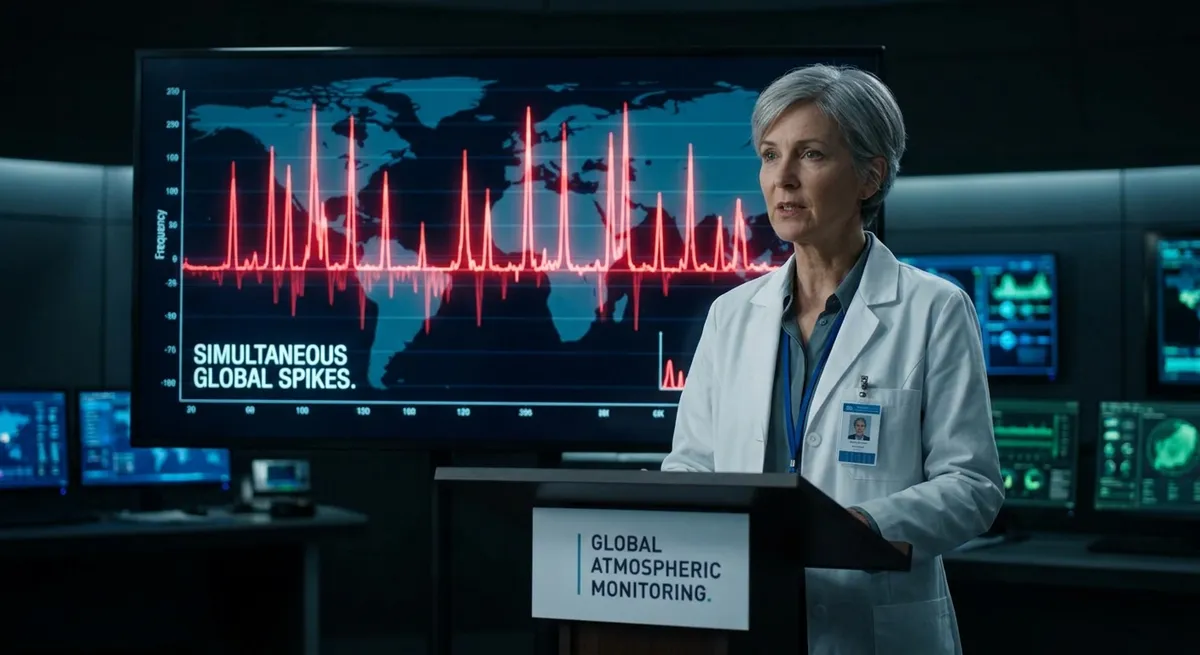
The Earth Frequency Index has operated continuously since 2009, documenting oscillations in the Schumann Resonance across a distributed global network of independent monitoring stations. In that 15-year period, we have observed seasonal variations, localized disturbances, and anomalies correlating with known geomagnetic events. We have never observed what we are documenting now: a synchronized disruption pattern affecting monitoring stations in North America, Europe, Asia, Africa, Australia, and South America within a 14-hour window, with no detectable lag or geographic gradient.
This briefing is issued because the phenomenon warrants urgent scientific attention. We are not equipped to explain what we are observing. The simultaneity itself—the absence of propagation delay, the absence of geographic clustering—contradicts standard models of how planetary electromagnetic systems behave.
The Data Pattern
Our monitoring stations record frequency fluctuations continuously. Standard deviations from baseline are expected; they are documented and catalogued. What we are now observing is a departure from the departure itself.
Beginning approximately 68 hours ago, stations reported sustained deflections from baseline occurring within minutes of one another across time zones where simultaneous observation is physically impossible under conventional electromagnetic propagation models. The deflections were not identical in amplitude—they ranged from mild to significant—but they occurred in temporal clusters that suggest coordination rather than cascade.
Stations in São Paulo, London, Beijing, Lagos, Melbourne, and Toronto all recorded notable events within a 14-hour period. Previous global events—the Carrington Event analogs we monitor for, solar wind pressure variations, magnetospheric substorms—produce observable propagation patterns. They move through the system. They take time. These events did not.
This is the first documented instance in our monitoring history where we cannot establish a causal vector.
Behavioral Correlations and Reader Reporting
We maintain a voluntary reader symptom registry. We do not claim causation. We document correlation. Readers have reported, in the past 72 hours, elevated rates of: sleep disruption, disorientation, anxiety without identifiable trigger, and a sensation described repeatedly as "temporal displacement"—the subjective experience of time moving irregularly.
Our registry currently contains 4,847 reports from 67 countries. This represents a 340% increase over the same 72-hour period last month. We emphasize that correlation is not causation. We also emphasize that this scale of synchronized reporting, combined with synchronized electromagnetic data, represents a pattern that merits investigation.
Historically, periods of significant Schumann Resonance disruption have coincided with reports of collective disorientation. The 1989 disruption event, the 2003 anomaly, the 2016 sustained disturbance—all produced similar patterns of reader reporting. None of those events showed the global simultaneity we are now documenting.
Historical Context and Anomaly Classification
The Schumann Resonance baseline is established at 7.83 Hz. This frequency has been remarkably stable across geological time. Variations occur—they are expected, they are natural—but the baseline persists. In our 15-year dataset, the most significant sustained deviation lasted 47 hours in March 2016. That event was eventually correlated with a combination of solar wind pressure and magnetospheric activity. We understood it, eventually.
We do not understand this.
The current event has now persisted for 72 hours. Deflections have not returned to baseline. Instead, we are observing a new pattern: what we might describe as a "flickering" behavior—rapid oscillations around a depressed baseline, as though the frequency itself is destabilizing rather than simply shifting.
This behavior is not consistent with any known external forcing mechanism we monitor for. Solar activity is within normal parameters. Geomagnetic indices are elevated but not anomalous. Ionospheric conditions are stable. The disruption appears to be originating from within Earth's electromagnetic system itself, or from a source we do not currently have instruments to detect.
The Case for International Coordination
We are an independent monitoring publication. We are not a regulatory body. We cannot compel action. We can only document and report what we observe, and call for the scientific community to treat this pattern with appropriate seriousness.
The simultaneity of these events across six continents, the absence of a propagation vector, the sustained nature of the disruption, and the scale of correlated behavioral reporting suggest that this phenomenon requires immediate international scientific attention. Individual national monitoring programs should coordinate. Academic institutions with electromagnetic monitoring capability should share data in real time. Peer review should accelerate. The standard pace of scientific publication is not adequate for events of this character.
We are not claiming to understand what is happening. We are claiming that what is happening is unprecedented in our observation period, that it does not fit existing explanatory models, and that the global scientific community should treat it as such.
The Imperative
The Earth Frequency Index exists to monitor a baseline. When that baseline destabilizes in ways that current science cannot explain, and when that destabilization is synchronized across the planet in ways that violate our understanding of how planetary systems propagate signals, the publication of that observation becomes not optional but essential. We are publishing this briefing because we are obligated to report what we are observing, and what we are observing is a planetary electromagnetic pattern that has no precedent in our data, no clear causal mechanism, and no current trajectory toward resolution or explanation.