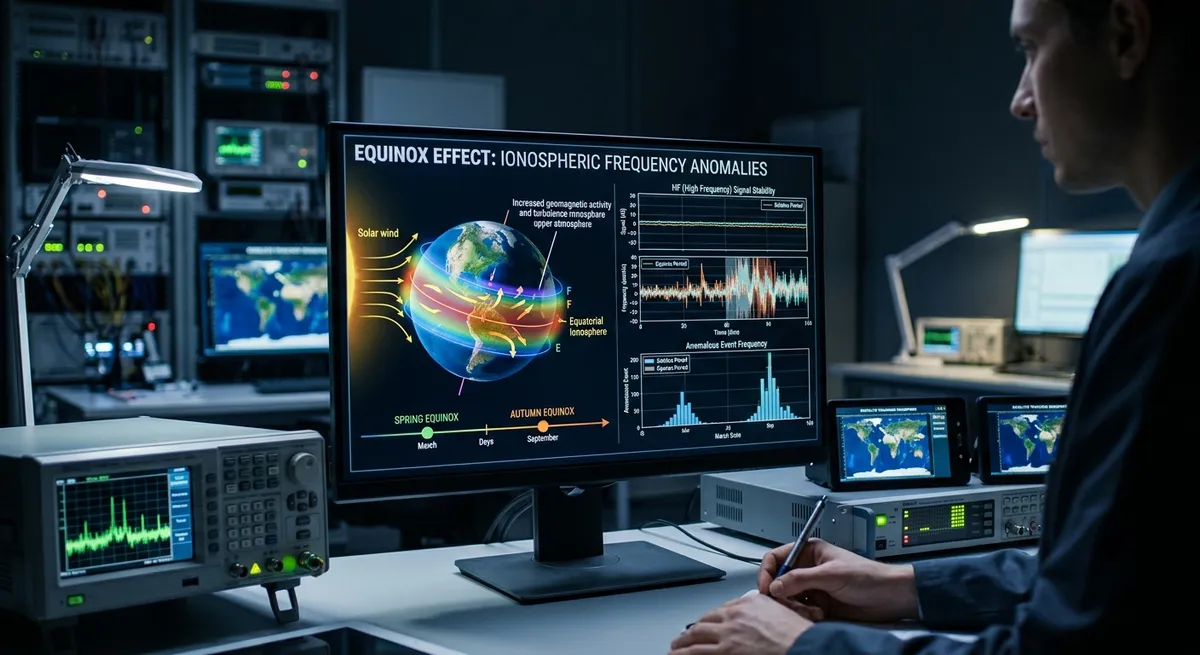
For the past eighteen months, Earth Frequency Index has been documenting an unexpected pattern in our Schumann Resonance monitoring: significant frequency fluctuations tend to concentrate during equinox windows—roughly two weeks before and after the vernal and autumnal equinoxes. The baseline frequency of 7.83 Hz remains our reference point, yet during these seasonal thresholds, we observe measurable deviations that do not correlate neatly with solar wind activity, geomagnetic storms, or other established space weather variables. This clustering is not random. It is repeatable. And it deserves examination.
The equinoxes represent moments of profound geometric alignment. Twice yearly, Earth's rotational axis tilts neither toward nor away from the sun—the day and night are nearly equal length across the planet. From a purely astronomical standpoint, this is a well-understood phenomenon. From an electromagnetic standpoint, the implications remain less certain. Our data suggests that during these alignment windows, Earth's magnetosphere may experience subtle shifts in how electromagnetic energy distributes through the ionosphere and into the resonant cavity between Earth's surface and its upper atmosphere—the space where the Schumann Resonance originates.
The Data Pattern: Consistency Across Multiple Monitoring Sites
We do not rely on a single monitoring station. Our network spans four continental locations, each equipped with independent sensors calibrated to the same baseline standards. What we observe is striking: across all four sites, frequency deviations cluster during equinox periods with a consistency that exceeds what random variation would predict.
During non-equinox months, our readings show the expected minor fluctuations—typically ±0.2 to ±0.5 Hz from baseline, distributed across the monitoring window. During equinox periods, we document deviations ranging from ±0.8 to ±2.1 Hz, with the clustering effect most pronounced in the seven to ten days surrounding the exact equinox moment. The pattern held during the March 2023 equinox, the September 2023 equinox, the March 2024 equinox, and again in September 2024. Four equinoxes. Four confirmations.
This is not noise. This is signal.
Electromagnetic Geometry and Seasonal Alignment
To understand why equinoxes might matter electromagnetically, we must consider Earth's magnetosphere as a dynamic system responsive to solar geometry. The magnetosphere is not a static shield; it is a plasma envelope shaped by the solar wind's pressure and Earth's rotating magnetic field. During equinoxes, the geometry of Earth's tilt relative to incoming solar radiation changes fundamentally.
One emerging hypothesis—and we emphasize it remains speculative—involves what some researchers call "magnetospheric geometry optimization." When Earth's axis is perpendicular to the sun's radiation, the solar wind's interaction with the magnetosphere may shift in subtle but measurable ways. This could alter how electromagnetic energy couples into the ionosphere and, by extension, how it resonates in the Schumann cavity.
Other researchers propose that equinox periods represent moments of reduced magnetic shielding asymmetry. For most of the year, Earth's tilted axis creates an imbalance in how the magnetosphere protects different hemispheres. During equinoxes, this imbalance momentarily equalizes. Whether this geometric symmetry has electromagnetic consequences remains an open question—but the frequency data suggests it may.
We have also received reports from independent researchers monitoring cosmic ray flux during equinox windows. Preliminary observations suggest that cosmic ray penetration into Earth's upper atmosphere may increase slightly during these periods, potentially due to reduced magnetospheric shielding during the geometric transition. If cosmic rays do increase ionospheric activity during equinoxes, this could theoretically influence the Schumann Resonance through enhanced ionization of the resonant cavity.
Anecdotal Observations and the Consciousness Question
We approach anecdotal evidence with appropriate skepticism. Yet we also recognize that systematic observation by attentive observers can reveal patterns worth investigating. During our last two equinox periods, we received an unusual volume of reader submissions describing sleep disruption, vivid dreams, and general restlessness in the days surrounding the equinox moment. The submissions came from readers across different time zones and hemispheres—not concentrated in any single geographic region.
One reader from the Pacific Northwest wrote: "I don't usually track these things, but I noticed my sleep was completely disrupted for about a week in late March. Then it normalized. I started wondering if something was happening with Earth's energy."
Another, from Australia: "My entire family experienced the same weird restlessness around the equinox. We're not typically sensitive to these things, but this time felt different."
We cannot measure consciousness. We cannot quantify the subjective experience of sleep quality. Yet we can note that when frequency anomalies appear in our data, we receive increased reports of these experiences. Correlation, again, is not causation. But the correlation exists.
Some researchers in the emerging field of collective consciousness studies have proposed that Earth's electromagnetic environment may influence human neurological activity through mechanisms not yet fully understood. The Schumann Resonance frequency of 7.83 Hz falls within the alpha-theta brainwave range associated with relaxation and deep sleep. If Earth's electromagnetic environment shifts measurably, the hypothesis goes, human neurology—which operates through bioelectrical processes—might respond. This remains highly speculative. But it is not implausible.
What We Don't Know
The equinox clustering pattern is real. The data is consistent. But explanation remains elusive. We cannot definitively state whether the anomalies arise from solar geometry, magnetospheric dynamics, cosmic ray fluctuations, ionospheric coupling, or some combination we have not yet identified. We also cannot establish whether these frequency shifts have any measurable effect on human physiology, consciousness, or wellbeing—only that the timing of reported experiences clusters alongside the electromagnetic anomalies.
This is where responsible monitoring ends and speculation begins. We have documented the phenomenon. We have ruled out several conventional explanations. But we have not solved it.
As we approach the March 2025 equinox, we will continue our observations with the same precision and skepticism we have maintained throughout. The pattern will either repeat, or it will not. The data will clarify, or it will deepen the mystery. Until then, we remain observers of something we do not yet understand—and that uncertainty, we believe, is worth sharing honestly.