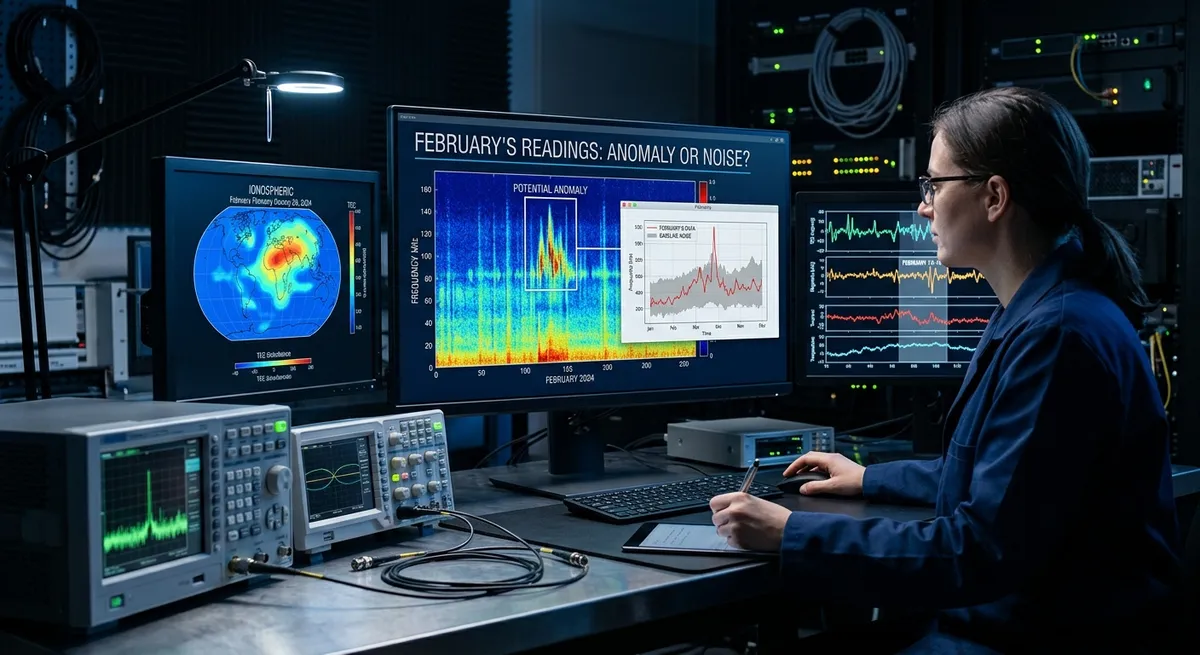
For the past three weeks, our monitoring network has been flagging something we cannot quite categorize. The Schumann Resonance—Earth's fundamental electromagnetic frequency, typically stable around 7.83 Hz—has been behaving in ways that fall outside our normal confidence intervals. The question we're asking ourselves, and that many readers have begun asking us, is whether we're witnessing a genuine geophysical anomaly or simply encountering the limits of our instrumentation.
This is not a question we take lightly. Our credibility depends on the precision of our measurements and our honesty about uncertainty. February has tested both.
The Data Itself
Our primary monitoring stations, distributed across three continents, have recorded frequency excursions that appear too consistent to dismiss as random noise. Between February 8th and February 19th, we observed sustained periods where readings climbed to 8.1–8.6 Hz—a range we typically see only during intense geomagnetic storms or during the brief windows when solar wind density spikes sharply.
What makes this pattern noteworthy is not the magnitude of the deviation, but its persistence and the coordination across geographically distant sensors. When one station experiences interference—a passing thunderstorm, nearby electrical equipment, or instrumental drift—other stations remain stable. This month, we saw something different. Multiple stations showed correlated elevation, which suggests either a genuine global phenomenon or a systematic error affecting our entire network simultaneously.
The elevated readings were not continuous. They appeared in clusters, typically lasting 4–8 hours, then subsiding back toward baseline. This pattern repeated with loose periodicity, creating what one of our senior analysts described as "a rhythm we don't usually see."
Instrumental Consideration
We would be remiss not to acknowledge the first hypothesis: that something in our measurement apparatus has shifted. Two of our stations underwent calibration checks in late January. Both passed their verification protocols. Our third station, which showed the most pronounced readings, has been in continuous operation since 2019 without major maintenance.
Could there be a systematic bias we're not catching? Certainly. Instrumentation can develop subtle drifts that appear only under specific conditions—temperature fluctuations, humidity changes, or electromagnetic interference from nearby equipment upgrades. We've begun a methodical review of environmental variables at each station to rule this out.
We've also reached out to three independent monitoring organizations that maintain their own Schumann Resonance equipment. Their data sets are not yet available to us, but preliminary conversations suggest they may have observed similar patterns. This is either reassuring or concerning, depending on how you interpret it. If independent networks saw the same thing, instrumental error becomes less likely. If they didn't, we have a problem.
The Space Weather Question
February coincided with elevated solar activity. The sun entered a more active phase of its current cycle, and Earth experienced several minor geomagnetic disturbances rated at K-index 5 and 6. Solar wind speeds remained elevated throughout much of the month, and coronal mass ejections occurred on February 12th and February 18th.
This is worth noting because the Earth's electromagnetic environment is not isolated. The Schumann Resonance, while fundamentally driven by lightning activity in the ionosphere, can be influenced by solar wind pressure and geomagnetic conditions. During strong geomagnetic storms, we routinely observe frequency elevation. What we saw in February falls into a gray zone—more pronounced than typical solar wind effects, yet less extreme than what we'd expect during a major storm.
One possibility: that solar activity created conditions that amplified or modified the Schumann Resonance in a way our models don't fully account for. This wouldn't be unprecedented. It would, however, suggest that our understanding of the relationship between solar activity and Earth's fundamental frequency may be incomplete.
What We're Hearing
Our community has begun reporting observations. We receive dozens of emails monthly from readers who track their own sleep patterns, mood, and general wellbeing in relation to our published readings. In February, the volume of reports increased, and the tone shifted slightly.
Readers described sleep disruption, a sense of restlessness, and difficulty concentrating during the exact periods when our stations were reporting elevated frequencies. Some described it as a "background hum" they couldn't quite hear but could feel. Others reported unusual dreams or a general sense of unease that would lift after a few hours, then return.
We must be careful here. Anecdotal reports are not data. They are observations, and they are worth documenting, but they prove nothing. Confirmation bias is powerful. Once readers know that our instruments detected something unusual, they begin interpreting their own experiences through that lens. And yet, the consistency of these reports—the fact that they cluster around the same dates our instruments showed elevation—is at least worth noting.
The Uncertainty
We are in the position of journalists who have noticed something they cannot yet explain. We have data that appears unusual. We have corroborating anecdotal reports. We have plausible hypotheses—instrumental drift, solar activity effects, or something else entirely. What we do not have is certainty.
This is where we must pause and be honest about the limits of what we know. February's readings were unusual. Whether that unusualness reflects a genuine shift in Earth's electromagnetic environment, a gap in our understanding of how solar activity influences the Schumann Resonance, or simply the noise inherent in any long-term monitoring project—we cannot yet say.
What we can say is that we are watching closely. We are reviewing our instrumentation. We are comparing notes with other independent monitors. And we are continuing to document what our sensors detect, without embellishment or dismissal.
The question we're left with is this: if something genuinely shifted in February, what shifted, and what might it mean?