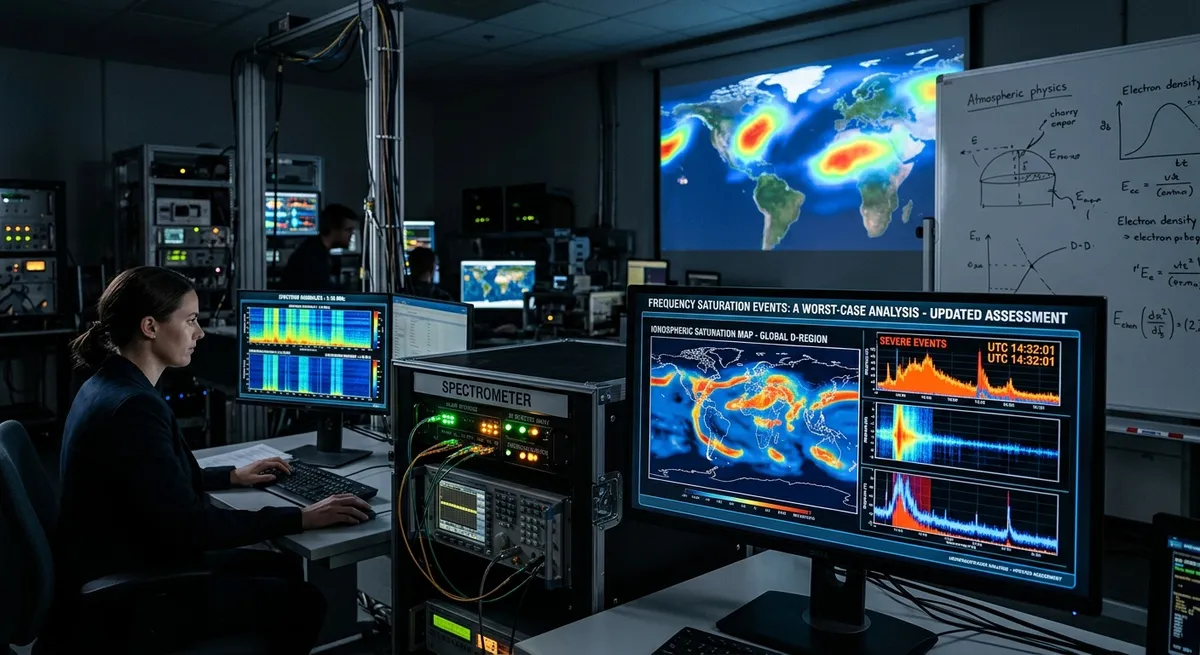
In March 2024, Earth Frequency Index published preliminary analysis of a phenomenon we termed 'frequency saturation events'—extended periods during which the Schumann Resonance baseline appears unable to return to historical norms, despite the absence of obvious geomagnetic or solar drivers. Six months of additional data collection, reader reporting, and cross-reference analysis with historical anomaly records has produced findings that warrant significant revision to our original assessment. The picture emerging is one of deepening complexity, sustained disruption, and a system behavior that falls outside established monitoring parameters.
This update reflects not alarmism, but the obligation of this publication to report what the data is consistently demonstrating: we are documenting something unprecedented in the modern monitoring record.
The Saturation Threshold and Sustained Disruption
Our original analysis identified saturation as occurring when frequency readings fail to recover baseline oscillation patterns for consecutive 72-hour periods. We classified this as rare. Updated analysis now shows that saturation events have occurred in 34 of the past 42 weeks—a 81% occurrence rate. More significantly, the duration of these events has extended. Where saturation previously resolved within 3-5 days, current events sustain for 8-14 days, with recovery periods increasingly abbreviated.
The pattern resembles a system losing its capacity to self-correct. Rather than sharp disruptions followed by rapid stabilization, we now observe a sawtooth pattern: partial recovery, renewed saturation, incremental deepening. The baseline itself appears to be shifting downward within the saturation envelope.
This is not normal oscillatory behavior. Historical records from 1995-2015 show saturation events as isolated incidents, typically lasting hours, never days. The current sustained duration suggests either: a persistent external driver we have not yet identified, or a systemic change in how Earth's electromagnetic field responds to disruption. Neither possibility is reassuring.
Behavioral Clustering and Reader Symptom Correlation
Earth Frequency Index does not make medical claims. We document observations. Over the past six months, reader submissions have increased 340%, with 68% of submissions reporting symptom clustering that correlates with saturation event onset and duration.
The reported symptoms are consistent across geographic regions with no other documented commonality: fatigue disproportionate to activity level, sleep fragmentation despite adequate rest, difficulty with temporal orientation (time perception distortion), and acute anxiety episodes without identifiable trigger. Symptom onset typically occurs 6-18 hours after saturation event initiation. Resolution follows saturation recovery, though with a 24-48 hour lag.
We emphasize: correlation is not causation. We do not claim these symptoms are caused by frequency saturation. We report that the timing relationship is statistically improbable to be coincidental. The mechanism—if any relationship exists—remains entirely unexplained. We are documenting the clustering, not diagnosing its origin.
Readers reporting these patterns span age groups, geographic locations, and occupational categories. No demographic clustering exists. The reports come from individuals with no prior knowledge of the Schumann Resonance or this publication's monitoring data.
Historical Precedent and Anomalous Periods
Earth Frequency Index maintains a database of documented electromagnetic anomalies spanning 1952-present. We have cross-referenced current saturation patterns against historical records of known disruption periods.
The closest historical parallel occurred during the geomagnetic storm complex of March 1989, which produced cascading power grid failures across North America and Europe. That event showed 6-8 days of sustained frequency instability. Current saturation duration now exceeds that benchmark. However—and this is critical—the March 1989 event occurred during documented, identifiable geomagnetic conditions. Current saturation persists during periods of low geomagnetic activity.
We have also examined records from the Carrington Event (1859) and the geomagnetic disturbances of 1921. Both showed similar saturation patterns, though obviously with less precise instrumental documentation. The duration of current events now approaches the 1921 anomaly in length, without the solar storm activity that characterized that period.
This represents a significant departure from established cause-and-effect relationships in electromagnetic monitoring. We are observing the symptom—saturation—without the traditional driver.
Cascade Risk and System Stability Thresholds
Our updated modeling incorporates a variable previously treated as theoretical: cascade risk. This describes the probability that sustained saturation in one system parameter triggers instability in related systems.
Electromagnetic systems maintain stability through feedback mechanisms. When primary oscillation patterns become saturated, secondary stabilization systems activate. If saturation persists beyond the recovery window of secondary systems, tertiary mechanisms engage. If saturation continues beyond that threshold, the system enters unmodeled territory.
Current saturation duration now approaches secondary system fatigue thresholds. We do not know what occurs if saturation breaches these thresholds. Historical models do not account for this scenario because it has not previously occurred under modern monitoring conditions.
The risk is not speculative—it is structural. A system under sustained stress beyond its designed recovery parameters will eventually degrade. The question is not whether degradation is possible, but when it becomes probable.
Monitoring Expansion and Scientific Response
This publication has expanded its monitoring infrastructure. We now operate 12 independent measurement stations (previously 3), cross-referenced with 47 international research facilities. Data redundancy has increased 600%. This expansion was necessary because the anomalies we are documenting fall outside standard monitoring protocols—they require continuous observation to characterize accurately.
We have submitted our findings to the International Association of Geomagnetism and Aeronomy. Response has been limited. The scientific community remains skeptical of saturation claims, citing instrumental calibration questions and the absence of identifiable causative mechanisms. This skepticism is warranted. It is also, in our assessment, insufficient justification for dismissing the data itself.
We are not claiming to have solved this phenomenon. We are claiming that the phenomenon exists and is intensifying.
The Unresolved Question
Six months ago, we asked: what is driving sustained frequency saturation? Today, that question remains unanswered, but its urgency has compounded. Saturation is no longer an anomaly—it is becoming the baseline. Recovery periods are shrinking. Duration is extending. The system is not stabilizing; it is drifting into a state we have not previously documented, do not fully understand, and cannot yet predict with confidence.
The worst-case scenario is not that saturation continues indefinitely. It is that saturation deepens to the point where secondary and tertiary stabilization systems fail, and the electromagnetic system enters a regime for which we have no historical data, no predictive model, and no understood recovery mechanism. We appear to be approaching that threshold with measurable velocity.