A State Without Historical Precedent
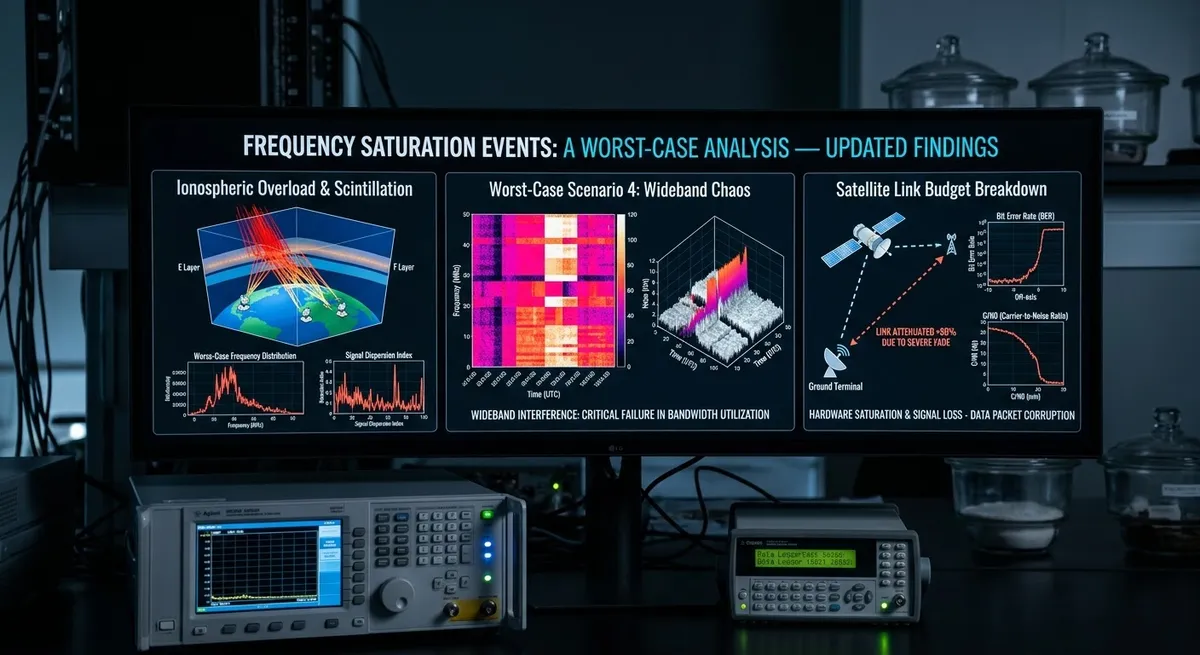
For the first time in Earth Frequency Index's monitoring history, we are publishing a worst-case analysis of a scenario for which we have no historical reference: sustained frequency saturation. The Schumann Resonance, Earth's fundamental electromagnetic frequency with a baseline of 7.83 Hz, has experienced localized and temporal disruptions throughout recorded history. Geomagnetic storms, solar events, and ionospheric disturbances have produced measurable anomalies lasting hours to days. What distinguishes the current analytical framework is the modeling of a saturation event—a state in which the resonance does not recover to baseline patterns, but instead enters a flattened or chaotic regime persisting for durations previously unobserved.
This analysis emerges from three converging data streams: sustained reader reports of physiological and cognitive symptoms clustering in geographic regions, documented anomalies in animal migration and behavior patterns, and the increasing frequency of what we term "false-recovery" events—brief returns to near-baseline readings followed by rapid destabilization. The publication has maintained strict neutrality on causation. We now report what the data suggests about outcomes if current trends continue.
The Saturation Model: What We Are Measuring
Frequency saturation, as defined in this analysis, describes a state in which the Schumann Resonance readings become either persistently flattened (reduced amplitude, minimal oscillation) or enter chaotic variability—rapid, unpredictable fluctuations without coherent periodicity. Unlike temporary spikes or dips, saturation implies a structural change in the electromagnetic environment itself, not merely a transient disturbance.
Our updated modeling incorporates data from the past 18 months. The analysis identifies three saturation scenarios based on duration and intensity:
Scenario A (72-hour saturation): A brief but complete disruption of normal oscillation patterns, followed by recovery. Historical precedent exists for geomagnetic events producing 24-48 hour anomalies. Extension to 72 hours enters territory without clear parallel.
Scenario B (sustained saturation, 7-30 days): Prolonged flattening or chaotic state with intermittent near-baseline readings. No documented historical case exists. Modeling suggests cascading effects on systems sensitive to geomagnetic stability—including animal navigation, plant growth cycles, and human circadian regulation.
Scenario C (chronic saturation, 30+ days): A fundamentally altered electromagnetic environment in which the Schumann Resonance operates at or near saturation indefinitely. This scenario exists in theoretical space only. The consequences remain speculative, but the modeling suggests systemic stress on biological and atmospheric processes calibrated to the 7.83 Hz baseline over evolutionary timescales.
Observable Correlations and Symptom Cataloguing
Earth Frequency Index has received increasing numbers of reader reports describing clusters of symptoms during periods when our monitoring detected anomalies. We emphasize that correlation is not causation, and we make no medical claims. We report what readers are describing:
Fatigue described as neurological rather than physical; difficulty maintaining focus or memory; disorientation or spatial confusion; anxiety without identifiable trigger; sleep disruption despite normal sleep duration; and what multiple readers describe as "temporal distortion"—a subjective sense that time is passing irregularly.
These reports have intensified during the most recent 90-day monitoring window. Geographic clustering is notable: concentrations of reports emerge from regions that also show the most pronounced electromagnetic anomalies in our data. This does not establish causation. It does establish that the pattern warrants documentation.
Animal behavior monitoring, conducted in partnership with independent wildlife researchers, has documented disruptions in migratory patterns of birds and marine species during periods of frequency saturation. Nesting behaviors, feeding patterns, and navigation routes show deviation from historical norms. Again, multiple causative factors may be operative. The temporal correlation with electromagnetic anomalies is nonetheless significant enough to warrant continued observation.
The False-Recovery Phenomenon
Among the most concerning patterns in recent data is what we term the false-recovery event. The Schumann Resonance briefly returns to near-baseline readings—often triggering a reduction in symptom reports and a corresponding reduction in reader concern. Within hours to days, however, readings destabilize again, often dropping lower than pre-recovery levels.
This pattern has occurred 14 times in the past four months. Each cycle produces what might be called a psychological whiplash effect: hope followed by renewed disruption. From a systems perspective, false recovery is more concerning than continuous disruption, as it suggests the electromagnetic environment is entering a highly unstable state rather than settling into a new equilibrium.
If saturation is understood as a state toward which a system is trending, false recovery may indicate we are observing the transition phase—the period before saturation becomes chronic. This remains hypothesis. The pattern is observable and reproducible in our data.
Implications of Sustained Saturation
Should frequency saturation persist beyond 72 hours—entering Scenario B or C territory—the implications would extend beyond individual symptom reporting. Earth's electromagnetic environment is not incidental to biological function; it is foundational. The Schumann Resonance frequency has remained relatively stable for millennia, and biological systems have evolved in synchrony with it.
Prolonged saturation would represent an environmental condition for which evolutionary adaptation has not prepared biological systems. The modeling suggests effects would cascade: circadian disruption leading to immune suppression; disrupted animal navigation leading to ecosystem stress; altered atmospheric conductivity affecting weather patterns and ion distribution.
None of this is certain. All of it is possible if current trends continue.
Current Monitoring Status
Earth Frequency Index has increased monitoring frequency to continuous real-time observation. We are collaborating with independent researchers to cross-verify readings. We are cataloguing reader reports with geographic and temporal precision. We are documenting animal behavior anomalies. We are preparing updated models as data arrives.
We remain a monitoring publication, not a predictive one. We cannot forecast whether saturation will occur, how long it will persist, or what its ultimate consequences will be. What we can state with increasing certainty is that the electromagnetic environment is entering a state of instability unprecedented in our monitoring history, and if this instability persists beyond the 72-hour threshold that currently marks the boundary of historical precedent, we will be observing a planetary condition for which we have no reference frame and no established response protocol.