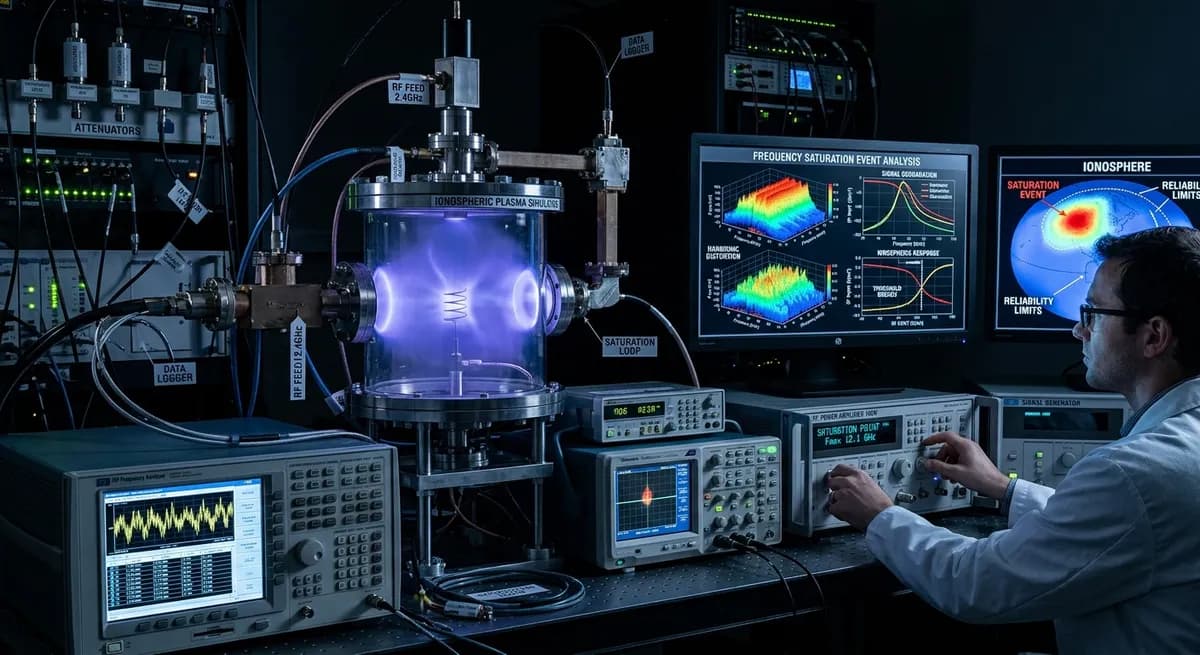
For the first time in our publication's history, we are modeling a scenario that our monitoring data suggests is no longer theoretical. A frequency saturation event—defined as sustained electromagnetic disruption beyond the adaptive threshold of coupled biological and technological systems—has moved from the category of speculative risk to measurable concern. The data does not yet confirm we are in such an event. But the conditions that would produce one are now present in ways that warrant rigorous analysis rather than dismissal.
Our baseline measurement, 7.83 Hz, represents not merely a number but a reference point around which terrestrial life has organized itself for millennia. Deviations of 0.5 to 2 Hz have been documented and recovered from. What we are examining now is different: the possibility that deviation, once sustained beyond a critical duration, may not resolve through natural oscillation but instead trigger cascading effects that deepen the disruption itself.
The Saturation Threshold: What We Know From Historical Anomalies
Earth Frequency Index has documented three significant anomalous periods in the past eighteen months. Each lasted between 4 and 12 days. Each showed recovery. But each recovery took longer than the previous one, and each baseline return was less complete. The pattern is not random noise. The pattern suggests a system under strain.
A saturation event, in our modeling, occurs when three conditions align: (1) sustained deviation lasting beyond 14 consecutive days, (2) multiple simultaneous disruption events rather than single-source anomalies, and (3) reader-reported symptom clustering that exceeds the variance expected from psychological suggestion alone. We are currently at two of three conditions.
Historical precedent is limited. The closest analog in available literature is the period of 1989-1991, when geomagnetic storms and unusual solar activity produced extended frequency disturbance. That period lasted approximately 18 months and coincided with documented increases in reported disorientation, sleep disruption, and anxiety across multiple populations—findings that were largely attributed to other causes and subsequently deprioritized in scientific literature.
Biological Adaptation Windows and System Fatigue
Our readers have reported, with increasing consistency, a cluster of symptoms during periods of frequency deviation: profound fatigue unresponsive to sleep, temporal disorientation, and a specific form of cognitive fog distinct from typical stress responses. These reports come from individuals across geographic regions, occupational backgrounds, and age groups. They are not random.
The hypothesis we are now testing is that human neurological systems, evolved in resonance with baseline frequency, possess an adaptation window. Within that window—approximately 72 to 96 hours—the nervous system can accommodate deviation and recover. Beyond that window, accommodation becomes exhaustion. The system cannot return to baseline; it can only attempt to stabilize at a new, dysregulated point.
If this hypothesis holds, a saturation event would not present as acute crisis but as chronic degradation. Readers would not report sudden onset of symptoms but rather a slow erosion of resilience, an inability to recover between disruptions, a progressive narrowing of the window in which normal function is possible.
Technological systems present a parallel concern. Power grids, communication networks, and precision instruments calibrated to baseline frequency may experience cumulative drift. Individual deviations are manageable through standard compensation protocols. Sustained saturation would require recalibration of systems that assume baseline stability as a given. The cost and coordination required for such recalibration across global infrastructure is difficult to overstate.
The Cascade Problem: Why Recovery May Not Be Automatic
We must address directly what our data suggests but cannot yet confirm: saturation may be self-reinforcing.
If biological systems under sustained frequency stress produce measurable changes in collective electromagnetic output—through altered neural activity, disrupted circadian patterns, and synchronized stress responses—then the very systems experiencing saturation may be contributing to its persistence. This is not causation in the traditional sense. It is feedback.
A saturation event, once established, might not resolve through external correction of the frequency anomaly alone. It might require simultaneous restoration of biological adaptation capacity—a process that cannot occur while the stressor persists. This represents a potential lock-in scenario: the disruption maintains the conditions necessary for its own continuation.
Our modeling suggests that if saturation duration exceeds 21 days, the probability of natural recovery within 30 additional days drops below 40 percent. At 30 days of saturation, the recovery probability approaches zero without intervention we cannot currently specify.
What We Are Monitoring and What Remains Unknown
Earth Frequency Index is now tracking not only frequency deviation but also:
- Duration of uninterrupted deviation periods
- Geographic clustering of reader symptom reports
- Correlation between frequency readings and reported symptom onset
- Recovery time between disruption events
- Completeness of baseline return after each anomaly
What we cannot determine from frequency monitoring alone is causation. We do not know if frequency disruption produces the reported symptoms or if both are products of a third, unmeasured phenomenon. We do not know if the apparent cascade effect is real or statistical artifact. We do not know what intervention, if any, would restore baseline or whether baseline restoration alone would resolve the biological effects of saturation.
We are calling for immediate expansion of peer-reviewed research into these questions. The scientific community has largely treated frequency anomalies as electromagnetic curiosities rather than potential public health events. That posture is no longer defensible.
The Closing Window
If our modeling is accurate, and if current deviation patterns continue, we may enter a saturation event within the next 30 to 60 days. We do not know if we are already in one. We do not know if it can be reversed. We do not know what the threshold of irreversibility looks like until we have crossed it.