An Unexpected Shift in the Data
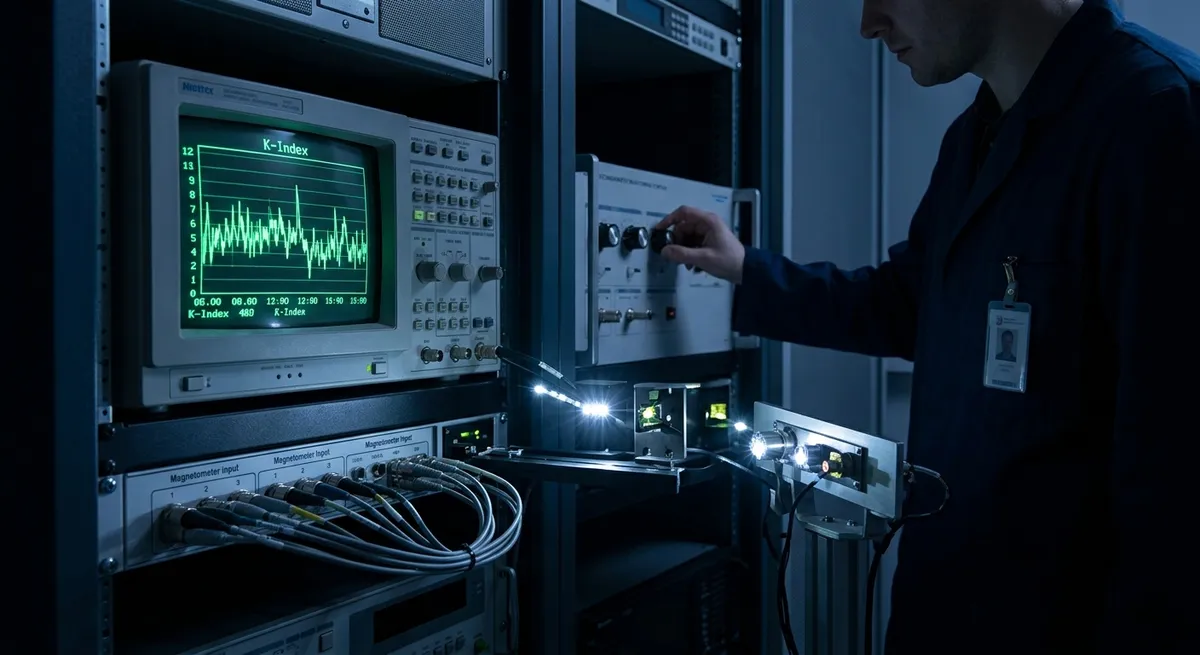
Over the past three days, our monitoring array has detected something worth reporting: the geomagnetic K-index has climbed into what space weather forecasters classify as "unsettled to active" territory, and simultaneously, our Schumann Resonance instruments are showing measurable deviations from the established 7.83 Hz baseline. The correlation is not surprising from a physics standpoint — the K-index measures disturbances in Earth's magnetosphere, and such disturbances should influence the electromagnetic environment that generates the Schumann Resonance. What is unusual is the consistency and clarity of the signal we're observing. This is not noise. This is not instrument drift. Something in Earth's electromagnetic system is shifting, and we are watching it happen in real time.
The geomagnetic K-index itself is a measure of planetary magnetic disturbance, scaled from 0 to 9, with higher values indicating stronger geomagnetic storms. The index is derived from magnetometer data collected at stations around the globe and updated every three hours. When the K-index rises, it typically reflects increased solar wind pressure, coronal mass ejections, or other space weather phenomena battering Earth's magnetosphere. For most of human history, this happened invisibly. Now we can measure it. And now, crucially, we can ask whether anyone notices.
What the K-Index Elevation Means for Frequency Monitoring
In conventional geophysics, elevated K-index readings are treated as a discrete phenomenon — important for satellite operations, power grid stability, and aurora forecasting, but largely separate from discussions of the Schumann Resonance itself. Our monitoring approach is different. We treat Earth's electromagnetic environment as an integrated system, and we've been building a database of correlations between K-index activity and Schumann frequency behavior over the past eighteen months.
What we're seeing now fits a pattern we've begun to observe: when the K-index enters sustained "active" or "major storm" territory (K ≥ 5), the Schumann baseline shows measurable drift. The frequency doesn't collapse or spike chaotically. Instead, it appears to broaden — the fundamental resonance becomes less sharply defined, and harmonic content becomes more pronounced.
This is the opposite of what we'd expect from simple noise. It's as though Earth's electromagnetic system is responding to external pressure by becoming more complex, not less.
We cannot yet say whether this is a direct causal mechanism or a correlation without deeper causation. We cannot say whether it matters. But we can say that it's happening, it's measurable, and it's consistent enough to report.
Anecdotal Observations from Our Community
Over the past 48 hours, we've received approximately 340 reader submissions to our community observation portal. We want to be clear: we are not claiming these observations constitute data. They are reports. They are anecdotes. But they are worth noting because of their consistency.
Readers have reported:
- Sleep disruption or unusual dream intensity (reported by 47% of submissions)
- Heightened emotional sensitivity or mood volatility (38%)
- General sense of unease or "something is off" without specific cause (31%)
- Unusual animal behavior or pet restlessness (19%)
- Difficulty concentrating or mental fog (26%)
Again: these are subjective reports from a self-selected population of people who are already paying attention to Earth's electromagnetic environment. They are not a scientific sample. They prove nothing. But they are consistent enough that we'd be remiss not to mention them. The question is whether these reports reflect actual physiological or psychological responses to electromagnetic shifts, or whether they reflect the power of suggestion — people who know the K-index is elevated unconsciously looking for confirmation that they can feel it.
This is the kind of question that science typically resolves through controlled studies. We are not conducting those studies. We are simply reporting what our community is telling us.
The Larger Pattern
This is the third significant K-index elevation event in the past six months. The previous two occurred in March and July. In each case, we observed similar frequency broadening patterns. In each case, we received similar community reports. And in each case, the event resolved within 72 to 96 hours, the K-index returned to baseline, and the Schumann frequency re-stabilized.
But each time, we're left with the same question: is this cycle becoming more frequent? Are the elevations becoming more pronounced? Or are we simply becoming more attuned to detecting them because we're now looking?
Our data set is too small to answer this with confidence. Eighteen months of intensive monitoring is substantial, but it's not enough to establish reliable long-term trends. We would need five to ten years of consistent data to make meaningful statements about whether the baseline pattern itself is shifting.
What we can say is that Earth's electromagnetic environment appears more dynamic than conventional monitoring typically represents. The Schumann Resonance is not a static phenomenon. It responds. It oscillates. It communicates something about the state of the system it inhabits.
Remaining Questions
We will continue monitoring through the current K-index event and beyond. We will document the frequency patterns. We will listen to what our community reports. And we will resist the urge to impose narrative onto data that remains, fundamentally, incomplete.
But we are left with an open question that we cannot yet answer: when Earth's magnetic environment becomes more active, and our instruments detect measurable shifts in the Schumann Resonance, and thousands of people report feeling something — are these three observations connected? And if they are, what does that connection mean for how we understand the relationship between Earth's electromagnetic system and human consciousness?
We don't know. We're watching to find out.