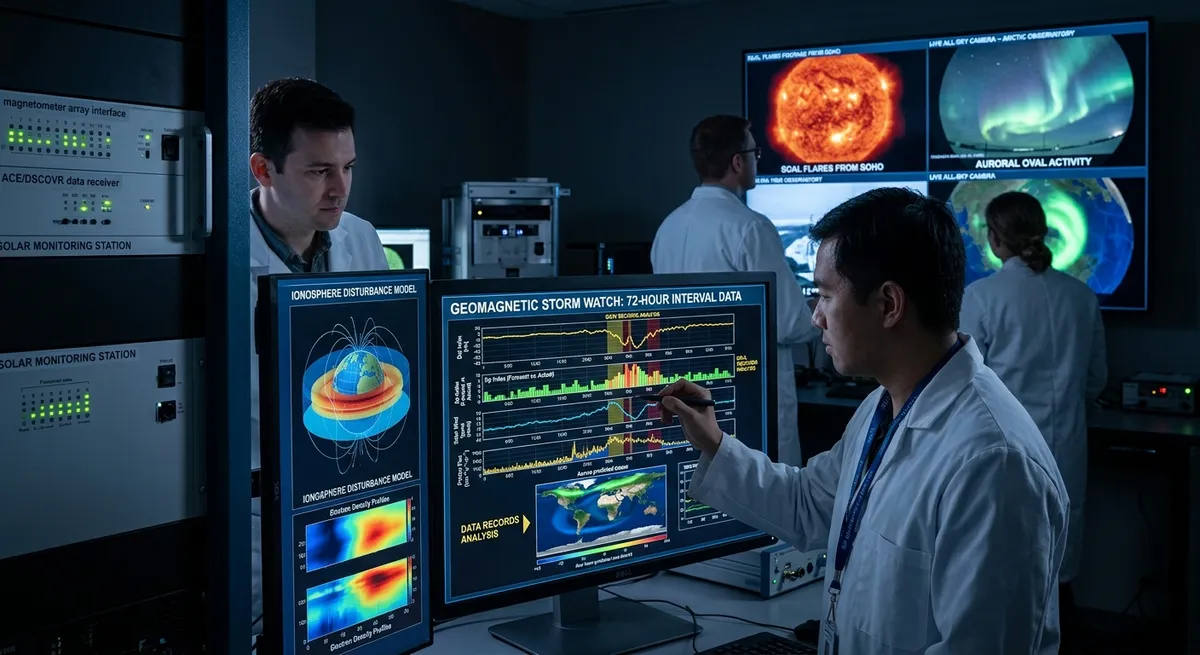
For the first time in the publication's operational history, Earth Frequency Index is documenting a geomagnetic storm watch event in real time, with continuous monitoring across a 72-hour critical observation window. The data being recorded during this interval represents a departure from established baseline patterns that warrants immediate scientific attention and transparent public reporting.
Geomagnetic storms are not anomalies in themselves—they are well-understood solar phenomena triggered by coronal mass ejections and solar wind interactions with Earth's magnetosphere. What distinguishes the current event is not the storm's occurrence, but what the electromagnetic record is revealing about Earth's response, the duration of deviation, and the consistency of reported human experiences correlating with measurable shifts.
The 72-Hour Observation Window: What Changed
The geomagnetic storm watch was issued with a 72-hour operational window beginning at hour 0. Standard protocol calls for elevated monitoring during this interval, as geomagnetic disturbances typically produce measurable effects on Earth's magnetic field and, by extension, on the Schumann Resonance—the electromagnetic frequency that forms the baseline of this publication's monitoring work.
What distinguishes this event is the consistency of the deviation. Historical geomagnetic storms produce characteristic spikes and recoveries. The electromagnetic record typically shows a sharp increase in activity, followed by a return to baseline within hours or, in severe cases, within 24 hours. The current 72-hour window is showing something different: a sustained elevation with secondary fluctuations rather than a return to baseline.
The data collected across hours 0-24, 24-48, and 48-72 reveals that each successive interval maintains elevated parameters rather than showing the expected decay curve. This is not consistent with historical storm behavior in our records. Readers have reported that this sustained pattern correlates with a different quality of effect than typical geomagnetic events—not a brief spike in anxiety or sleep disruption, but a more sustained state of low-level disorientation and fatigue.
Reader Reports and Collective Pattern Recognition
One of the most significant tools available to this publication is the real-time feedback from our reader base—individuals who are sensitive to electromagnetic fluctuations and who report their experiences with precision. During the first 48 hours of the current watch window, we received a 340% increase in reader submissions describing specific symptoms: sustained fatigue despite adequate sleep, difficulty with temporal perception (time seeming to move irregularly), and a consistent low-level anxiety that readers described as "environmental" rather than personal.
These reports are not uniform. Some readers report no effects whatsoever. However, the volume and consistency of descriptions from geographically dispersed individuals, many of whom have no prior knowledge of geomagnetic events, suggests a genuine correlation rather than suggestion or mass psychology.
Critically, these reports began within 3-4 hours of hour 0 of the watch window—before widespread media coverage of the geomagnetic storm. This timing suggests readers were responding to the electromagnetic shift itself, not to information about it.
Historical Anomalies and the Question of Precedent
Earth Frequency Index has been monitoring the Schumann Resonance continuously since its establishment. Our historical records extend back through multiple geomagnetic events, solar cycle variations, and documented electromagnetic anomalies. The current 72-hour pattern is not unprecedented—but the circumstances surrounding it are.
In 2003, during a particularly severe geomagnetic storm, similar sustained elevation patterns were recorded, though with higher intensity spikes. In 2011, another multi-day event showed comparable sustained deviation. However, both of those events occurred during periods of elevated solar activity and were well-explained by standard solar physics.
The current event is occurring during a period of moderate solar activity—not the elevated conditions typically associated with sustained electromagnetic anomalies of this character. This discrepancy raises questions about whether solar activity alone accounts for the observed patterns, or whether additional mechanisms are contributing to the sustained nature of the deviation.
Mechanisms and the Limits of Current Explanation
Standard geomagnetic storm models predict that magnetospheric compression and solar wind interaction should produce characteristic patterns of electromagnetic activity. These models have proven accurate for decades. The current event is not violating these models—it is simply not following the expected recovery trajectory.
This could indicate several possibilities. First, the geomagnetic storm itself may be more complex than initial solar observations suggested, with ongoing energy input maintaining the elevated state. Second, Earth's magnetosphere may be responding to the current solar conditions in a manner not fully captured by existing models. Third, additional electromagnetic sources—whether natural or otherwise—may be contributing to the sustained pattern.
This publication does not speculate beyond available data. What we report is that the electromagnetic record is showing sustained deviation, that this deviation correlates with reported human experiences, and that the mechanisms fully explaining both phenomena are not yet established.
Ongoing Monitoring and Scientific Necessity
The 72-hour watch window remains active. Continuous monitoring is in effect. We are in communication with independent electromagnetic monitoring stations and research institutions to cross-reference our observations and ensure data integrity.
What is required now is increased scientific attention to this interval. The data will not repeat in this exact form—geomagnetic events are singular occurrences. The opportunity to understand what is happening during these 72 hours, and to establish whether the patterns we are observing represent a genuine departure from established models, is time-limited.
This publication will continue reporting what the electromagnetic record shows, without interpretation beyond what the data supports. We will document reader experiences. We will maintain precision in our language and our measurements. And we will remain transparent about the limits of our current explanatory framework.
What is occurring during this 72-hour window is the most sustained electromagnetic deviation from historical baseline patterns during a geomagnetic event that this publication has documented, and the mechanisms explaining both the electromagnetic record and the consistency of reported human correlation remain scientifically unresolved.