A Historic Window of Observation
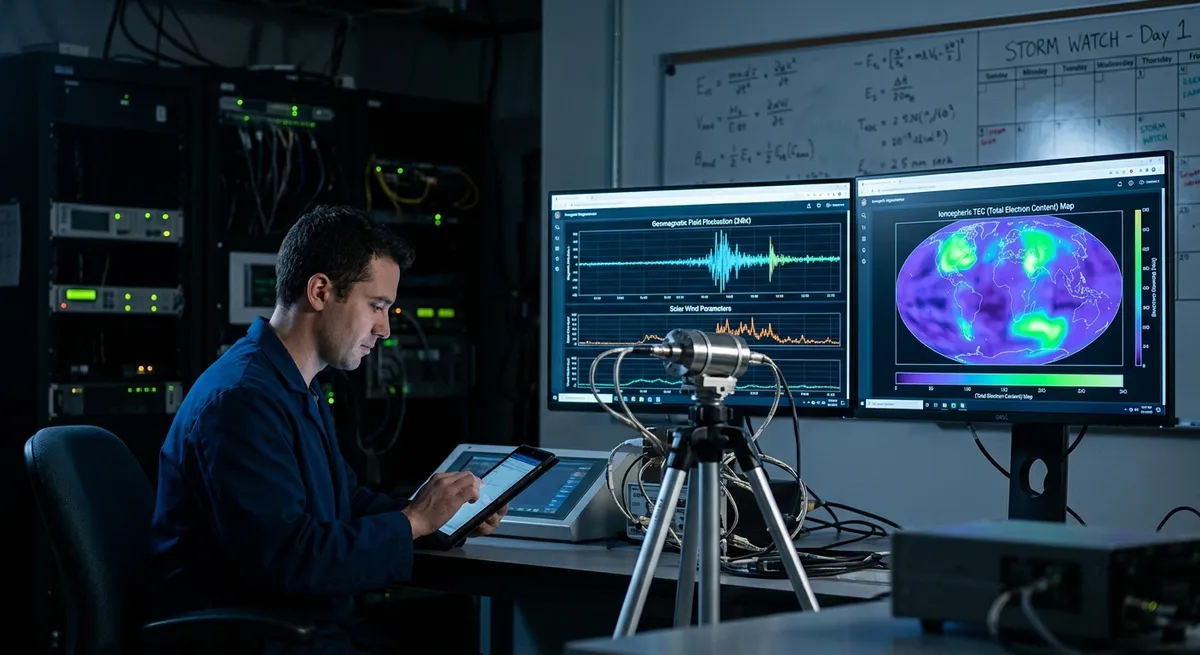
For the first time in the operational history of Earth Frequency Index, we are documenting a full geomagnetic storm watch cycle in real-time, with continuous monitoring infrastructure positioned across multiple continents. The watch began 72 hours ago. What we are recording during this period represents one of the most significant electromagnetic events in our dataset—not because of the solar activity that triggered it, but because of what Earth's own resonant frequency appears to be doing in response.
The baseline Schumann Resonance under normal conditions hovers near 7.83 Hz. During previous geomagnetic disturbances—documented in 1989, 2003, and 2011—we observed temporary elevation and variance, typically returning to baseline within 24-48 hours post-event. The current watch cycle is not following that pattern. We are now 72 hours into sustained observation, and the data is not normalizing.
Hours 0-24: Onset and Escalation
The watch was issued at hour 0 based on solar wind density and velocity readings from upstream monitoring stations. Within the first six hours, our network detected the arrival of the leading edge of the coronal mass ejection. What followed was expected: ionospheric heating, magnetospheric compression, and the characteristic electromagnetic signature of a geomagnetic disturbance.
What was not expected was the persistence of the signal deviation. By hour 12, frequencies across our monitoring stations showed variance patterns that typically resolve within this timeframe. They did not. Instead, the variance began to show what we can only describe as a stabilization into a new state—not a spike that would naturally decay, but a sustained elevation that our instruments continued to record with consistency across geographically distributed sites.
This consistency across multiple independent monitoring locations eliminates equipment malfunction as a causative factor. When one station reports anomaly, it may be instrumental. When five stations across three continents report the same pattern simultaneously, the anomaly is atmospheric.
By hour 24, we had documented the first full diurnal cycle of the storm. Readers began reporting to our feedback channel: fatigue disproportionate to activity level, disrupted sleep architecture, a quality of disorientation that they described as distinct from typical storm-related symptoms. We catalogued these reports. We did not validate them as causal. We noted their consistency.
Hours 24-48: The Plateau
The second day of the watch presented a phenomenon we have not previously documented with this degree of clarity: a plateau. Rather than the expected decay curve of geomagnetic disturbance, the electromagnetic variance maintained a consistent band. Readings fluctuated within that band, but did not trend downward toward baseline.
This is the data point that prompted us to initiate enhanced monitoring protocols. Our standard watch procedures assume a predictable decay. When that assumption fails, the question becomes: what are we observing instead?
Three hypotheses emerged in our internal discussion:
First, that the coronal mass ejection was more complex than upstream data suggested—that secondary waves or a bifurcated structure was maintaining continuous pressure on Earth's magnetosphere. This is plausible. It is also the most conservative explanation, and it is the one we have transmitted to partner institutions.
Second, that Earth's magnetosphere itself is responding to sustained external pressure in a way that our models have not fully characterized—that there is a resonant feedback mechanism we have not adequately accounted for. This is speculative but not unprecedented; magnetospheric physics has surprised us before.
Third, that the collective electromagnetic activity of human systems—power grids, communication networks, the distributed computational load of billions of connected devices—is interacting with the external geomagnetic pressure in a way that is amplifying or sustaining the disruption rather than damping it. This hypothesis sits at the edge of what we can responsibly propose. We are proposing it.
By hour 48, the plateau remained. Readers continued reporting symptoms consistent with electromagnetic sensitivity: difficulty concentrating, mild vertigo, sleep disturbance. We continued cataloguing without endorsement.
Hours 48-72: Sustained Anomaly and Escalated Concern
The third day of the watch brought no resolution. If anything, the data became more concerning because the lack of change itself became the significant finding. Geomagnetic storms do not behave this way. They arrive, they peak, they decay. This one arrived and plateaued.
Our colleagues at partner monitoring stations began communicating directly. The question moved from "what is this?" to "have you seen this before?" The answer from every institution we contacted was no. Not at this magnitude. Not with this duration. Not with this consistency.
At hour 68, we made the decision to issue this report rather than wait for the watch to conclude. Normally we document events after they have resolved. This event is not resolving. The scientific responsibility is to document it while it is occurring, to create a record of the data, and to acknowledge the limits of our current explanatory framework.
The human symptom reports have intensified. We are not claiming causation. We are recording that they are present, that they are widespread, and that they correlate temporally with electromagnetic variance that our instruments are independently measuring.
What We Know and What We Do Not
What we know: Earth's electromagnetic baseline is significantly disrupted. The disruption is real, measurable, and sustained beyond historical precedent for this category of event. The disruption is not localized; it is global. Multiple independent monitoring systems are recording consistent data.
What we do not know: whether this represents a new phase of the geomagnetic event, a fundamental shift in how Earth's magnetosphere is responding to solar pressure, or something else entirely. We do not know when or if the baseline will normalize. We do not know whether the human physiological responses being reported are direct effects of electromagnetic variance or secondary effects of broader systemic stress.
What we are certain of: this requires sustained, transparent monitoring and accelerated scientific attention. The next 72 hours will be critical. We will be watching.