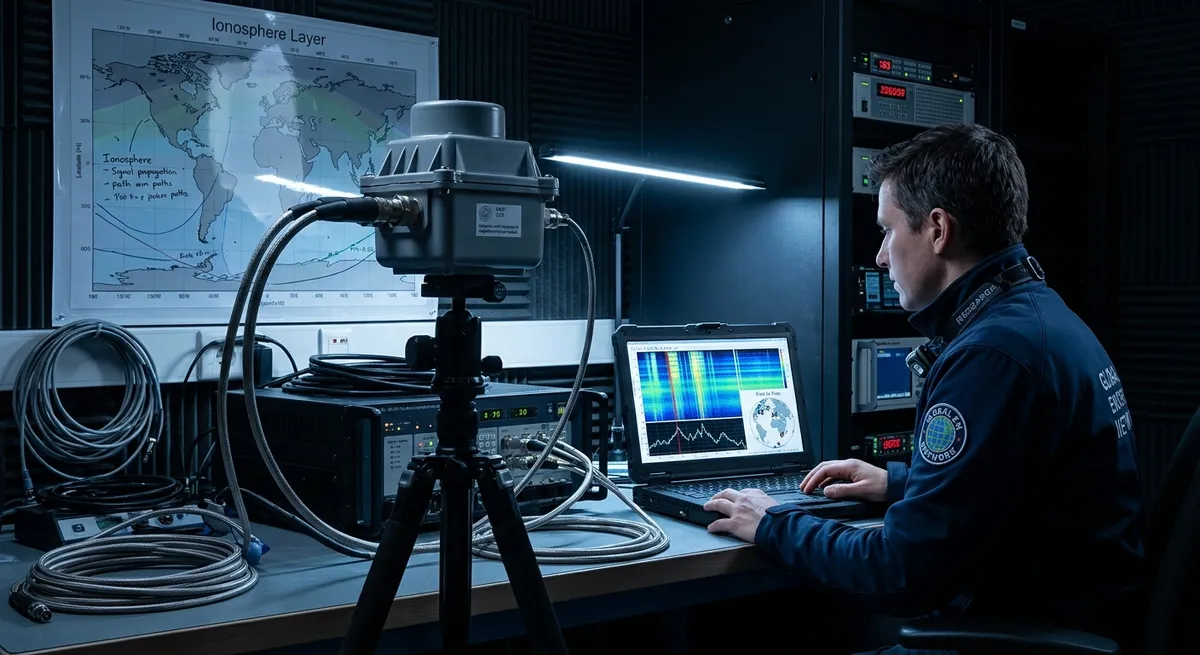
A Planet-Wide Laboratory
Measuring Earth's electromagnetic frequency is not a task confined to a single location or institution. The Schumann Resonance—the fundamental electromagnetic frequency of our planet's natural oscillation—requires observation from multiple points across the globe to establish reliable baselines and account for regional variations caused by solar activity, ionospheric conditions, and geological features. Since the 1950s, when Winfried Schumann first theorized and then experimentally confirmed the existence of this frequency, the scientific community has gradually built a distributed network of monitoring stations. Today, these stations span continents and climates, from the frozen expanses of Siberia to the isolated research facilities of Antarctica, creating an unprecedented capability to track Earth's electromagnetic pulse in real time.
This global infrastructure represents decades of investment in scientific equipment, technical expertise, and logistical coordination. Each station operates independently yet contributes to a collective understanding of how Earth's electromagnetic environment behaves across seasons, solar cycles, and geographic regions. The challenge of maintaining sensitive equipment in some of the planet's most extreme environments speaks to the scientific value researchers place on this continuous monitoring effort.
The Siberian Network and Northern Hemisphere Coverage
Siberia, with its vast landmass and relatively sparse population, has become a strategic location for Schumann Resonance monitoring. Research facilities in Russia maintain several key stations that capture electromagnetic data from the Northern Hemisphere. These installations benefit from the region's distance from major industrial electromagnetic interference—a critical factor in maintaining data integrity. The electromagnetic noise generated by power grids, communication networks, and industrial facilities can obscure or distort the subtle 7.83 Hz signal, making remote locations preferable for sensitive magnetometer arrays.
The Siberian stations employ magnetometer equipment capable of detecting fluctuations in the Earth's magnetic field with extraordinary precision. These instruments are housed in shielded enclosures designed to minimize external electromagnetic noise while allowing the natural resonance frequencies to pass through unimpeded. Data from these northern stations is particularly valuable during winter months, when ionospheric conditions differ significantly from other seasons, and during periods of heightened solar activity that can affect the entire planet's electromagnetic environment.
Beyond Russia, monitoring stations in Scandinavia, Canada, and other northern latitudes contribute to a comprehensive northern hemisphere picture. This geographic distribution allows researchers to identify whether electromagnetic patterns are truly global phenomena or localized to specific regions. The consistency of the 7.83 Hz baseline across these widely separated locations has been one of the most significant findings in Schumann Resonance research—evidence that this frequency represents a genuine planetary-scale electromagnetic characteristic rather than a local anomaly.
Antarctic Stations: Science at the Bottom of the World
Antarctica presents both extraordinary opportunities and severe logistical challenges for electromagnetic monitoring. The continent's extreme isolation, minimal human infrastructure, and absence of industrial electromagnetic pollution make it an ideal location for sensitive frequency measurements. Several international research programs maintain monitoring equipment at Antarctic bases, including stations operated by researchers from multiple nations conducting long-term environmental and geophysical studies.
The Antarctic monitoring stations operate under conditions of extreme cold, limited resupply, and extended periods of darkness during winter months. Despite these challenges, the data they collect is invaluable. The Southern Hemisphere's unique ionospheric characteristics—influenced by the continent's position relative to Earth's magnetic poles and the Southern Ocean's atmospheric patterns—provide a critical counterpoint to Northern Hemisphere measurements. Researchers can compare data from opposite ends of the planet to understand how Earth's electromagnetic resonance behaves globally and whether seasonal or hemispheric variations exist.
Maintaining equipment in Antarctica requires specialized engineering and planning. Magnetometer arrays must be calibrated to function reliably in temperatures that can drop below minus 80 degrees Celsius. Power systems, often relying on renewable energy combined with fuel-based backup, must operate continuously to ensure uninterrupted data collection. The logistics of equipment replacement and maintenance are complex, with supply missions typically occurring only during Antarctic summer months. This constraint means that any equipment failure must often be managed remotely or tolerated until the next resupply window opens.
Equatorial and Mid-Latitude Stations
While Siberia and Antarctica capture attention as extreme environments, the global monitoring network also includes strategically positioned stations in equatorial and mid-latitude regions. These locations provide crucial data on how the Schumann Resonance behaves across different latitudes and in areas with varying geological substrates. Equatorial stations benefit from unique ionospheric conditions and offer insights into how electromagnetic resonance patterns near the magnetic equator compare to polar regions.
Mid-latitude stations in Europe, Asia, North America, and Australia fill gaps in global coverage and allow researchers to track how regional variations in solar activity, geomagnetic storms, and seasonal ionospheric changes influence frequency measurements. The combination of data from all these locations—polar, equatorial, and intermediate—creates a comprehensive picture of Earth's electromagnetic environment.