Since Winfried Schumann's theoretical prediction in 1952 and subsequent experimental confirmation by Herbert König in 1954, monitoring Earth's natural electromagnetic frequency has evolved into a sophisticated scientific discipline. Today, a distributed network of research institutions and independent monitoring stations worldwide continuously measure the Schumann Resonance—the fundamental electromagnetic frequency generated by lightning activity within the Earth-ionosphere cavity. Understanding how these measurements are conducted, where stations are located, and what methodology ensures data reliability is essential for anyone seeking to grasp the current state of this field.
The Earth-Ionosphere Cavity and Signal Generation
The Schumann Resonance emerges from a natural phenomenon: lightning discharges within the Earth-ionosphere cavity generate electromagnetic waves that resonate at specific frequencies. The cavity itself is formed by Earth's conductive surface and the ionosphere, which acts as a reflective boundary approximately 80 kilometers above the planet's surface. When lightning strikes—occurring roughly 40 to 50 times per second globally—it excites electromagnetic waves that travel around the planet within this cavity. These waves constructively interfere at certain frequencies, with the fundamental resonance occurring at approximately 7.83 Hz.
This natural oscillation is not uniform or isolated; it exists within a spectrum of resonant modes. The first mode (7.83 Hz) is the most prominent and most commonly monitored, but higher harmonics exist at roughly 14.3 Hz, 20.8 Hz, 27.3 Hz, and beyond. The intensity and precise frequency of these resonances depend on several factors: the global distribution of thunderstorm activity, seasonal variations in lightning patterns, solar activity, and ionospheric conditions. Accurate measurement requires instruments sensitive enough to detect these subtle electromagnetic signals against background noise.
Magnetometer Technology and Sensor Design
The primary instrument used in Schumann Resonance monitoring is the magnetometer—a device that detects and measures magnetic field variations. Modern monitoring stations typically employ extremely low frequency (ELF) magnetometers, which are specifically engineered to detect electromagnetic signals in the range of 1 to 100 Hz or beyond. The most sensitive magnetometers used in this field are induction coil magnetometers, which consist of a coil of wire wound around a ferromagnetic core. When electromagnetic waves pass through the coil, they induce electrical currents proportional to the rate of change of the magnetic field.
The sensitivity of these instruments is remarkable. High-quality research-grade magnetometers can detect magnetic field variations on the order of picoteslas (trillionths of a tesla), enabling researchers to distinguish the Schumann Resonance signal from background electromagnetic noise generated by power lines, radio transmitters, and industrial equipment. To achieve this sensitivity, magnetometers are often installed in locations chosen for their low electromagnetic noise environment—remote areas away from major power infrastructure, communication towers, and urban development.
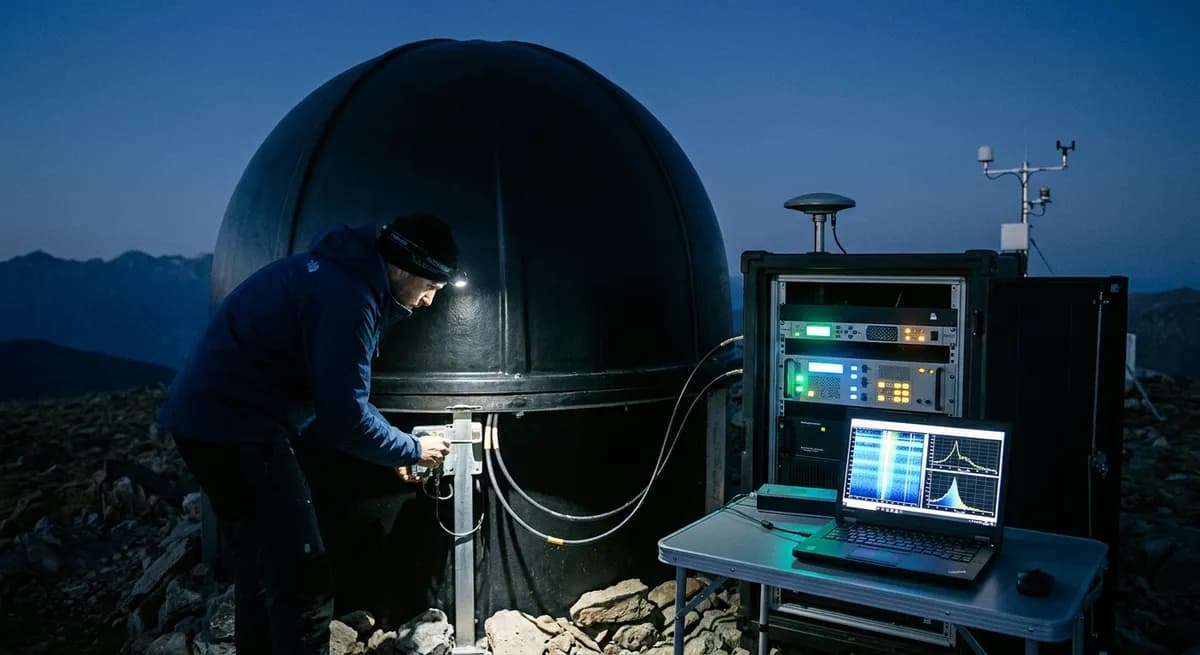
Station design extends beyond the sensor itself. A complete monitoring installation includes signal conditioning electronics that amplify and filter the magnetometer output, analog-to-digital converters that transform continuous signals into discrete digital data, data logging systems that record measurements, and often internet connectivity for real-time data transmission to central analysis facilities. Proper grounding and shielding of all components is critical to minimize interference from external electromagnetic sources.
Global Station Network and Geographic Distribution
The infrastructure for monitoring the Schumann Resonance is distributed across multiple continents, though not uniformly. Major research institutions in Europe, North America, Asia, and Australia maintain dedicated monitoring facilities. Universities and research centers in Germany, the United States, Russia, and Japan have established some of the longest-running continuous measurement programs, with some stations operating for decades without interruption.
The geographic distribution of stations serves important scientific purposes. Because the Schumann Resonance is a global phenomenon—electromagnetic waves circumnavigate the planet—multiple measurement points allow researchers to verify signal consistency across different locations and detect any regional variations. Stations positioned at different longitudes also capture the effects of local thunderstorm activity and seasonal weather patterns on global resonance characteristics. Additionally, having stations at varying latitudes provides data on how ionospheric conditions change with geography and geomagnetic latitude.