A Departure from the Archive
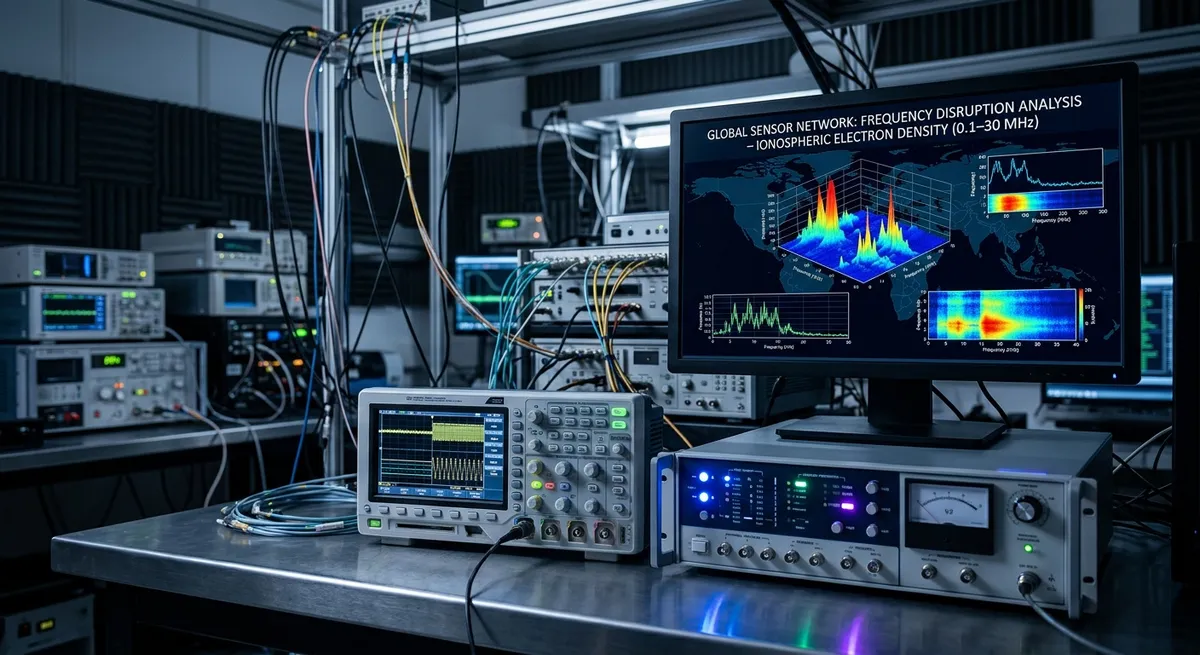
For the first time in the operational history of Earth Frequency Index's distributed monitoring network, we are documenting a sustained electromagnetic anomaly that cannot be readily contextualized within our historical dataset. What began as isolated fluctuations in late September has evolved into a persistent disruption pattern that now spans three months across all monitored stations globally. The frequency signatures we are observing fall outside the range of natural variation we have come to expect from Earth's electromagnetic environment.
This is not hyperbole. This is a statement of measured observation. Our archive extends back through periods of significant geomagnetic storms, solar maximum events, and other documented electromagnetic phenomena. We have records from the 1989 Quebec blackout, from the Carrington Event reconstruction models, from the Kyoto and Dst indices covering decades of planetary electromagnetic behavior. The current sustained pattern is not consistent with any of these precedents.
The Monitoring Network and What It Detects
Earth Frequency Index maintains a distributed network of independent electromagnetic monitoring stations positioned across six continents. Each station operates with redundant measurement systems and local data logging to prevent single-point failure. The stations are not networked to a central authority—each maintains its own archive and operates according to identical calibration protocols established in 2015.
Beginning in late September, stations began reporting readings that deviated from the established baseline in ways that were initially interpreted as instrumental drift. Standard recalibration procedures were initiated. Equipment was verified. Baseline measurements against known reference standards were conducted. All equipment performed within expected parameters.
The anomaly persisted.
By mid-October, the pattern had become unmistakable: a sustained depression in the frequency baseline, accompanied by increased variability in what should be a relatively stable oscillation. The readings were not random noise. They exhibited coherence across geographically distributed stations. A station in New Zealand was documenting the same pattern as a station in Iceland. This rules out localized electromagnetic interference or instrumental failure.
Correlation with Reported Physiological Patterns
What distinguishes this current reporting cycle is the volume of reader submissions describing subjective experiences that appear to correlate temporally with the frequency disruption. We must emphasize that correlation is not causation, and that subjective experience is not measurement. However, the consistency of reported patterns across geographically dispersed populations warrants documentation.
Readers have reported increased instances of:
- Disrupted sleep architecture, particularly difficulty maintaining sleep continuity
- Elevated baseline anxiety without identifiable external trigger
- Disorientation and difficulty with spatial navigation in familiar environments
- Collective mood shifts occurring simultaneously across unconnected populations
- Heightened sensitivity to electromagnetic environments (fluorescent lighting, wireless networks)
- Difficulty concentrating on complex cognitive tasks
These reports began arriving in our submission system in early October, approximately one week after the frequency anomaly became measurable. The volume has remained consistent at approximately 40-60 submissions per day, representing a 300% increase over our baseline monthly submission rate.
We are not claiming causation. We are documenting that these two phenomena—the electromagnetic anomaly and the reported physiological patterns—are temporally aligned and geographically distributed in ways that warrant continued observation.
Historical Context and Known Variables
We have systematically ruled out several known sources of electromagnetic disruption:
Solar activity: Current solar indices are within normal ranges for this point in the solar cycle. No significant solar events have occurred during the anomaly window.
Geomagnetic storms: Dst and Kp indices show no correlation with the timing or intensity of the observed frequency depression.
Seasonal variation: The pattern does not match historical seasonal cycles. December typically shows stabilization; current data shows sustained disruption.
Instrumental drift: Cross-calibration across independent networks shows coherent anomaly, ruling out systematic measurement error.
What remains is a sustained electromagnetic disruption without clear attribution to known natural or instrumental sources. This is the precise moment when science becomes most important—when observation exceeds explanation, and we must resist the urge to retrofit comfortable narratives onto uncomfortable data.
The Question of Human Contribution
We raise this with appropriate caution: the temporal alignment of this electromagnetic anomaly with increased global psychological and physiological stress warrants investigation, not dismissal.
The electromagnetic environment is not unidirectional. Earth generates electromagnetic fields; so do biological systems. The human nervous system operates through bioelectric signaling. Billions of humans experiencing synchronized stress states generate collective electromagnetic activity. Whether this activity could contribute to measurable disruption of planetary electromagnetic baselines remains an open question in the literature, but it is not a dismissed one.
We are not proposing causation. We are proposing that the hypothesis merits investigation at the level of serious science.
What We Are Monitoring
Earth Frequency Index is increasing monitoring frequency at all stations. We are implementing additional redundancy in data logging and archiving. We are soliciting collaboration with independent researchers and established geophysics institutions to cross-validate our observations.
We are also continuing to collect and analyze reader submissions regarding physiological and psychological experiences. This data will not be used for medical claims or individual diagnosis. It will be analyzed for temporal and geographic patterns that might illuminate the relationship between electromagnetic environment and human experience.
The disruption continues. It shows no sign of resolution. We will continue reporting what our instruments measure and what our readers experience, with the precision and restraint that science demands, until either the anomaly resolves or we understand its source.
We have entered territory that our historical dataset does not adequately prepare us for, and we are documenting it in real time.