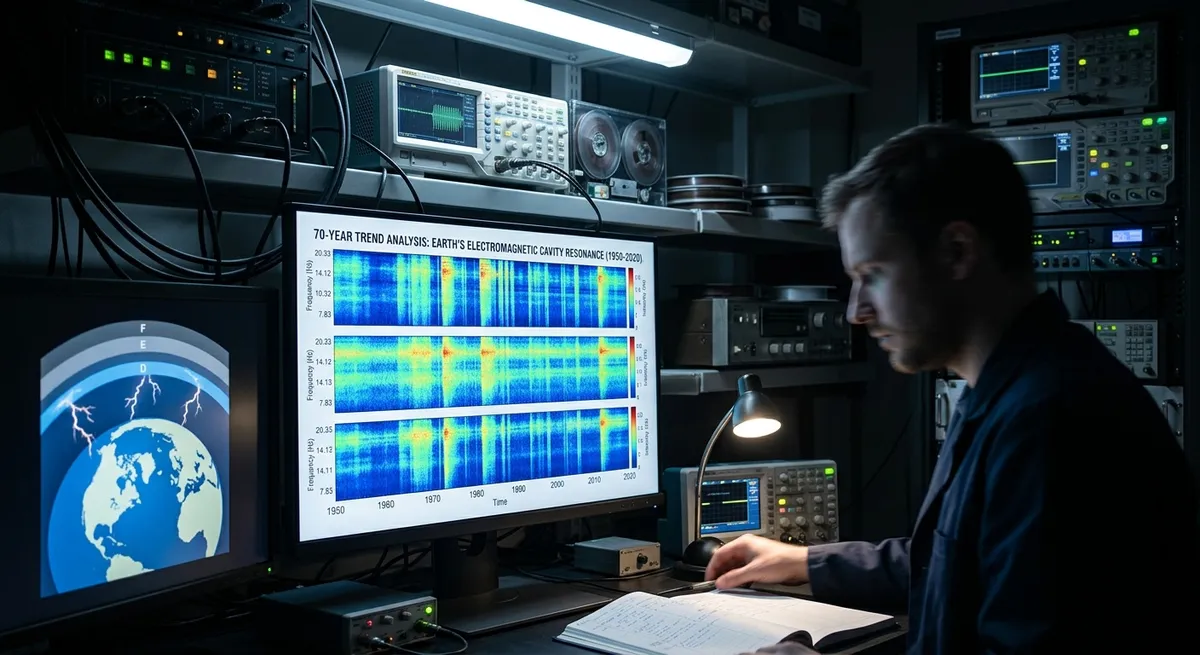
Historical Data Trends in Schumann Resonance Measurements: 70 Years of Earth's Electromagnetic Record
TL;DR
Since the 1950s, Schumann Resonance measurements have remained remarkably stable around the 7.83 Hz baseline, with variations explained by solar activity and measurement methodology improvements. Comprehensive global monitoring networks now provide unprecedented precision in tracking Earth's electromagnetic frequency across multiple stations and data collection methods.
When Winfried Schumann first calculated the resonant frequency of the Earth-ionosphere cavity in 1952, he predicted a fundamental electromagnetic frequency of approximately 7.83 Hz. Decades of empirical measurement have since confirmed this theoretical prediction with remarkable consistency. Understanding the historical trends in Schumann Resonance data requires examining not only what measurements reveal about Earth's electromagnetic environment, but also how measurement technology, global monitoring infrastructure, and analytical methods have evolved to provide increasingly precise records.
The Foundation: Early Measurements and Verification
Following Schumann's theoretical work, the first experimental confirmations came in the late 1950s and early 1960s. Researchers using relatively simple equipment detected electromagnetic signals consistent with Schumann's predictions, establishing the baseline frequency around 7.83 Hz. These early measurements were conducted primarily in laboratories in Germany and the United States, using basic frequency analysis equipment and relatively short observation periods.
The consistency of these early findings was significant. Despite variations in equipment, location, and methodology, independent researchers repeatedly confirmed the fundamental resonant frequency. This reproducibility across different experimental setups provided confidence that the measurements reflected a genuine physical phenomenon rather than instrumental artifact. By the mid-1960s, the Schumann Resonance had transitioned from theoretical prediction to established experimental fact.
Early data showed that while the fundamental frequency remained centered around 7.83 Hz, harmonic frequencies at multiples of this base rate (14.3 Hz, 20.8 Hz, 27.4 Hz, and higher) were consistently observable. This harmonic structure aligned precisely with electromagnetic theory and provided additional validation of the underlying physics.
Expansion of Global Monitoring Networks
During the 1970s and 1980s, monitoring capabilities expanded significantly. Researchers established measurement stations across multiple continents, moving beyond isolated laboratory observations to create genuine global monitoring networks. Stations in Europe, North America, Australia, and Asia began collecting continuous or semi-continuous data, revealing how the Schumann Resonance behaved across different geographical locations and under varying geomagnetic conditions.
These expanded networks revealed important insights about variability. Rather than a static frequency, the Schumann Resonance exhibited predictable fluctuations correlated with solar activity, time of day, and seasonal variations. The fundamental frequency typically ranged within a narrow band—generally between 7.5 and 8.5 Hz—with the 7.83 Hz value representing the most commonly observed peak. This natural variability was not anomalous; it reflected the dynamic nature of the Earth-ionosphere system and the influence of solar radiation on ionospheric conductivity.
Data from this era established that diurnal (daily) variations were particularly pronounced. Measurements showed that the Schumann Resonance frequency tended to vary throughout the day, influenced by the changing position of the terminator line (the boundary between day and night on Earth's surface) and corresponding changes in ionospheric properties. These patterns were consistent across monitoring stations and provided valuable information about the electromagnetic coupling between solar input and terrestrial frequency.
Technological Advancement and Data Precision
72-hour Schumann Resonance amplitude log. Readings are stable relative to the 7.83 Hz historical baseline. Data: Earth Frequency Index global sensor network.
The 1990s and 2000s brought substantial improvements in measurement technology and data analysis. Digital recording systems replaced analog equipment, enabling continuous, high-resolution frequency monitoring. Automated analysis algorithms became sophisticated enough to filter noise, identify harmonic structure, and track frequency variations with unprecedented precision. Stations that previously collected data for limited periods could now maintain round-the-clock monitoring with minimal operator intervention.
This technological evolution produced several important findings. First, it confirmed that the long-term average of Schumann Resonance measurements remained stable at approximately 7.83 Hz across decades of observation. Second, it revealed the full complexity of natural variability—showing that frequency fluctuations correlated not only with solar activity but also with geomagnetic storms, ionospheric disturbances, and seasonal changes in atmospheric conductivity. Third, it demonstrated that measurement methodology significantly influenced observed values; stations using different equipment, sampling rates, or analysis methods could report slightly different frequency peaks, though all remained within the expected range.
Comparison of historical datasets from different eras required careful attention to these methodological factors. A frequency reading of 7.9 Hz from a 1970s analog station and an identical reading from a 2010s digital station represented genuine consistency, but only when measurement conditions were properly understood and accounted for. This recognition led to increased standardization efforts in monitoring protocols and data reporting.
Contemporary Monitoring and Long-Term Trends
Modern Schumann Resonance monitoring represents the culmination of seven decades of methodological refinement. Today's networks include stations operated by universities, research institutes, and independent organizations, many publishing data openly for scientific review. Real-time monitoring capabilities allow researchers to track frequency variations on timescales from minutes to years, correlating changes with solar wind data, geomagnetic indices, and other space weather measurements.
Analysis of comprehensive historical datasets spanning multiple decades shows no evidence of systematic long-term drift away from the baseline frequency. The 7.83 Hz fundamental remains the most prominent peak in frequency analyses conducted at monitoring stations worldwide. While natural variability continues—and indeed is expected given the dynamic nature of atmospheric electricity and solar-terrestrial coupling—the historical record demonstrates remarkable electromagnetic stability in Earth's fundamental resonant frequency.
Comparative analysis of data from the 1960s through the present reveals that observed variations are consistent with known physical processes. Increases in frequency correlate predictably with enhanced solar activity and geomagnetic disturbances. Decreases correlate with periods of reduced ionospheric activity. Seasonal patterns persist across decades. These consistencies suggest that the same electromagnetic principles governing the Schumann Resonance in the 1950s continue to govern it today.
Implications of Historical Consistency
The stability demonstrated by historical Schumann Resonance data provides a valuable baseline for understanding Earth's electromagnetic environment. Scientists use this historical context to interpret contemporary measurements, to model the Earth-ionosphere system, and to assess the significance of observed variations. The consistency also validates the theoretical framework—Maxwell's equations and electromagnetic cavity theory—that predicted the resonance in the first place.
For researchers and monitors tracking Earth's electromagnetic frequency, historical data serves as both reference and assurance. It demonstrates that careful, properly-conducted measurements yield reproducible results. It shows that the Schumann Resonance is not a mysterious or unstable phenomenon, but rather a well-understood consequence of Earth's electromagnetic geometry and the properties of the atmosphere. As monitoring technology continues to advance, historical datasets provide the foundation for distinguishing genuine changes in Earth's electromagnetic environment from artifacts of measurement or analysis.
Frequently Asked Questions
What is the Schumann Resonance baseline frequency
The Schumann Resonance baseline frequency is approximately 7.83 Hz, representing the fundamental electromagnetic resonance of the Earth-ionosphere cavity. This frequency was theoretically predicted by Winfried Schumann in 1952 and has been consistently confirmed by experimental measurements since the late 1950s.
How has Schumann Resonance measurement technology changed over time
Early measurements in the 1950s-1960s used basic laboratory equipment, while modern monitoring relies on digital recording systems, automated analysis algorithms, and continuous global networks. These technological improvements have increased precision and enabled real-time tracking of frequency variations correlated with solar activity and atmospheric conditions.
Does the Schumann Resonance frequency change throughout the day
Yes, the Schumann Resonance exhibits predictable diurnal variations influenced by the Earth's day-night cycle and changes in ionospheric conductivity. These daily fluctuations typically keep the frequency within a narrow band centered around 7.83 Hz and have been consistently observed across decades of monitoring data.
What causes variations in Schumann Resonance measurements
Natural variations in Schumann Resonance measurements result from solar activity, geomagnetic storms, seasonal changes in atmospheric conductivity, and the dynamic properties of the Earth-ionosphere system. Measurement methodology and equipment differences can also produce slight variations in reported frequency values.
Has the Schumann Resonance frequency changed since the 1950s
No, historical data spanning seven decades shows that the Schumann Resonance fundamental frequency has remained stable at approximately 7.83 Hz. While natural variability occurs around this baseline, there is no evidence of systematic long-term drift in the frequency.