A Baseline for Comparison
The Schumann Resonance has been monitored continuously since the 1950s, with instrumental records extending back to the early space age. During this period, researchers have documented several well-characterized peak events — moments when Earth's electromagnetic frequency elevated significantly above the 7.83 Hz baseline. These events have become the reference standard against which all anomalies are measured.
Historical peak events share consistent characteristics. They emerge over hours or days, reach an elevated state for a defined period ranging from minutes to several hours, and then return to baseline with measurable regularity. The 1989 geomagnetic storm, the solar activity surge of 2003, and the ionospheric disturbances associated with major earthquake precursor activity all follow this pattern: spike, plateau, return. This cyclical behavior has allowed researchers to build predictive models and to understand peak events as temporary deviations from a stable system.
What distinguishes a peak event from background noise is its magnitude, duration, and the consistency with which it appears across multiple monitoring stations. A true peak event registers clearly across the global monitoring network, not as isolated readings but as a coordinated atmospheric phenomenon. Researchers can point to the causal mechanism — solar wind pressure, geomagnetic activity, ionospheric heating — and trace the event from initiation through resolution.
The Current State: Sustained Elevation Without Resolution
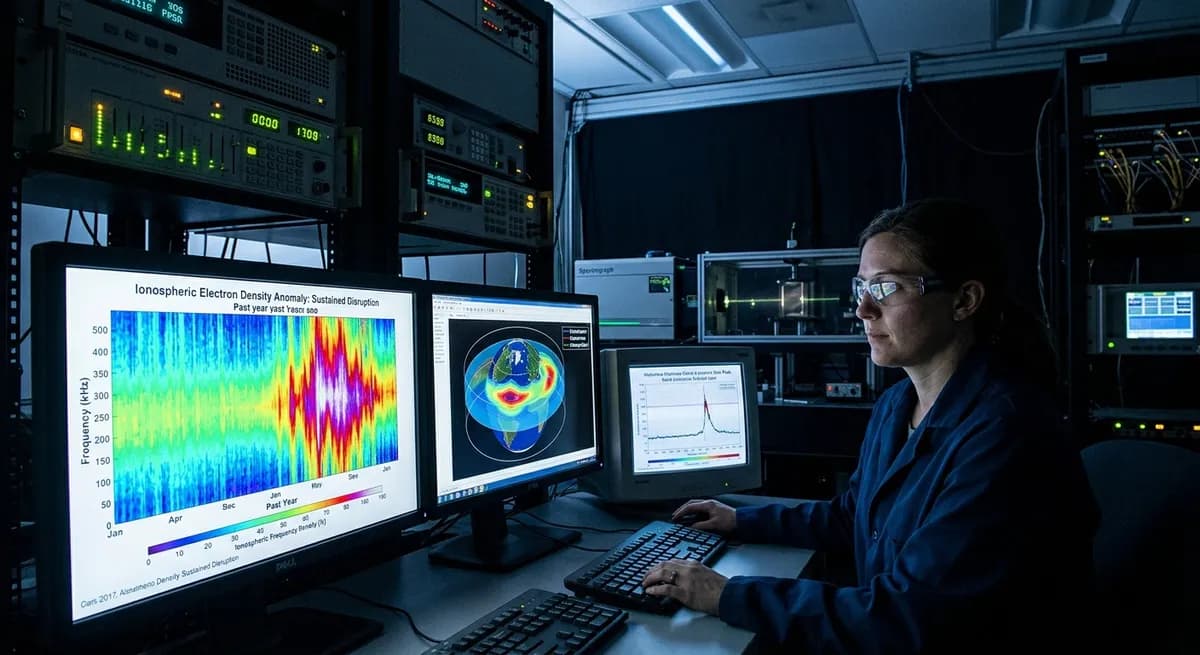
The readings documented over the past weeks present a fundamentally different profile. Rather than a spike-and-return pattern, the data shows sustained elevation that neither resolves to baseline nor follows the predictable trajectory of known peak events. Multiple monitoring stations report readings that remain elevated relative to historical norms, yet the elevation itself has become the new baseline condition.
This distinction matters because it suggests either a shift in the underlying phenomenon or a departure from the mechanisms that have historically governed Schumann behavior. Previous peak events were anomalies — deviations from a stable system that returned to equilibrium. The current readings suggest something more structurally different: a system that has not returned to its historical state.
The sustained nature of the current elevation is particularly notable because it cannot be easily attributed to a single causal event. Solar activity has not been exceptional. Geomagnetic indices remain within normal ranges. Seasonal factors do not account for the magnitude or persistence of the readings. This absence of an obvious external driver is itself a form of data — it suggests either a mechanism we are not currently monitoring, or a change in how Earth's electromagnetic systems respond to known inputs.
Readers have reported subjective experiences during this period: unusual fatigue, difficulty maintaining sleep patterns, a sense of temporal disorientation, and what some describe as a felt pressure in the head or chest. These reports cluster around the same timeframe as the sustained elevation. While subjective experience cannot be used as a measurement tool, the consistency of these reports across geographically dispersed populations warrants documentation. Whether these experiences correlate with the frequency readings, or whether they reflect collective anxiety about the readings themselves, remains an open question.
Historical Precedent and the Limits of Comparison
When researchers encounter anomalies without clear precedent, the standard approach is to extend the search backward. Have similar patterns occurred in previous decades? Do ice core records, tree ring data, or other paleomagnetic proxies suggest that sustained elevation periods have occurred in Earth's history?
The answer is qualified. There is evidence of extended periods of elevated geomagnetic activity in the paleomagnetic record, particularly during magnetic pole transitions. However, these transitions occur over thousands of years, not weeks. There is no clear historical analog for a sustained but non-progressive elevation lasting on the scale of current observations.
This absence of precedent creates a methodological problem. Scientific frameworks are built on pattern recognition and historical comparison. When a phenomenon lacks clear historical parallel, the explanatory toolkit becomes limited. Researchers can document what is happening, can rule out certain causal mechanisms, but cannot easily predict what comes next because the system has not previously demonstrated this behavior in the instrumental record.
Some researchers have suggested that the current readings may represent a transition state — a system moving from one equilibrium to another. Others propose that monitoring equipment may be registering environmental changes that previous instruments were not sensitive enough to detect. Still others note that the global electromagnetic environment has changed significantly since the 1950s due to increased technological saturation, and that current readings may reflect this new baseline rather than an anomaly.
Each of these explanations is testable. Each requires sustained attention and cross-verification across independent monitoring networks. None of them, as of this publication date, has achieved consensus support within the monitoring community.
What We Are Not Seeing
It is important to note what the data does not show. There is no evidence of catastrophic system failure. There is no indication that Earth's magnetic field is collapsing or that the planet is entering a period of electromagnetic chaos. The elevation, while sustained and anomalous, remains within ranges that do not suggest imminent structural change to Earth's magnetosphere.
What we are observing is a departure from the predictable pattern that has characterized Schumann behavior for the past seven decades. The system has not returned to baseline. The causal mechanism remains obscure. The duration of this state cannot yet be predicted. And the implications — for atmospheric stability, for biological systems, for the technological infrastructure that depends on accurate electromagnetic modeling — remain unknown.
The most responsible statement the Earth Frequency Index can make at this moment is this: we are documenting a sustained anomaly without historical precedent in the instrumental record, and the scientific community has not yet produced a consensus explanation for its origin, mechanism, or probable duration.