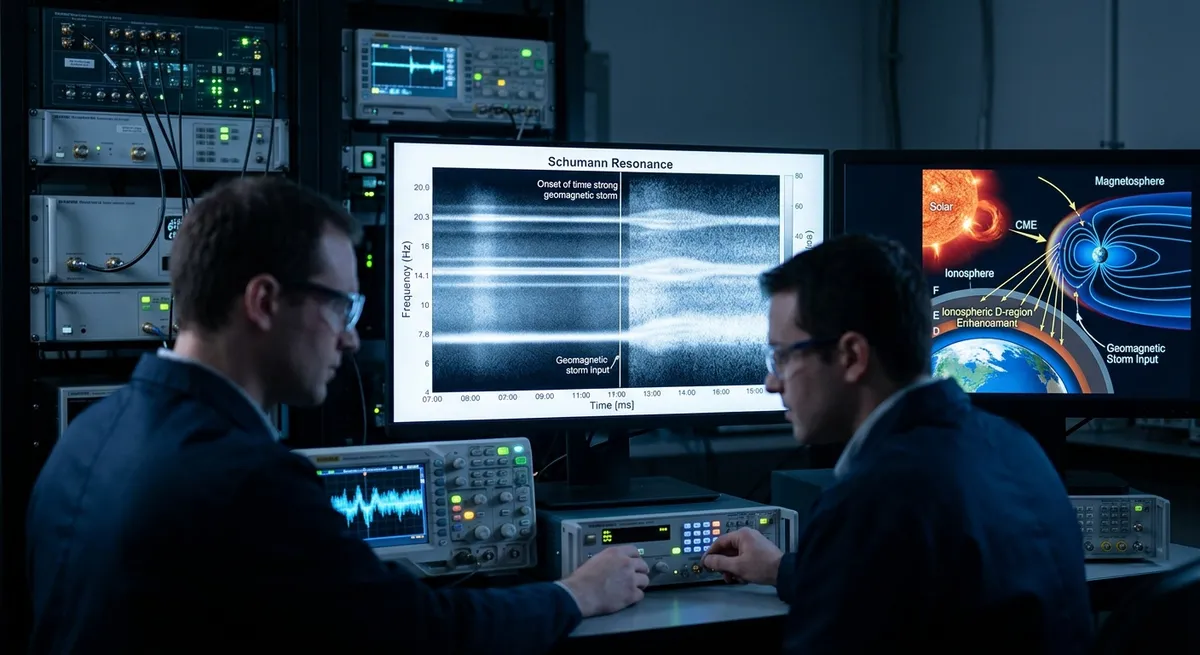
How Geomagnetic Storms Interact with the Schumann Resonance
TL;DR
Geomagnetic storms—triggered by solar wind disturbances—alter the ionospheric conditions that sustain the Schumann Resonance, though the fundamental 7.83 Hz frequency remains stable. Monitoring stations observe variations in resonance amplitude and harmonic intensity during geomagnetic activity, providing insights into Earth-ionosphere cavity dynamics.
The Schumann Resonance, Earth's natural electromagnetic frequency at approximately 7.83 Hz, exists within a dynamic electromagnetic environment. One of the most significant influences on this resonance comes from geomagnetic storms—disturbances in Earth's magnetosphere triggered by solar wind activity. Understanding how these storms interact with the Schumann Resonance requires examining the physics of the Earth-ionosphere cavity, the role of solar activity, and what modern monitoring reveals about these interactions.
The Earth-Ionosphere Cavity and Geomagnetic Context
The Schumann Resonance emerges from electromagnetic waves trapped between Earth's surface and the ionosphere, forming a resonant cavity. This cavity is not isolated from space weather. The ionosphere itself is shaped by solar radiation and the solar wind, which is constantly streaming from the Sun. During normal conditions, the ionosphere maintains a relatively stable structure, allowing the Schumann Resonance to persist at its characteristic frequency. However, when a geomagnetic storm occurs, the influx of charged particles from the solar wind compresses and destabilizes the magnetosphere, which in turn affects ionospheric density and conductivity.
Geomagnetic storms are classified on the K-index scale, which ranges from 0 (quiet) to 9 (extreme). During major storms (K-index 7 or higher), the magnetosphere undergoes significant restructuring. The increased particle precipitation into the upper atmosphere ionizes additional molecules, raising the overall conductivity of the ionosphere. Because the Schumann Resonance depends on the electromagnetic properties of the ionosphere, these changes create measurable effects on resonance characteristics.
Amplitude and Harmonic Variations During Storms
Research from monitoring stations worldwide has documented that geomagnetic storms do not shift the fundamental Schumann Resonance frequency from its baseline of approximately 7.83 Hz. Instead, they produce variations in amplitude—the strength or intensity of the resonance signal—and affect the harmonic structure above the fundamental frequency.
During moderate to strong geomagnetic activity, monitoring stations typically record increased amplitude in the Schumann Resonance signal. This occurs because enhanced ionospheric conductivity improves the efficiency of the Earth-ionosphere cavity as an electromagnetic resonator. The cavity becomes, in effect, a better conductor of electromagnetic energy. Simultaneously, the harmonic frequencies—which occur at multiples of the fundamental frequency (14.3 Hz, 20.8 Hz, 27.4 Hz, and so on)—often show increased intensity and clarity during storms.
These variations are not random. They follow patterns correlated with geomagnetic indices and solar wind parameters. Researchers monitoring the Schumann Resonance at multiple global locations have observed that the timing and magnitude of amplitude increases align with documented geomagnetic storm events. This correlation provides validation that the monitoring equipment is detecting genuine ionospheric changes, not instrumental artifacts.
72-hour Schumann Resonance amplitude log. Readings are stable relative to the 7.83 Hz historical baseline. Data: Earth Frequency Index global sensor network.
Solar Wind Parameters and Ionospheric Response
The mechanism linking solar activity to ionospheric changes involves several solar wind parameters. The solar wind's dynamic pressure, the interplanetary magnetic field (IMF) orientation, and the Kp-index (a measure of geomagnetic disturbance) all influence how severely the magnetosphere is compressed and how much particle precipitation reaches the ionosphere.
When the IMF turns southward (negative Bz component), magnetic reconnection occurs at the magnetosphere's dayside boundary, allowing solar wind particles to penetrate deeper into the magnetosphere. This intensifies the geomagnetic storm and increases ionospheric particle loading. Conversely, when the IMF is northward, the magnetosphere is better shielded, and geomagnetic activity remains minimal.
The relationship between these solar parameters and Schumann Resonance variations has been the subject of peer-reviewed research. Studies comparing Schumann Resonance data with simultaneous solar wind measurements show that amplitude variations lag geomagnetic storm onset by several hours to a day, reflecting the time required for ionospheric conditions to fully respond to magnetospheric disturbances.
Measurement Considerations and Global Monitoring
Accurate monitoring of the Schumann Resonance during geomagnetic storms requires careful attention to measurement methodology. Global monitoring networks operate multiple stations equipped with sensitive magnetometers designed to detect extremely low frequency (ELF) electromagnetic signals. These stations are typically located in magnetically quiet regions to minimize local electromagnetic noise.
During geomagnetic storms, the increased electromagnetic activity in the ionosphere can elevate background noise levels, making precise frequency detection more challenging. However, modern digital signal processing techniques allow researchers to filter this noise and isolate the Schumann Resonance signal even during active geomagnetic conditions. The consistency of observations across multiple geographic locations provides independent verification that recorded changes reflect genuine geophysical phenomena.
Monitoring data also reveals that the response to geomagnetic storms is not instantaneous or uniform. Different frequency components of the Schumann Resonance may respond differently to the same geomagnetic event. The fundamental frequency remains remarkably stable, while harmonic amplitudes show greater variability. This differential response provides clues about the complex layering and conductivity structure of the ionosphere at different altitudes.
Implications for Schumann Resonance Research
The interaction between geomagnetic storms and the Schumann Resonance demonstrates that Earth's natural electromagnetic environment is tightly coupled to solar activity. This coupling is not a disruption or anomaly—it is a normal feature of the Earth-ionosphere system. For researchers studying the Schumann Resonance, accounting for geomagnetic activity is essential when interpreting long-term frequency and amplitude data.
Understanding these interactions also provides a window into ionospheric physics. By studying how the Schumann Resonance responds to known geomagnetic events, scientists gain insight into ionospheric conductivity profiles, the effectiveness of particle precipitation, and the dynamics of the magnetosphere-ionosphere coupling process. This makes Schumann Resonance monitoring a valuable complementary tool for space weather research.
The stability of the fundamental Schumann Resonance frequency across geomagnetic conditions underscores the robustness of this natural electromagnetic phenomenon. While solar activity influences the amplitude and harmonic structure of the resonance, the core frequency persists as a stable characteristic of the Earth-ionosphere cavity, reflecting the fundamental physics of electromagnetic wave propagation in this natural resonator.
Frequently Asked Questions
Does the Schumann Resonance frequency change during geomagnetic storms
No, the fundamental frequency remains stable at approximately 7.83 Hz during geomagnetic storms. However, the amplitude and harmonic structure of the resonance signal do vary in response to changes in ionospheric conductivity.
What causes geomagnetic storms to affect the Schumann Resonance
Geomagnetic storms increase ionospheric particle precipitation and conductivity, which alters the electromagnetic properties of the Earth-ionosphere cavity and affects the resonance signal's amplitude and harmonic characteristics.
How do scientists measure Schumann Resonance during space weather events
Researchers use sensitive magnetometer networks deployed globally in magnetically quiet locations, combined with digital signal processing techniques to filter noise and isolate the Schumann Resonance signal even during elevated geomagnetic activity.
Does solar wind activity directly influence the Schumann Resonance
Solar wind does not directly affect the Schumann Resonance frequency, but it triggers geomagnetic storms that alter ionospheric conditions, which in turn influence the resonance signal's amplitude and harmonic structure.
What is the K-index and how does it relate to Schumann Resonance changes
The K-index measures geomagnetic disturbance on a scale from 0 to 9; higher K-indices indicate stronger storms that produce more pronounced variations in Schumann Resonance amplitude and harmonic intensity as recorded by monitoring stations.