How Lightning Sustains Earth's Electromagnetic Heartbeat — Updated Analysis
TL;DR
Lightning strikes continuously excite the Earth-ionosphere cavity, sustaining the Schumann Resonance at approximately 7.83 Hz. This natural electromagnetic frequency emerges from the resonant properties of the space between Earth's surface and the ionosphere, driven by roughly 40 to 50 lightning events occurring globally every second.
Earth generates a continuous electromagnetic hum at approximately 7.83 Hz — a frequency so fundamental to our planet's electrochemistry that it has been called the electromagnetic heartbeat of the world. This phenomenon, known as the Schumann Resonance, has fascinated scientists since Winfried Schumann's theoretical prediction in 1952 and its experimental confirmation in the late 1950s. Yet the mechanism that sustains this frequency remains less widely understood than the frequency itself. The answer lies in one of nature's most violent and energetic phenomena: lightning.
The Earth-Ionosphere Cavity as a Resonator
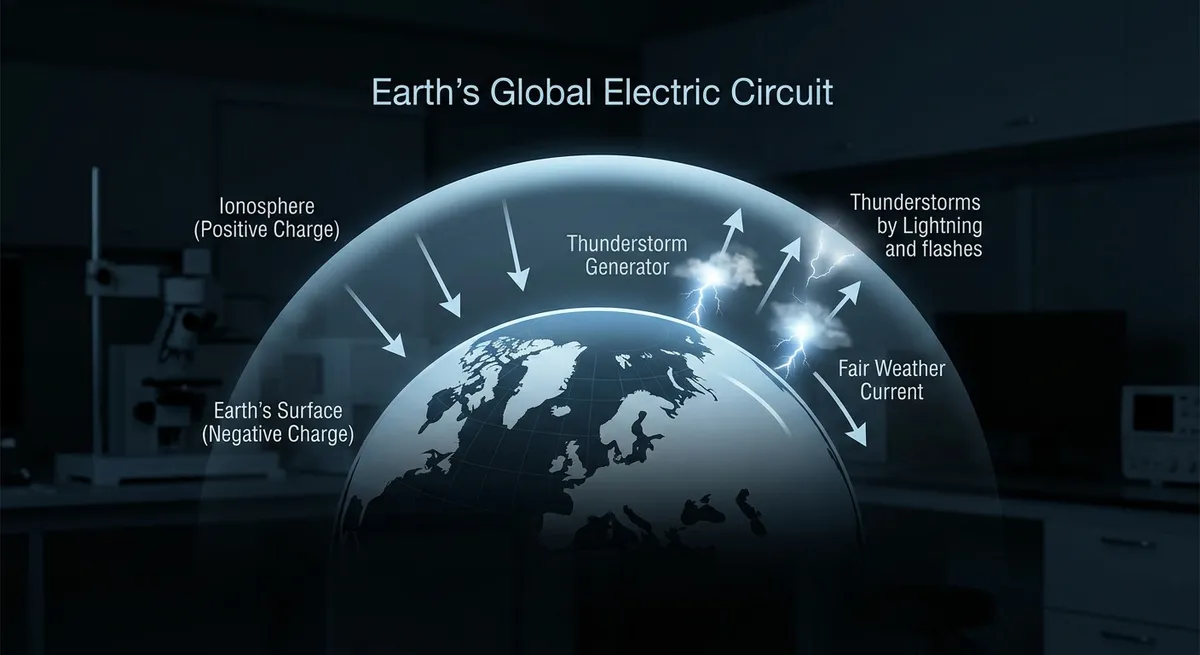
To understand how lightning sustains the Schumann Resonance, we must first recognize that Earth and its ionosphere form a spherical cavity — an electromagnetic chamber of sorts. The ionosphere, a layer of ionized gas extending from approximately 60 to 100 kilometers above Earth's surface, acts as an upper boundary. Earth's conductive surface forms the lower boundary. Between these two conductive surfaces exists a space filled with air and electromagnetic fields.
This cavity has natural resonant frequencies, much like a musical instrument resonates at specific pitches. The lowest and most prominent of these frequencies is approximately 7.83 Hz — the fundamental Schumann Resonance. Higher harmonics occur at roughly 14.3 Hz, 20.8 Hz, 27.3 Hz, and beyond, but the fundamental frequency dominates in terms of energy and detection.
The resonant frequency depends on the circumference of Earth and the speed of light. Electromagnetic waves travel around Earth's surface in the Earth-ionosphere waveguide, and when the distance traveled matches the wavelength of a particular frequency, resonance occurs. This is why the Schumann Resonance is sometimes described as Earth's natural frequency — it emerges directly from the planet's geometry and electromagnetic properties.
Lightning as the Primary Excitation Source
The Earth-ionosphere cavity would not resonate without an energy source to excite it. That source is lightning. Approximately 40 to 50 lightning strikes occur globally every second, delivering enormous amounts of electromagnetic energy into the cavity. Each lightning strike is a broadband electromagnetic event — it radiates energy across a wide spectrum of frequencies.
When lightning strikes, it injects electromagnetic energy into the Earth-ionosphere system. This energy includes the fundamental Schumann Resonance frequency and its harmonics. Critically, the cavity's resonant properties naturally amplify and sustain the frequencies that match its resonant modes while damping others. This selective amplification is why we observe a strong, persistent signal at 7.83 Hz despite the chaotic, broadband nature of individual lightning events.
Think of it as a tuning fork struck repeatedly by random impacts. The tuning fork rings at its natural frequency regardless of how or where you strike it, because that frequency is what the fork's physical structure naturally amplifies. Similarly, lightning strikes the Earth-ionosphere cavity billions of times per day, and the cavity responds by resonating at its natural frequency.
Global Lightning Distribution and Frequency Stability
One of the most striking features of the Schumann Resonance is its remarkable stability. Despite variations in solar activity, seasonal changes, and fluctuations in lightning distribution, the fundamental frequency remains centered near 7.83 Hz. This stability reflects the fact that lightning is distributed globally and occurs continuously.
72-hour Schumann Resonance amplitude log. Readings are stable relative to the 7.83 Hz historical baseline. Data: Earth Frequency Index global sensor network.
Research shows that lightning activity varies with time of day and season. Thunderstorm activity peaks in the afternoon in many regions and follows seasonal patterns tied to solar heating and atmospheric dynamics. Yet despite these variations, the Schumann Resonance frequency remains stable because the global distribution of lightning ensures that the cavity is continuously excited across all hours and seasons.
When lightning activity is higher in one region, it may be lower in another, but the net effect on the Earth-ionosphere cavity is a steady, persistent excitation at the resonant frequency. This global averaging effect is one reason why early concerns about potential disruptions to the Schumann Resonance due to localized changes in lightning activity have not materialized — the system is inherently robust to regional variations.
Energy Dissipation and Dynamic Equilibrium
Electromagnetic energy in the Earth-ionosphere cavity does not persist indefinitely. It is dissipated through various mechanisms, including absorption by the atmosphere and ionosphere, and losses due to the imperfect conductivity of these media. This energy dissipation would cause the Schumann Resonance to decay if it were not continuously replenished.
Lightning provides the continuous replenishment. The system exists in dynamic equilibrium — energy is constantly being added by lightning and constantly being removed by dissipation. This equilibrium maintains the Schumann Resonance at a measurable, detectable amplitude. The frequency itself is determined by the cavity's geometry, while the amplitude is determined by the balance between excitation and dissipation.
This dynamic equilibrium also explains why the Schumann Resonance is observed at monitoring stations worldwide. The resonance is not a local phenomenon but a global electromagnetic property of the Earth-ionosphere system. Sensitive equipment at any location on Earth can detect the fundamental frequency because it represents the resonant mode of the entire planet.
Measurement and Modern Understanding
Modern monitoring of the Schumann Resonance has become increasingly sophisticated. Ground-based magnetic field sensors positioned at various locations record the electromagnetic activity in the extremely low frequency (ELF) band. Analysis of these recordings reveals the fundamental frequency and its harmonics, as well as variations in amplitude and spectral characteristics.
Updated analysis incorporates improved understanding of the relationship between lightning activity and Schumann Resonance intensity. Researchers have found correlations between global lightning activity measured by satellite and the amplitude of the Schumann Resonance measured at ground stations. These correlations provide direct evidence that lightning is indeed the primary driver of the resonance.
The mechanism is now well established in the scientific literature: lightning excites the Earth-ionosphere cavity across a broad spectrum of frequencies, the cavity's resonant properties selectively amplify the fundamental and harmonic frequencies, and continuous global lightning activity maintains a steady electromagnetic oscillation at approximately 7.83 Hz. This understanding bridges the gap between the theoretical prediction of Schumann's equations and the experimental observations made by researchers over the past seven decades.
Earth's electromagnetic heartbeat is thus revealed as a direct consequence of the planet's geometry, the properties of its upper atmosphere, and the relentless energy input from global lightning activity. It is a natural phenomenon that emerges from the interaction of several physical systems — a testament to the elegant complexity of Earth's electromagnetic environment.
Frequently Asked Questions
What is the Schumann Resonance?
The Schumann Resonance is Earth's natural electromagnetic frequency at approximately 7.83 Hz, produced by electromagnetic waves traveling around the planet in the space between Earth's surface and the ionosphere. It is the fundamental resonant frequency of the Earth-ionosphere cavity.
How does lightning create the Schumann Resonance?
Lightning strikes inject broadband electromagnetic energy into the Earth-ionosphere cavity roughly 40 to 50 times per second globally. The cavity's resonant properties amplify the energy at 7.83 Hz while damping other frequencies, sustaining the Schumann Resonance.
Why is the Schumann Resonance frequency stable?
The frequency is stable because it is determined by Earth's geometry and the speed of light, not by the intensity of lightning activity. Global lightning distribution ensures continuous excitation across all regions and times, maintaining steady resonance.
Can you measure the Schumann Resonance?
Yes, sensitive magnetometers positioned at ground stations worldwide detect the extremely low frequency electromagnetic signals of the Schumann Resonance. The fundamental frequency and its harmonics are regularly recorded and analyzed by researchers.
Does solar activity affect the Schumann Resonance frequency?
Solar activity can influence ionospheric conditions and potentially affect the amplitude and spectral characteristics of the Schumann Resonance, but the fundamental frequency at 7.83 Hz remains stable because it is determined by Earth's physical dimensions rather than solar input.