How Researchers Measure Electromagnetic Frequency from Space — Updated Analysis
TL;DR
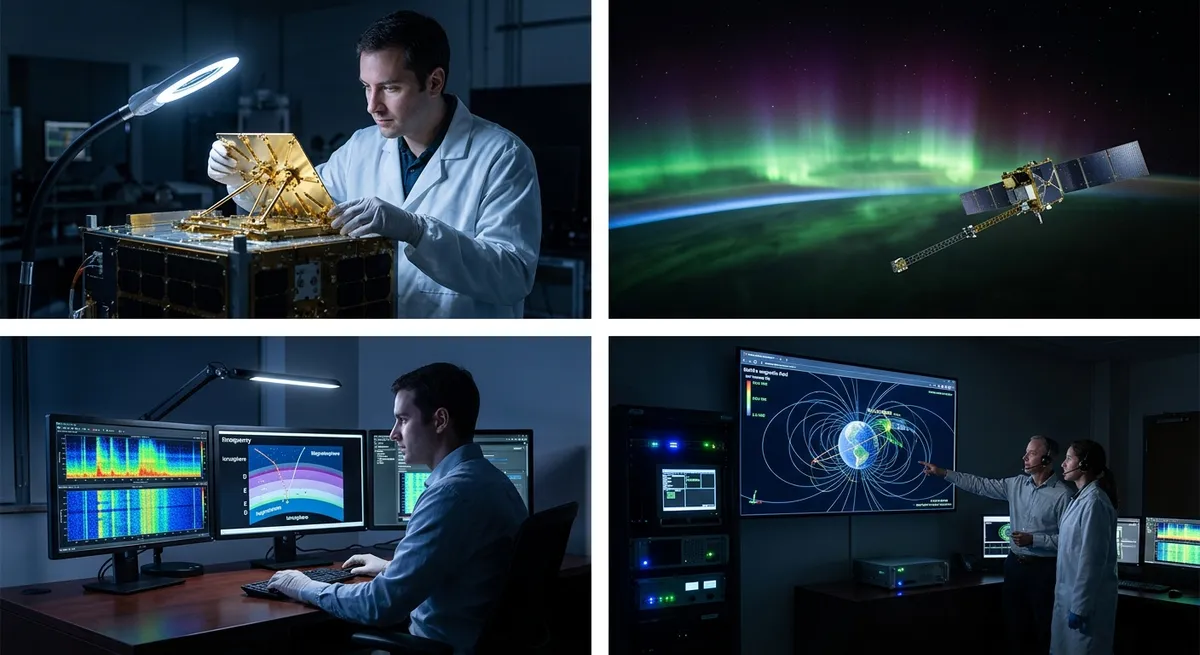
Researchers measure Earth's electromagnetic frequencies using a combination of ground-based magnetometer networks, satellite instruments, and ionospheric monitoring stations positioned globally. These methods capture both the baseline Schumann Resonance and variations caused by solar activity, providing continuous data that advances our understanding of Earth's electromagnetic environment.
Since Winfried Schumann's 1952 prediction of Earth's natural electromagnetic resonance at 7.83 Hz, scientists have developed increasingly sophisticated methods to measure and monitor this phenomenon from both ground and space. Today's measurement infrastructure represents decades of technological refinement, combining classical magnetometry with modern satellite systems to create a comprehensive picture of Earth's electromagnetic activity. Understanding how these measurements are conducted is essential for anyone seeking reliable data on Earth's frequency environment.
Ground-Based Magnetometer Networks
The foundation of Schumann Resonance monitoring rests on a global network of ground-based magnetometers—sensitive instruments that detect changes in Earth's magnetic field with extraordinary precision. These stations measure variations in the electromagnetic field at frequencies typically ranging from 0.1 Hz to several hundred Hz, capturing the very low frequency (VLF) band where the Schumann Resonance operates.
Modern magnetometer stations employ coils of wire wound around ferromagnetic cores, which generate electrical signals proportional to changes in the surrounding magnetic field. The sensitivity of these instruments allows detection of field variations as small as a few picoteslas—roughly one-billionth of Earth's static magnetic field strength. Data from these ground stations flows continuously to research centers, where it undergoes real-time analysis and archival storage.
The global distribution of these monitoring stations is strategically planned. Stations positioned at high magnetic latitudes near the poles capture different ionospheric dynamics than those in equatorial or mid-latitude regions. This geographic diversity allows researchers to distinguish between local electromagnetic activity and global phenomena. Major networks include stations operated by universities, government agencies, and independent research organizations across North America, Europe, Asia, and the Southern Hemisphere.
Satellite-Based Measurement Systems
Space-based instruments provide a complementary perspective on Earth's electromagnetic environment. Satellites equipped with magnetometers orbit at altitudes ranging from several hundred to tens of thousands of kilometers, measuring the magnetic field in regions inaccessible to ground instruments. These orbital platforms detect electromagnetic variations caused by solar wind interactions, magnetospheric currents, and ionospheric dynamics.
One of the most significant satellite missions for electromagnetic monitoring is the Swarm constellation, operated by the European Space Agency. Three satellites flying in formation measure magnetic field components with unprecedented accuracy, providing data that helps researchers understand the coupling between Earth's surface, atmosphere, and magnetosphere. Other missions, including THEMIS (Time History of Events and Macroscale Interactions during Substorms) and MMS (Magnetospheric Multiscale Mission), contribute specialized measurements of electromagnetic phenomena at different scales and altitudes.
Satellite instruments measure not only the static magnetic field but also electromagnetic waves and fluctuations. Fluxgate magnetometers aboard these platforms operate on principles similar to ground-based instruments but are optimized for the space environment, where they encounter different noise sources and field strengths. The continuous orbital coverage provided by satellite networks ensures that electromagnetic activity is monitored globally, even over oceans and remote regions where ground stations are sparse.
72-hour Schumann Resonance amplitude log. Readings are stable relative to the 7.83 Hz historical baseline. Data: Earth Frequency Index global sensor network.
Ionospheric Monitoring and Radio Wave Propagation
The Schumann Resonance exists as electromagnetic waves trapped in the Earth-ionosphere cavity—the region between Earth's surface and the lower ionosphere, approximately 100 kilometers altitude. Measuring this resonance requires understanding how electromagnetic waves propagate through this cavity and interact with the ionosphere's varying conductivity.
Researchers employ Very Low Frequency (VLF) receivers to detect radio waves in the 3 Hz to 30 kHz range, which encompasses the Schumann Resonance frequencies. These receivers are often paired with directional antenna arrays that help scientists pinpoint the sources of electromagnetic signals. VLF monitoring stations can detect electromagnetic activity from distant thunderstorms and natural phenomena, providing insights into global lightning activity and its relationship to the Earth-ionosphere system.
Ionospheric sounding techniques, including incoherent scatter radar systems, measure the electron density and temperature profiles of the ionosphere at various altitudes. This data is crucial because ionospheric conductivity directly affects how electromagnetic waves propagate within the Earth-ionosphere cavity. By understanding the ionosphere's state, researchers can better interpret Schumann Resonance measurements and distinguish between changes in the resonance itself and changes caused by ionospheric variations.
Data Integration and Analysis Methodology
Modern frequency monitoring relies on sophisticated data integration techniques that combine measurements from multiple sources. Ground-based magnetometer networks, satellite instruments, and VLF receivers all feed data into centralized analysis systems where researchers apply spectral analysis, Fourier transforms, and other signal processing methods to extract meaningful information.
Spectral analysis techniques break down complex electromagnetic signals into their constituent frequencies, allowing researchers to isolate the Schumann Resonance peak from background noise and other electromagnetic phenomena. Power spectral density plots reveal not only the dominant frequency but also the strength and bandwidth of the resonance at any given moment. These analyses are performed continuously, generating time series data that researchers can examine for patterns, trends, and correlations with solar activity or other environmental factors.
Quality control procedures are essential to ensure data reliability. Researchers must distinguish between genuine electromagnetic phenomena and instrumental artifacts, environmental noise, or equipment malfunctions. Cross-validation between independent monitoring stations and satellite data helps verify measurements and identify anomalies in individual instruments. This rigorous approach ensures that published data represents genuine electromagnetic activity rather than measurement errors.
Advancing Measurement Capabilities
The field of electromagnetic monitoring continues to evolve. New satellite missions are planned with enhanced magnetometric sensitivity, and ground-based networks are expanding into previously unmonitored regions. Advances in sensor technology, data transmission, and computational analysis enable researchers to detect and characterize electromagnetic phenomena with increasing precision.
The combination of space-based and ground-based measurements provides a comprehensive view of Earth's electromagnetic environment. Satellite data reveals large-scale patterns and magnetospheric dynamics, while ground stations capture local variations and provide the long-term records necessary for detecting subtle trends. Together, these measurement systems form an integrated observational network that continues to advance scientific understanding of the Schumann Resonance and Earth's natural electromagnetic frequencies.
Frequently Asked Questions
What instruments measure the Schumann Resonance
Scientists use ground-based magnetometers, VLF receivers, and satellite-mounted instruments to detect Earth's electromagnetic frequencies. These tools measure magnetic field variations in the very low frequency band where the Schumann Resonance operates.
How sensitive are Schumann Resonance detectors
Modern magnetometers can detect magnetic field variations as small as a few picoteslas, which is approximately one-billionth of Earth's static magnetic field strength. This extreme sensitivity allows researchers to isolate the Schumann Resonance signal from background electromagnetic noise.
Why do researchers use satellites to measure electromagnetic frequency
Satellites provide global coverage over oceans and remote regions where ground stations are sparse, and they measure electromagnetic activity at different altitudes to understand how Earth's surface, atmosphere, and magnetosphere interact electromagnetically.
What is the Earth-ionosphere cavity
The Earth-ionosphere cavity is the region between Earth's surface and the lower ionosphere (approximately 100 kilometers altitude) where electromagnetic waves become trapped, creating the resonant conditions that produce the Schumann Resonance.
How do researchers separate real signals from measurement noise
Scientists use spectral analysis, cross-validation between independent monitoring stations, satellite data verification, and quality control procedures to distinguish genuine electromagnetic phenomena from instrumental artifacts or environmental interference.