Earth exists within a dynamic electromagnetic environment shaped by forces both terrestrial and extraterrestrial. The Schumann Resonance—the 7.83 Hz fundamental frequency of electromagnetic oscillations in the Earth-ionosphere cavity—depends on stable ionospheric conditions. Understanding how solar wind interacts with Earth's magnetosphere is essential to understanding the physical environment in which this resonance persists.
The Solar Wind and Magnetospheric Interaction
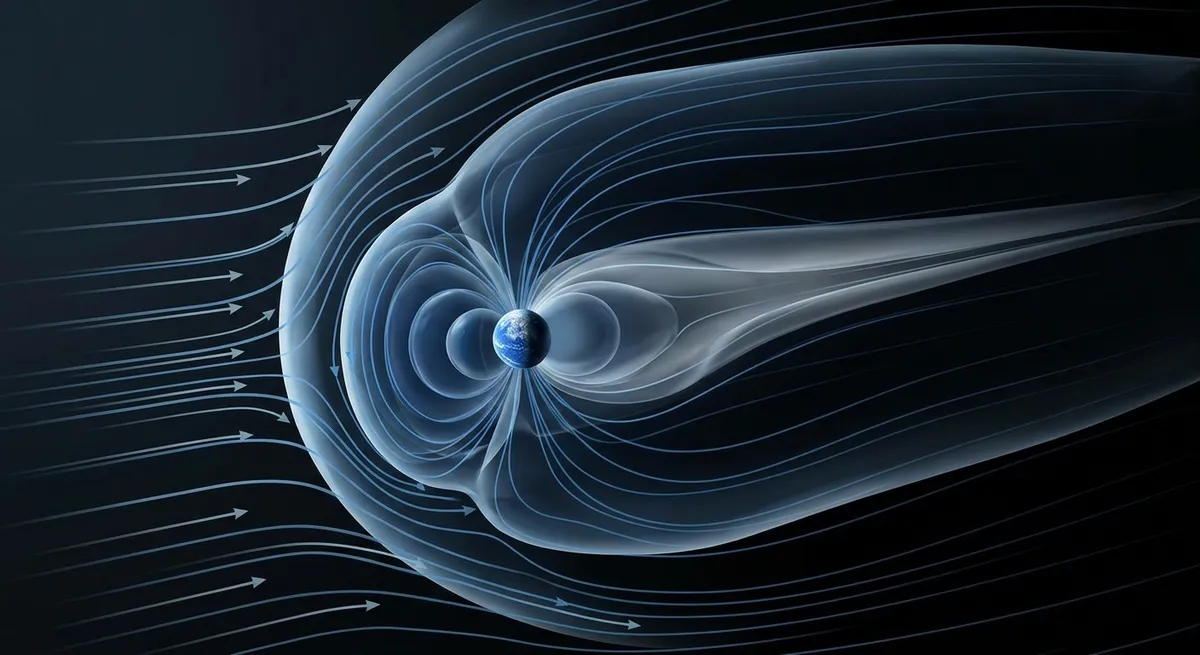
The Sun continuously emits a stream of charged particles known as the solar wind. This plasma, composed primarily of protons and electrons, flows outward at speeds typically between 300 and 800 kilometers per second. When this stream encounters Earth's magnetic field, it does not pass through unimpeded. Instead, it compresses the magnetosphere on the day-side of Earth and stretches it into an elongated tail on the night-side—a phenomenon first observed and theorized in the mid-20th century as our understanding of space physics advanced.
The interaction between solar wind and Earth's magnetic field is not static. As solar wind pressure varies, the magnetosphere expands and contracts. During periods of high solar activity, increased particle flux compresses the magnetosphere more severely. During quiet periods, the magnetosphere expands further into space. This dynamic boundary, called the magnetopause, represents the point where the pressure of Earth's magnetic field balances the pressure of the incoming solar wind.
This continuous interaction has profound implications for Earth's upper atmosphere. The magnetosphere acts as a shield, deflecting most solar wind particles around the planet. However, some particles—particularly during geomagnetic storms—can penetrate to lower altitudes and interact with the ionosphere, the electrically conductive layer of atmosphere critical to Schumann Resonance measurements.
Ionospheric Conductivity and the Schumann Cavity
The Schumann Resonance exists as an electromagnetic standing wave in the cavity formed between Earth's surface and the ionosphere. For this resonance to be measurable and stable, the ionosphere must maintain sufficient electrical conductivity. Solar wind-magnetosphere interactions directly influence ionospheric conductivity through several mechanisms.
During geomagnetic storms, energetic particles precipitate into the ionosphere, ionizing atmospheric molecules and increasing conductivity. This enhanced ionization can alter the electromagnetic properties of the cavity, affecting how electromagnetic waves propagate and resonate within it. The relationship is not one of disruption but of modulation—the cavity remains functional, but its electromagnetic characteristics respond to changing ionospheric conditions driven by solar activity.
The lower ionosphere, particularly the D-layer, is most sensitive to these changes. Solar radiation, particularly extreme ultraviolet (EUV) radiation, maintains baseline ionospheric ionization during quiet conditions. During geomagnetic disturbances, particle precipitation adds an additional ionization source. Monitoring stations measuring the Schumann Resonance must account for these natural variations when interpreting frequency and amplitude data.
Solar Activity Indices and Measurement Context
Space weather scientists use several indices to quantify solar wind conditions and their effects on Earth's magnetosphere. The Kp index measures geomagnetic disturbance on a scale of 0 to 9, with higher values indicating stronger geomagnetic storms. The solar wind speed, density, and interplanetary magnetic field strength are measured by satellites positioned between Earth and Sun, providing real-time data on incoming conditions.
These measurements provide essential context for Schumann Resonance monitoring. When interpreting frequency variations or amplitude fluctuations in Schumann data, researchers must consider concurrent solar wind conditions and geomagnetic indices. A change in measured resonance characteristics during a period of high solar activity may reflect ionospheric changes driven by solar wind interaction rather than any change in the fundamental Earth-ionosphere cavity system itself.
Historical data from multiple solar cycles demonstrates that the Schumann Resonance remains stable at its fundamental 7.83 Hz frequency across varying levels of solar activity. This stability, observed consistently since the 1950s when measurements began, reflects the robustness of the Earth-ionosphere cavity as a resonant system. The cavity's fundamental frequency is determined by the speed of electromagnetic wave propagation and the dimensions of the cavity—parameters that do not change with solar activity.
Seasonal and Diurnal Variations
Beyond solar wind effects, the ionosphere exhibits natural variations driven by Earth's rotation and orbital position relative to the Sun. Diurnal (daily) variations occur as the terminator—the boundary between day and night—moves around the planet, changing which hemisphere receives solar radiation. Seasonal variations reflect Earth's axial tilt and changing solar elevation angles.
These variations affect ionospheric conductivity and thus the electromagnetic environment in which the Schumann Resonance propagates. Morning and afternoon hours typically show different ionospheric conditions than nighttime hours. Summer and winter hemispheres exhibit different ionospheric characteristics. These natural variations are well-documented and expected. Monitoring networks account for them when establishing baseline measurements and interpreting data variations.