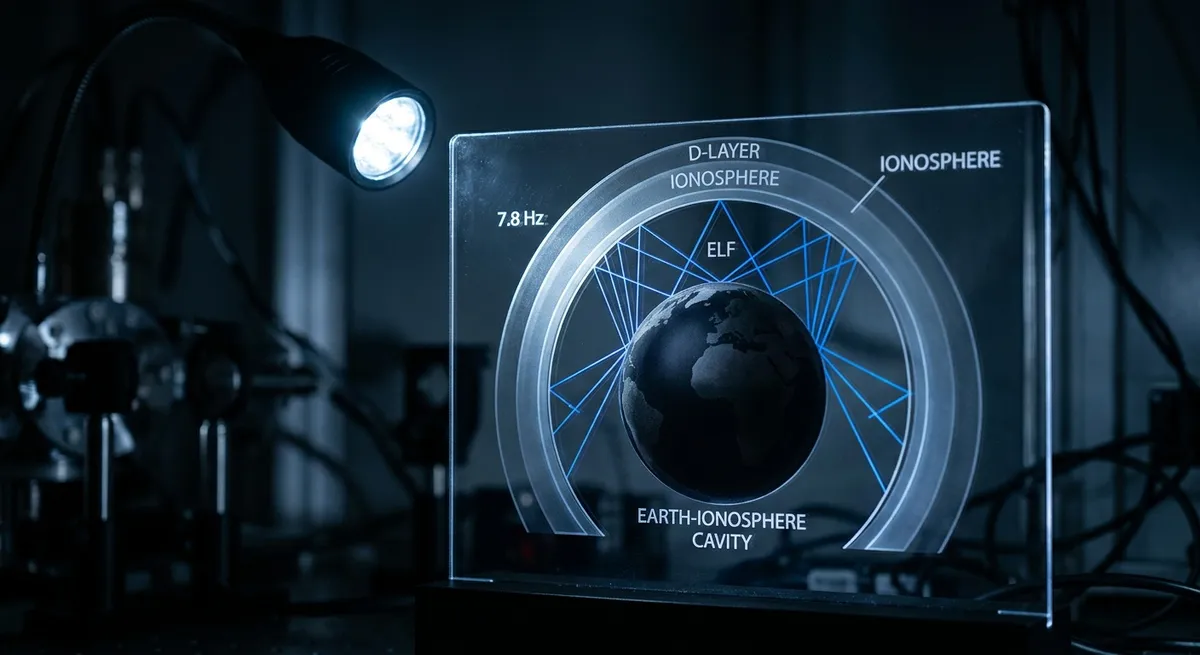
How the Schumann Resonance is Used in Atmospheric Science
TL;DR
The Schumann Resonance serves atmospheric scientists as a natural electromagnetic signature of Earth's ionosphere-surface cavity system, enabling monitoring of global lightning activity, ionospheric health, and atmospheric conditions. By tracking variations in this 7.83 Hz baseline frequency, researchers gain insights into planetary electromagnetic dynamics and can correlate frequency shifts with solar activity and weather phenomena.
Introduction
The Schumann Resonance—Earth's natural electromagnetic frequency at approximately 7.83 Hz—has become an increasingly valuable tool in atmospheric science. Far from being merely a curiosity of geophysics, this fundamental frequency serves as a diagnostic window into the health and dynamics of our planet's electromagnetic environment. Scientists use continuous monitoring of the Schumann Resonance to study the Earth-ionosphere cavity system, track global lightning activity, and correlate electromagnetic variations with atmospheric and solar phenomena. Understanding how researchers leverage this natural frequency illuminates both the sophistication of modern atmospheric monitoring and the interconnected nature of Earth's physical systems.
The Earth-Ionosphere Cavity as a Natural Laboratory
The Schumann Resonance emerges from a simple but elegant physical system: Earth's surface and the ionosphere form a spherical cavity that resonates at specific electromagnetic frequencies. This cavity is continuously excited by global lightning activity—approximately 40 to 50 lightning strikes occur every second worldwide. When lightning discharges occur, they generate electromagnetic waves that propagate around the planet within this cavity, creating standing wave patterns. The fundamental resonance frequency of this system is approximately 7.83 Hz, with harmonic resonances occurring at roughly 14.3 Hz, 20.8 Hz, 27.3 Hz, and higher multiples.
Atmospheric scientists exploit this natural resonance cavity as a measurement system. By monitoring the frequency and intensity of Schumann Resonance signals, researchers can infer properties of the ionosphere that would otherwise require expensive satellite instrumentation or complex modeling. The cavity itself acts as a distributed sensor network, with lightning activity providing the excitation energy. This means that the Schumann Resonance offers a cost-effective, passive method for studying atmospheric and ionospheric conditions on a global scale.
Lightning Activity and Global Weather Patterns
One of the most direct applications of Schumann Resonance monitoring is tracking global lightning distribution and intensity. Since lightning is the primary driver of the resonance, variations in the Schumann signal directly reflect changes in global thunderstorm activity. Scientists have established that lightning activity follows predictable diurnal (daily) patterns, with peak activity occurring in the early evening hours in the Earth's main thunderstorm regions—particularly over equatorial Africa, Southeast Asia, and the Americas.
By monitoring the intensity of Schumann Resonance signals at multiple ground-based stations, atmospheric researchers can construct a real-time picture of where thunderstorms are most active globally. This capability has proven valuable for validating satellite-based lightning detection systems and for understanding seasonal variations in global convective activity. For instance, researchers have observed that the Schumann Resonance intensity exhibits seasonal variations that correlate with known patterns of tropical convection and the migration of the intertropical convergence zone.
Furthermore, the frequency spectrum of Schumann Resonance measurements contains information about the vertical structure of the atmosphere. The propagation of electromagnetic waves within the Earth-ionosphere cavity depends on the conductivity profile of the atmosphere, which is influenced by temperature, humidity, and ionization. By analyzing how the Schumann signal changes across different frequency bands, scientists can infer information about atmospheric layering and conditions that affect wave propagation.
72-hour Schumann Resonance amplitude log. Readings are stable relative to the 7.83 Hz historical baseline. Data: Earth Frequency Index global sensor network.
Ionospheric Monitoring and Space Weather Connections
The ionosphere—the ionized layer of Earth's upper atmosphere—plays a crucial role in determining the characteristics of the Schumann Resonance. The height, density, and electron temperature of the ionosphere directly influence the resonant frequencies and damping of electromagnetic waves in the Earth-ionosphere cavity. This relationship makes Schumann Resonance monitoring a valuable tool for studying ionospheric variations without requiring direct measurement from satellites.
Atmospheric scientists use Schumann Resonance data to track ionospheric disturbances caused by solar activity. During solar storms or periods of intense solar radiation, the ionosphere becomes more ionized and its conductivity increases. These changes are reflected in subtle shifts in the Schumann Resonance frequency and intensity. By correlating Schumann measurements with solar indices such as the solar flux or geomagnetic indices like the Kp index, researchers have established relationships between space weather events and ionospheric changes.
This application has become increasingly important as solar activity cycles through periods of high and low intensity. Understanding how the ionosphere responds to solar forcing helps scientists improve models of the upper atmosphere and predict space weather impacts on communications and power systems. The Schumann Resonance provides a ground-based, continuous monitoring capability that complements satellite observations and offers a different perspective on ionospheric dynamics.
Integrating Schumann Data with Atmospheric Models
Modern atmospheric science relies heavily on numerical models that simulate weather, climate, and electromagnetic phenomena. Schumann Resonance measurements provide valuable observational constraints for these models. By assimilating Schumann data into atmospheric models, scientists can improve the representation of global lightning activity, which has important implications for atmospheric chemistry and energy balance.
Global lightning activity affects the production of nitrogen oxides in the upper troposphere, influences ozone chemistry, and contributes to the global electrical circuit. Accurate representation of this activity in atmospheric models requires good observational data. The Schumann Resonance network, distributed across multiple ground stations worldwide, provides continuous, real-time information about lightning activity that can be used to validate and calibrate model parameterizations of convective activity and lightning production.
Researchers have also used Schumann Resonance variations to study long-term trends in global thunderstorm activity. By analyzing decadal records of Schumann measurements, scientists can investigate whether global lightning activity is changing due to climate variations or other long-term atmospheric trends. These studies contribute to broader efforts to understand how the global electrical circuit and atmospheric dynamics may be evolving.
Conclusion
The Schumann Resonance has evolved from a theoretical prediction into a practical tool for atmospheric science. By monitoring this natural electromagnetic frequency, scientists gain insights into global lightning patterns, ionospheric conditions, and the interconnections between Earth's atmosphere and space environment. The network of Schumann Resonance monitoring stations worldwide provides a complementary perspective to satellite-based observations, offering continuous, cost-effective access to information about planetary electromagnetic dynamics. As atmospheric science continues to advance, the Schumann Resonance will likely remain an important component of the observational toolkit for understanding our dynamic planet.
Frequently Asked Questions
What is the Schumann Resonance used for in science
The Schumann Resonance is used to monitor global lightning activity, track ionospheric conditions, and study the Earth-ionosphere cavity system. Scientists leverage this natural electromagnetic frequency as a diagnostic tool for understanding atmospheric dynamics and space weather effects on the upper atmosphere.
How do scientists measure the Schumann Resonance
Scientists measure the Schumann Resonance using ground-based electromagnetic sensors distributed across the globe that detect the standing wave patterns created by global lightning activity within the Earth-ionosphere cavity. Multiple monitoring stations allow researchers to construct a real-time picture of global atmospheric conditions.
Can Schumann Resonance data improve weather forecasting
Schumann Resonance measurements provide information about global lightning distribution and thunderstorm activity that can be assimilated into atmospheric models to improve representation of convective processes. This data helps scientists better understand and validate their predictions of severe weather and atmospheric dynamics.
How does solar activity affect the Schumann Resonance
Solar activity influences the ionosphere's conductivity and electron density, which directly affects the propagation and resonant characteristics of Schumann waves. By correlating Schumann measurements with solar indices, scientists can track how space weather events alter ionospheric conditions.
Why is the Schumann Resonance important for atmospheric research
The Schumann Resonance provides a continuous, cost-effective, passive monitoring system for global atmospheric and ionospheric conditions without requiring expensive satellite instrumentation. It offers unique insights into the Earth-ionosphere electromagnetic system that complement other observational methods.