The Engine of Global Electromagnetic Resonance
Earth's electromagnetic environment is shaped by a constant, invisible phenomenon occurring thousands of times per second: lightning. Every thunderstorm that erupts across the globe contributes to maintaining one of the planet's most fundamental electromagnetic signatures—the Schumann Resonance. This natural frequency, centered near 7.83 Hz, emerges not from a single source but from the collective electromagnetic activity of thunderstorms distributed across the entire planet.
The relationship between lightning and the Schumann Resonance represents one of geophysics' most elegant natural systems. When lightning strikes the ground, it injects electromagnetic energy into the Earth-ionosphere cavity—the region between Earth's surface and the lower ionosphere, roughly 100 kilometers above the surface. This cavity acts as a resonant chamber, and the electromagnetic waves generated by lightning bounce between these boundaries, creating standing wave patterns. The Schumann Resonance emerges as the fundamental resonant frequency of this cavity, a phenomenon first predicted theoretically by physicist Winfried Otto Schumann in 1952 and experimentally confirmed by Schumann and Herbert König in 1954.
The Earth-Ionosphere Cavity as a Resonant System
Understanding how thunderstorms excite the Schumann Resonance requires understanding the geometry of the Earth-ionosphere cavity. Earth's surface is a relatively good electrical conductor, and the ionosphere—a layer of ionized gas created primarily by solar radiation—acts as another conductor. The space between them forms a spherical cavity with Earth's radius of approximately 6,371 kilometers. This cavity has natural resonant frequencies determined by its dimensions and electromagnetic properties.
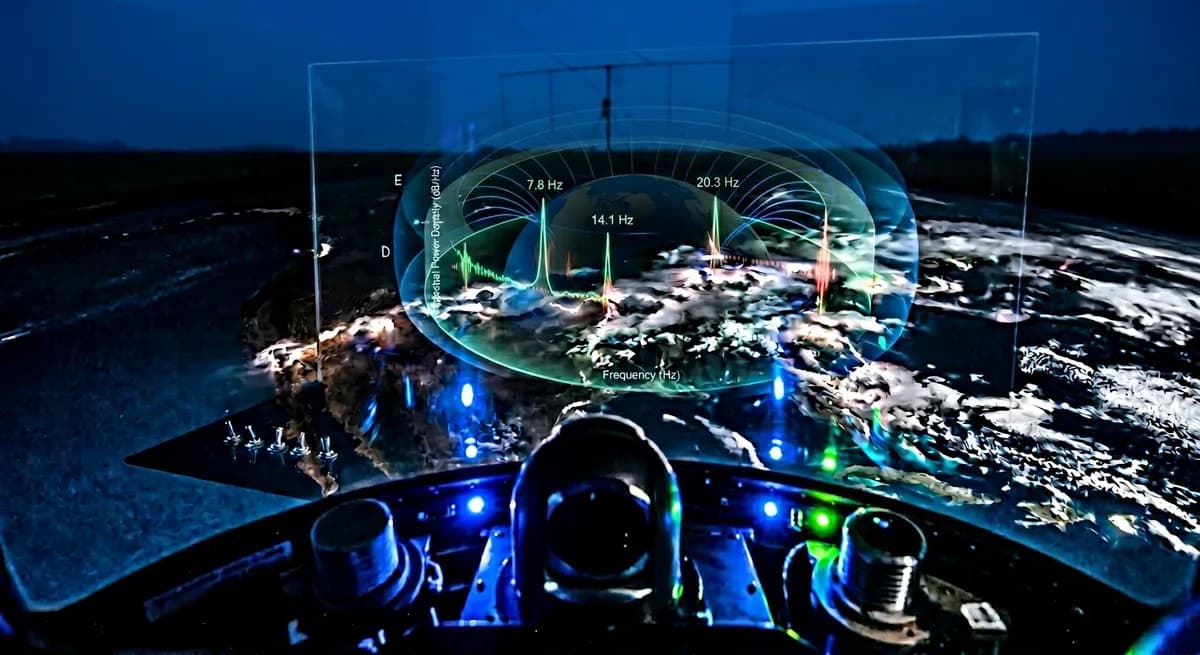
When lightning discharges occur, they emit broadband electromagnetic radiation across a wide spectrum of frequencies. However, the Earth-ionosphere cavity preferentially amplifies certain frequencies—those that correspond to its natural resonance modes. The fundamental resonant frequency, known as the Schumann Resonance, occurs at approximately 7.83 Hz. Higher harmonics exist at roughly 14.3 Hz, 20.8 Hz, 27.3 Hz, and beyond, but the fundamental frequency dominates both in amplitude and in scientific attention.
The electromagnetic energy from lightning doesn't dissipate immediately. Instead, it propagates around the planet in the form of electromagnetic waves confined within the cavity. These waves reflect off the ionospheric boundary and Earth's surface, creating interference patterns. Under ideal conditions, constructive interference occurs at the resonant frequencies, amplifying these signals while other frequencies dampen. This is why the Schumann Resonance appears as a discrete, measurable peak in the electromagnetic noise floor—it represents the cavity's preferred mode of oscillation.
Global Thunderstorm Activity and Continuous Resonance
At any given moment, approximately 40 to 50 thunderstorms are active somewhere on Earth. This constant global convective activity ensures that the Earth-ionosphere cavity receives a continuous input of electromagnetic energy. The distribution of these storms is not random; they follow seasonal and diurnal patterns influenced by solar heating, atmospheric circulation, and geography.
Tropical regions, particularly over Africa, South America, and Southeast Asia, experience the highest thunderstorm activity. The intense solar heating in these regions drives convection, generating more frequent lightning discharges than temperate or polar zones. As Earth rotates, the primary region of thunderstorm activity moves, but the global total remains relatively constant. This geographic distribution of lightning activity creates a natural "excitation pattern" that continuously drives the Schumann Resonance.
Research using satellite lightning detection has revealed that the global lightning rate shows clear diurnal cycles. Activity peaks in local afternoon and evening hours when solar heating is strongest. Despite this variation, the overall electromagnetic signature of the Schumann Resonance remains stable over long timescales, suggesting that the system is robust to fluctuations in local storm activity. The planetary-scale distribution of storms ensures that when activity decreases in one region, it increases elsewhere, maintaining the resonance.
The Mechanism of Electromagnetic Excitation
The process by which lightning excites the Schumann Resonance occurs in multiple steps. First, a lightning stroke delivers a large current impulse to the ground, typically ranging from 20,000 to 200,000 amperes. This sudden current change generates electromagnetic radiation across a broad frequency spectrum, from extremely low frequency (ELF) waves at a few hertz to radiofrequency emissions at megahertz scales.
The ELF component of this radiation is crucial for Schumann Resonance excitation. These low-frequency waves propagate efficiently within the Earth-ionosphere cavity because they experience minimal attenuation at these frequencies. As the electromagnetic wave travels around the planet, it interacts with the cavity's boundaries. At the resonant frequency, the wave's phase velocity and wavelength align perfectly with the cavity's circumference, allowing constructive interference to occur.
Multiple lightning strokes in rapid succession, or the cumulative effect of thousands of simultaneous storms, build up the electromagnetic field at the resonant frequency. This field oscillates at 7.83 Hz and its harmonics, creating the measurable Schumann Resonance signal that researchers detect with sensitive magnetometers and electric field sensors positioned around the globe.
Measurement and Monitoring Infrastructure
Scientists monitor the Schumann Resonance using networks of ground-based instruments designed to detect extremely low-frequency electromagnetic fields. These instruments measure both the magnetic component (using magnetometers) and the electric component (using electric field sensors) of the electromagnetic wave. The most prominent peak in the power spectrum of these measurements occurs at 7.83 Hz, confirming the theoretical prediction and demonstrating the continuous excitation by global thunderstorm activity.
Research stations are distributed across multiple continents, providing a global perspective on Schumann Resonance characteristics. Data from these stations have consistently shown that the fundamental frequency remains stable near 7.83 Hz over decades of measurement, with seasonal and diurnal variations of only a few tenths of a hertz. This stability reflects the robustness of the Earth-ionosphere system and the effectiveness of global thunderstorm activity in maintaining resonance.
Conclusion
Thunderstorms are far more than local weather phenomena; they are the planetary-scale mechanism that maintains one of Earth's most fundamental electromagnetic signatures. Through the continuous generation of lightning discharges, distributed across tropical and temperate regions, thunderstorms inject electromagnetic energy into the Earth-ionosphere cavity. This energy resonates at the cavity's natural frequencies, with the Schumann Resonance at 7.83 Hz emerging as the most prominent manifestation. This system operates with remarkable consistency, demonstrating how local meteorological processes connect to global electromagnetic phenomena. Understanding this relationship deepens our appreciation for Earth's interconnected physical systems.