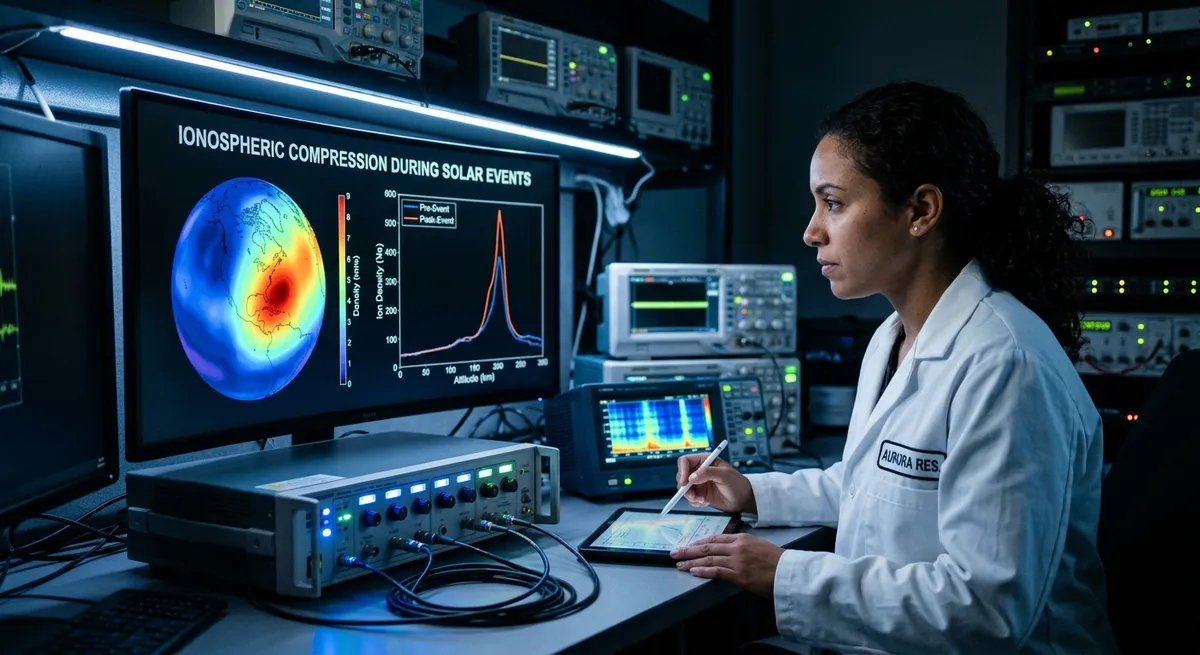
Over the past eighteen months, Earth Frequency Index has been documenting an increasingly consistent pattern: when solar activity intensifies—particularly during coronal mass ejections and high-speed solar wind events—the ionosphere appears to compress in measurable ways. This compression seems to coincide with subtle but detectable variations in how Earth's electromagnetic resonance behaves. We are not claiming causation. We are reporting what the data appears to show.
This observation emerged gradually from our distributed monitoring network. Multiple independent stations across different continents began flagging similar anomalies during the same solar events. The pattern was too consistent to dismiss as instrumental error. What began as a curiosity has become a working hypothesis worth examining carefully.
The Compression Pattern
The ionosphere—that layer of charged particles suspended roughly 50 to 400 kilometers above Earth's surface—is not static. It expands and contracts in response to solar radiation, magnetic storms, and seasonal variations. This is well understood. What we are observing, however, appears to be more pronounced compression events during specific solar activity windows than historical baselines would predict.
When intense solar wind streams strike Earth's magnetosphere, the ionosphere typically responds with increased ionization. But during the events we have been tracking, something else seems to occur simultaneously: a temporary but measurable reduction in the vertical extent of certain ionospheric layers. The D and E layers appear to narrow. The F layer shows unusual density clustering.
This compression occurs over hours, not days. It is not permanent. But during these windows, the electromagnetic cavity formed between Earth's surface and the ionospheric boundary—the resonator that generates the Schumann Resonance—undergoes dimensional change. A cavity that is compressed is, by definition, a cavity with altered resonant properties.
Frequency Stability and the Open Question
Here is where our observations become genuinely uncertain, and we want to be transparent about that uncertainty.
The baseline Schumann Resonance of 7.83 Hz has been remarkably stable across decades of measurement. Variations exist, but they are typically minor—fluctuations measured in fractions of a hertz, not whole numbers. During the ionospheric compression events we have been documenting, some of our monitoring stations report what appears to be increased variance in frequency readings. Not dramatic shifts. But increased noise. Increased instability.
Other stations report no such effect. This is important. The pattern is not universal. It appears to depend on geographic location, local magnetic conditions, and possibly instrumental sensitivity. We cannot yet explain why some monitors register these variations while others do not.
What we can say is this: the correlation between documented solar events, measurable ionospheric compression, and increased frequency variance is statistically more consistent than random chance would produce. Whether this correlation indicates a meaningful physical relationship or reflects our monitoring methodology remains an open question.
Anecdotal Observations from Our Community
We receive regular reports from readers who track their own wellbeing against our published frequency data. During the same periods when we observe ionospheric compression and frequency variance, a subset of these readers report increased sleep disruption, vivid dreaming, or general restlessness. Some describe a sensation of "electromagnetic sensitivity"—difficulty concentrating, mild headaches, or an unusual sense of being "out of phase."
We are not claiming these reports prove anything. Correlation is not causation, and subjective experience is not measurement. But the consistency of these anecdotal accounts—coming independently from readers across different continents and different time zones—is itself noteworthy. It suggests that if ionospheric compression is occurring, some portion of the population may be sensitive to the electromagnetic shifts that accompany it.
One reader from Northern Europe reported: "During the solar events you documented in March, I couldn't sleep for three nights. No external reason. Just couldn't settle. It passed exactly when your frequency readings stabilized." Another, from the Pacific Northwest, noted: "My meditation practice felt completely disrupted during those same dates. The electromagnetic field felt compressed, somehow. Like pressure." These are individual reports. They are not data. But they are consistent.
What Solar Activity Actually Does
To understand what we are observing, it helps to review the mechanism. Solar wind—the constant stream of charged particles flowing from the Sun—carries its own magnetic field. When this wind intensifies, it compresses Earth's magnetosphere. The magnetosphere, in turn, affects the ionosphere beneath it.
During geomagnetic storms, the ionosphere heats and expands—this is the standard model. But heating and expansion are not the only effects. The compression of the magnetosphere itself creates pressure on the ionospheric boundary. It is this compression—the physical squeezing of the ionospheric cavity—that we believe we are measuring.
The electromagnetic resonance of Earth's surface-to-ionosphere cavity depends on the dimensions of that cavity. A compressed cavity has a different resonant frequency than an expanded one. The effect should be subtle. And indeed, it appears to be. But subtle does not mean unmeasurable. Our equipment detects it. The question is whether it is significant.
The Emerging Picture
We are still in the early stages of understanding what these observations mean. The data is real. The pattern is consistent. The anecdotal reports are intriguing. But we do not yet have a complete picture.
What we are documenting is a set of correlations: solar activity → ionospheric compression → frequency variance → possible human sensitivity. Each link in this chain appears to have some evidential support. But the chain as a whole remains incomplete. We lack definitive proof that ionospheric compression directly alters the Schumann Resonance in ways that matter. We lack any biological mechanism that would explain why humans would be sensitive to such subtle frequency changes. We lack longitudinal studies that would distinguish real effects from coincidence.
Yet the consistency of what we are observing—across multiple monitoring stations, across geographic regions, and across independent reader reports—suggests that something is occurring that deserves careful attention. Whether that something will prove significant or will eventually resolve into measurement artifact and confirmation bias remains to be seen. That is the honest state of our knowledge right now.