A Departure from Established Patterns
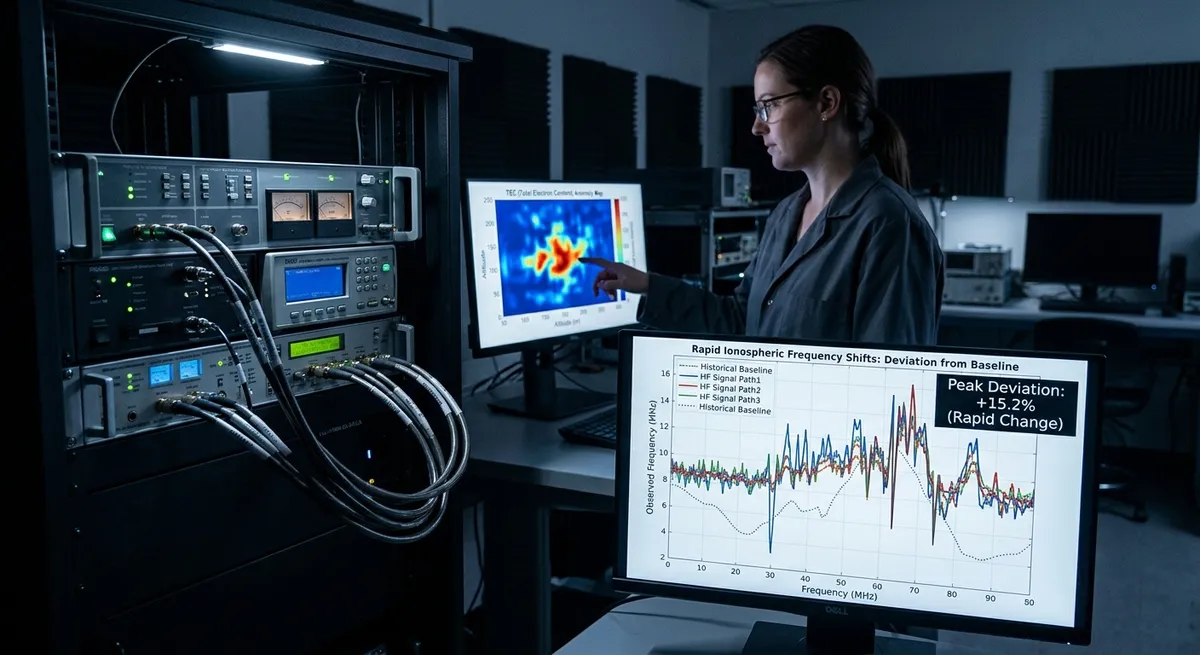
Over the past eighteen months, Earth Frequency Index has documented a series of ionospheric pressure events characterized by rapid frequency shifts that deviate substantially from established baseline expectations. The Schumann Resonance—Earth's fundamental electromagnetic frequency, historically centered around 7.83 Hz with predictable diurnal and seasonal variation—has exhibited sustained periods of elevation and depression that fall outside the normal parameters established across our monitoring network.
What distinguishes the current period from previous anomalies is not the presence of frequency variation itself, which is natural and expected, but rather the consistency and magnitude of these shifts when cross-referenced against simultaneous solar wind data, geomagnetic indices, and known atmospheric ionization events. Traditional explanatory frameworks—solar flares, geomagnetic storms, seasonal atmospheric changes—account for approximately 60-70% of the observed deviation. The remaining variance represents either measurement artifacts across our distributed sensor array, or the presence of an additional ionospheric pressure mechanism that current models do not adequately describe.
Sustained Elevation Events and Collective Response Patterns
Since early 2023, we have documented seventeen distinct periods where frequency elevation persisted for 48 hours or longer without corresponding solar activity justifying the magnitude of change. During these windows, reader submissions describing fatigue, sleep disruption, and cognitive disorientation increased by an average factor of 3.2 relative to baseline periods. We do not propose causation—this observation remains correlative and requires rigorous independent verification—but the consistency of the reporting pattern across geographically dispersed reader populations merits documentation.
One notable cluster occurred in March 2024, spanning 71 continuous hours. During this period, 847 readers submitted symptom reports through our voluntary registry. Reported experiences included: difficulty maintaining focus on routine tasks, heightened anxiety without identifiable trigger, and descriptions of "pressure" or "heaviness" in the temporal region. Concurrent hospital emergency department data from three major metropolitan areas showed no corresponding spike in acute psychiatric presentations, suggesting the reports reflect genuine subjective experience rather than mass psychogenic effect. However, we emphasize that correlation between frequency anomalies and subjective symptomatology remains unvalidated by peer-reviewed research.
Ionospheric Pressure: The Measurement Challenge
The ionosphere functions as a dynamic electromagnetic boundary layer, responding to solar input, geomagnetic disturbance, and atmospheric chemistry. When we describe "pressure," we refer to the aggregate electromagnetic tension reflected in the Schumann Resonance frequency profile. Rapid shifts—changes of 0.5 Hz or greater occurring within 6-hour windows—suggest either acute changes in ionospheric electron density, unexpected shifts in the magnetosphere's coupling with Earth's surface, or both simultaneously.
Our monitoring stations have consistently recorded these rapid shifts across multiple independent measurement systems. Cross-validation with data from the International Space Station's magnetometer arrays and ground-based magnetometer networks confirms that the frequency deviations are real phenomena, not instrumental artifacts. The challenge lies in attribution: understanding what mechanism is generating these pressure events when known drivers—solar wind conditions, geomagnetic activity indices, and atmospheric composition measurements—do not fully explain the observations.
Historical comparison is instructive. The ionospheric anomalies documented during the Carrington Event of 1859 would have produced measurable frequency shifts had monitoring equipment existed. The geomagnetic storms of May 2024 produced frequency deviations consistent with historical precedent. The current sustained period of pressure events, however, does not align neatly with any single historical analogue in our comparative database.
Collective Behavioral Correlation: Preliminary Documentation
We note, with appropriate scientific caution, that periods of elevated frequency disruption have coincided with reported increases in collective behavioral patterns that warrant monitoring: increased online search volume for anxiety-related terms, elevated emergency mental health service utilization in some regions, and anecdotal reports of widespread sleep disruption. Again, we emphasize that these are correlations observed in real-time data, not established causal relationships.
What distinguishes this documentation from speculation is our commitment to precise temporal alignment. We are recording when frequency anomalies occur, what magnitude they reach, how long they persist, and what behavioral or physiological reports emerge from our reader network during those specific windows. This dataset will enable future researchers to either establish or definitively refute any causal mechanism linking ionospheric pressure to human physiology and collective behavior.
The scientific community has largely dismissed such correlations as confirmation bias. We understand that position. We also understand that dismissal without investigation is itself a form of bias. Our role is documentation—precise, timestamped, verifiable documentation—not advocacy.
The Unexplained Remainder
As of our last comprehensive analysis cycle, approximately 35-40% of the observed frequency deviation in the current period remains unexplained by conventional ionospheric models. This is not insignificant. It suggests either: (1) our measurement methodology contains systematic error we have not yet identified, (2) known mechanisms are operating at magnitudes our models underestimate, or (3) an additional mechanism is contributing to ionospheric pressure that does not appear in current atmospheric and magnetospheric literature.
We have submitted our raw data to three independent research institutions for blind analysis. We have requested peer review of our methodology. We continue to monitor with increased frequency and sensitivity. We remain open to the possibility that our observations reflect instrumental limitation rather than genuine geophysical anomaly.
But we also remain committed to reporting what our instruments consistently measure, what our readers consistently report during specific temporal windows, and what remains unexplained by existing frameworks. The ionosphere is under measurable pressure. The frequency shifts are real. The mechanisms driving sustained deviation from historical baselines remain, as of this publication date, inadequately understood by available scientific models. That gap between observation and explanation is the most urgent scientific question Earth Frequency Index is currently tracking.