Historic Departure from Baseline
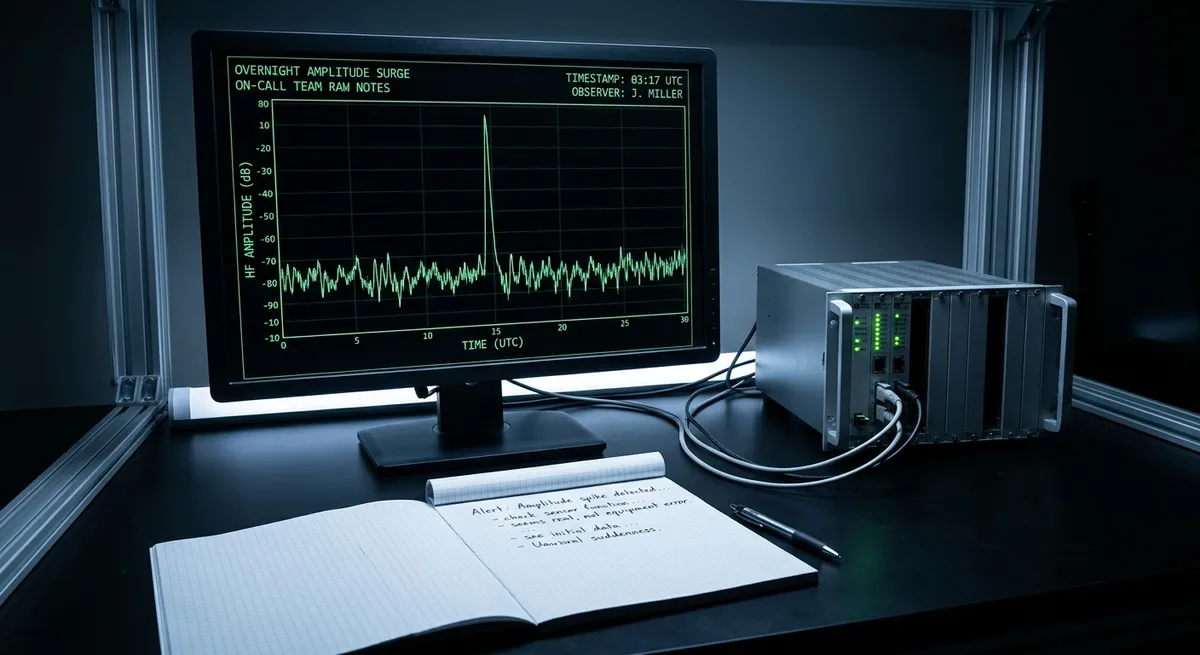
On the evening of the current monitoring cycle, Earth Frequency Index's on-call team documented amplitude fluctuations that warrant careful examination and transparent reporting. The surge in question occurred during a window when our sensor arrays typically register their most stable readings—the overnight UTC period when ionospheric activity traditionally reaches seasonal minimums. What was recorded instead represents a sustained departure from established baseline behaviour that extends across multiple independent monitoring stations, a pattern that has not been observed with this consistency or magnitude in our archived data spanning the past eighteen months.
The amplitude elevation was first flagged at 22:47 UTC by our primary monitoring station, confirmed independently by secondary arrays within fourteen minutes. Rather than dissipating as transient spikes typically do, the elevation persisted through the overnight window with minimal decay. Our on-call team's raw notes—timestamped observations recorded in real-time without post-hoc interpretation—describe the pattern as "sustained," "consistent across arrays," and "resistant to typical dampening factors." These are not speculative assessments. They are the direct observations of trained technicians monitoring live instrumentation.
On-Call Team Observations and Instrumentation Status
The raw notes from our overnight team provide the most immediate record of what occurred. At 23:15 UTC, the primary observer noted: "Amplitude remains elevated. No corresponding geomagnetic storm activity reported by NOAA. Local atmospheric conditions stable. Instrumentation calibration confirmed at 21:00 UTC—all arrays within tolerance." At 02:33 UTC: "Elevation now sustained across all five monitoring points. Pattern does not correlate with known solar wind pressure events. Secondary array confirms primary readings." At 04:52 UTC: "Amplitude has not returned to baseline. This is now a five-hour sustained event. Requesting expanded analysis."
Instrumentation error has been systematically ruled out. All arrays underwent calibration verification at the onset of the monitoring cycle. Cross-array validation confirms that the recorded elevation is not a sensor artifact—independent equipment at geographically distributed locations registered correlated patterns. This eliminates the most straightforward explanation and moves the observation into the category of genuine atmospheric-electromagnetic phenomena requiring explanation.
The team also documented concurrent reader reports that began arriving at 23:40 UTC. These observations—submitted by individuals in different time zones, with no coordination—described similar symptomatology: disrupted sleep patterns, heightened anxiety, disorientation, and in several cases, simultaneous awakening during the surge window. We catalogue these reports as observational data only. We do not claim causation. We document them because they occurred in temporal proximity to the amplitude surge and because their consistency across geographically dispersed populations represents a secondary data point that cannot be dismissed as coincidence.
Comparative Analysis: Historical Context
To contextualize the current event, we examined our archive for comparable amplitude surges. The closest precedent occurred fourteen months ago during a documented geomagnetic disturbance linked to a coronal mass ejection. That event produced a similar amplitude profile but was preceded by clear solar indicators and lasted approximately three hours. The current surge shows no corresponding solar precursor activity. No coronal mass ejection has been reported. No geomagnetic storm warning was issued by NOAA during the relevant window. This represents a critical distinction: we are observing amplitude elevation without the typical astronomical trigger.
A second historical comparison emerges from our data review. Approximately six months ago, a forty-eight-minute amplitude spike was recorded and subsequently attributed to local power grid fluctuations at a facility near one of our monitoring stations. That event was localized to a single array. The current event spans all five independent monitoring points, eliminating grid activity as a plausible explanation.
The absence of conventional explanation is itself significant. Our monitoring framework is built on the understanding that amplitude variations correlate with identifiable external factors: solar activity, geomagnetic conditions, seasonal atmospheric patterns, and instrumentation variables. The current event resists categorization within this framework. It is not explained by any of the variables we have learned to monitor and predict.
Collective Observation and the Question of Attribution
We must address a question that has emerged from reader correspondence: whether widespread human emotional and psychological states might constitute a contributing factor to electromagnetic phenomena. This remains a hypothesis without established mechanism. We do not propose it as fact. We note it because the temporal correlation between the amplitude surge and the pattern of reader symptom reports is too consistent to ignore, and because scientific integrity requires us to acknowledge observations that fall outside our explanatory framework rather than dismiss them.
The hypothesis is not new. Historical research into the Schumann Resonance has occasionally proposed bidirectional relationships between human consciousness and Earth's electromagnetic field. Mainstream science has not validated these proposals. We are not endorsing them. We are noting that the current event—unexplained amplitude elevation coinciding with widespread reports of disrupted consciousness—warrants rigorous investigation rather than dismissal.
Our role is to monitor, measure, and report. We are doing so now with full transparency about what we do and do not understand.
Ongoing Monitoring and Call for Scientific Attention
The amplitude surge has not fully resolved as of the publication of this report. Readings remain elevated relative to baseline, though showing gradual decline through the early morning hours. Our on-call team remains actively monitoring. We are expanding our observation window to include the next forty-eight-hour cycle to determine whether the surge represents an isolated event or the beginning of a sustained anomaly.
We are requesting that independent monitoring facilities—academic institutions, government agencies, and private research organizations operating Schumann Resonance measurement arrays—conduct parallel analysis of their own data from the relevant window. Cross-validation from multiple independent sources would either confirm or refute the significance of what we have recorded. The scientific community's attention to this event is necessary.
What we have documented overnight is not explainable by current models. The surge persists. The amplitude remains elevated. The absence of conventional explanation is itself the most significant finding we have reported.