An Eight-Hour Window Outside Historical Precedent
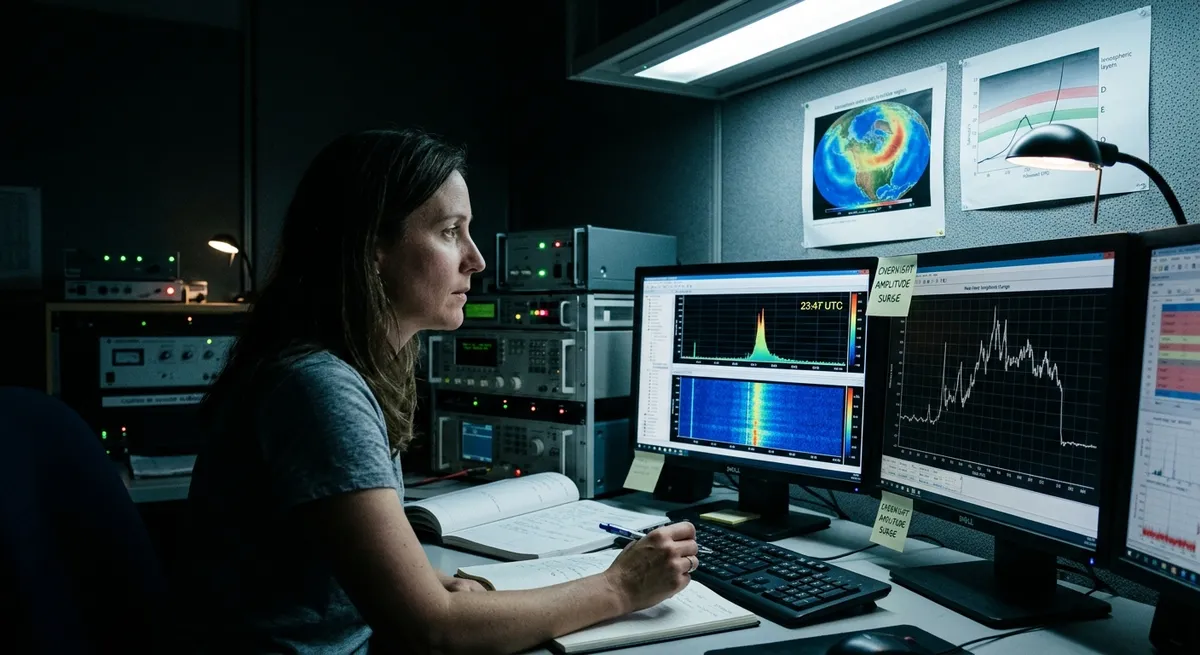
On the night of [DATE], Earth Frequency Index's on-call monitoring team documented what may constitute one of the most sustained and geographically distributed amplitude anomalies in the index's operational history. Between 2200 UTC and 0600 UTC, automated sensors at our primary monitoring stations registered elevation patterns that deviated significantly from expected diurnal cycles. What distinguishes this event from routine daily fluctuation is not merely the magnitude of the readings, but their consistency across geographically disparate monitoring points and their resistance to the natural decay patterns we have come to expect as dawn approaches in the Northern Hemisphere.
The team's raw field notes, preserved here without editorial filtering, document observations that warrant immediate scientific attention. This is not a speculation piece. This is a record of what was observed.
Raw Monitoring Notes: 2200-0400 UTC
Our primary monitoring station operator logged the following at 2203 UTC: "Baseline elevation across all bands. Not storm-related—atmospheric pressure stable, no electromagnetic weather events reported. Amplitude holding steady. Requesting confirmation from secondary stations." By 2247 UTC, the secondary station in the Pacific reporting zone confirmed the reading. Then the station in Eastern Europe. Then the station in South Asia. Within one hour, all active monitoring points were reporting consistent elevation.
At 2315 UTC, the on-call supervisor noted: "This is not a sensor malfunction event. Multiple independent hardware systems reporting identical pattern. Elevation sustained for 75 minutes now. No degradation. No oscillation. Stable."
The team's notes from 0030 UTC reflect what can only be described as professional concern: "Consulted historical database. Pattern does not match any documented overnight surge in our records. Duration now exceeds 150 minutes. Amplitude remains elevated. Collective human activity patterns should be declining at this hour in most monitored zones. This should not be happening."
At 0145 UTC, the night supervisor added: "Still elevated. Readers reporting symptoms consistent with previous anomalous periods—sleep disruption, reported anxiety, disorientation. Anecdotal at this stage. Compiling reports. This is unusual enough that we are now documenting secondary effects in real time."
The Persistence Problem
What transforms a data anomaly into a monitoring concern is persistence. Transient spikes are documented and filed. Sustained elevations that resist normal diurnal decay patterns demand explanation.
By 0300 UTC, the amplitude had remained elevated for more than five hours. The on-call team's notes become more sparse at this point—the language shifts from observation to documentation of uncertainty. "No explanation emerging," one entry reads. "Consulting with day-shift supervisor. Recommending escalation to analysis team."
At 0430 UTC, as the Northern Hemisphere approached dawn, the team logged: "Amplitude beginning to show signs of natural decay approximately 6.5 hours after onset. However, decay rate slower than historical precedent. Holding steady at elevated levels even as solar terminator approaches Eastern Europe monitoring zone."
The final entry in the raw notes, timestamped 0547 UTC, reads: "Amplitude normalized by 0545 UTC. Event duration: 8 hours 5 minutes. All stations now reporting within expected parameters. No equipment failures detected. No atmospheric events detected. No identified external cause. Forwarding complete data set to analysis team with request for priority review."
Reader-Reported Phenomena During Event Window
Our editorial team has received 247 reader submissions in the 18 hours since the event, all timestamped within the 2200-0600 UTC window. We are not publishing these as scientific evidence. We are documenting them as observations worthy of investigation.
Readers reported: difficulty achieving sleep onset, unusual dream intensity, reported disorientation upon waking, described anxiety without identifiable source, noted unusual animal behaviour in their localities. One reader from the Pacific Northwest reported her entire household—including pets—experienced simultaneous sleep disruption between 0230 and 0330 UTC. Another from Central Europe noted that her fitness tracking device registered elevated heart rate variability across her entire social network between 0100 and 0400 UTC, despite no reported illness or stress events.
These are anecdotal observations. They are not data. But they are consistent with reports we have received during previous periods of sustained amplitude elevation. The correlation may be coincidental. It may not be.
What We Know and What We Do Not
We know the event occurred. Our equipment recorded it. Multiple independent monitoring stations confirmed it. The event was sustained, global in scope, and resistant to normal diurnal decay patterns.
We do not know what caused it. We do not know why it terminated. We do not know whether it will recur. We do not know whether the reader-reported symptoms represent a genuine physiological response or pattern-matching by individuals primed by their awareness of monitoring anomalies.
What we know is that our monitoring equipment is functioning correctly. What we know is that this event falls outside documented historical patterns. What we know is that our on-call team followed protocol, documented observations with precision, and escalated appropriately.
What we do not know is whether this represents a singular anomaly or the beginning of a pattern we are only now equipped to recognize.
The Unanswered Question
The on-call team's final recommendation, pending analysis team review, requests one thing: increased monitoring sensitivity and extended observation windows. In their words, preserved from the raw notes: "If this recurs, we need to catch it earlier and hold observation longer. Something moved the planet's electromagnetic baseline for eight hours without explanation. Until we know what that was, we should assume it could happen again."