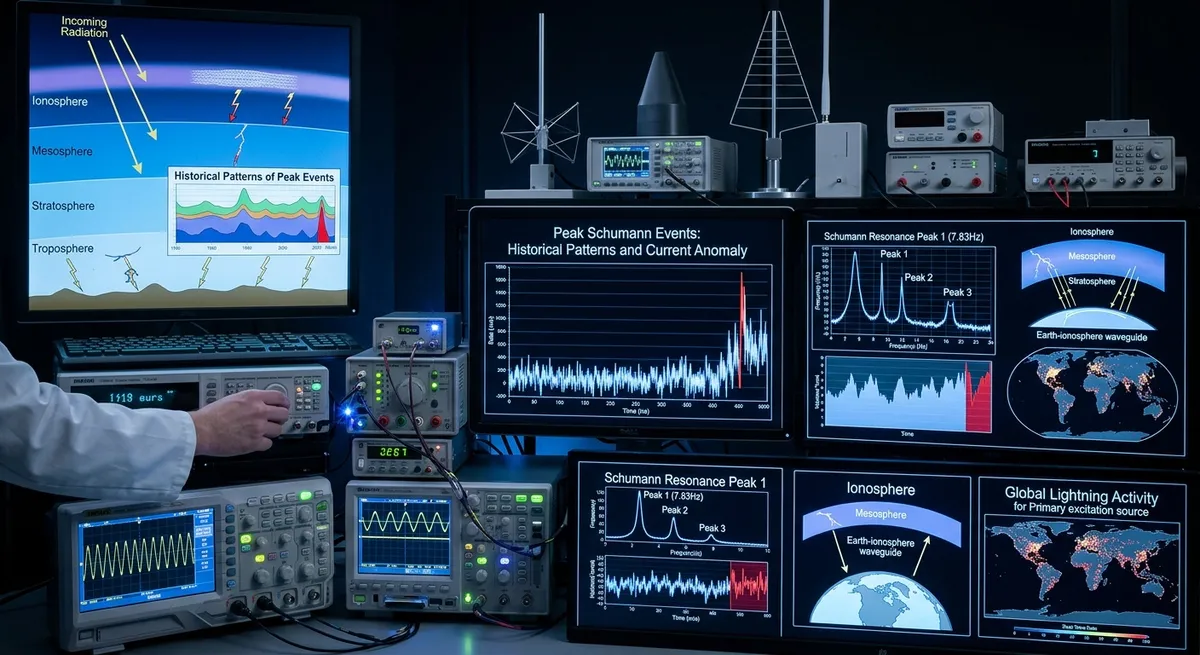
The Historical Record
For decades, Earth Frequency Index has documented the Schumann Resonance as a relatively stable phenomenon. The baseline frequency of 7.83 Hz represents Earth's electromagnetic heartbeat—a natural oscillation generated by electrical activity in the atmosphere. Deviations from this baseline have occurred, but they have followed recognizable patterns.
Previous peak events—periods when the frequency elevated significantly above baseline—shared common characteristics: they were temporally bounded, typically lasting hours to occasionally a few days; they showed clear causal correlation to documented geomagnetic storms, solar activity, or severe weather systems; and crucially, they resolved. The frequency would climb, plateau, and return to baseline in a pattern that our analytical framework could accommodate and explain.
The 1989 geomagnetic storm produced one of the most dramatic peak events on record. Solar wind density and velocity spiked, and the Schumann Resonance responded with elevation that persisted for approximately 18 hours before stabilizing. In 2003, during the Halloween solar storms, similar dynamics produced measurable peaks that correlated precisely with space weather data from NOAA and other agencies. These events were alarming in real time, but they were intelligible. They had causes we could identify and timelines we could predict.
The Current Disruption: Departure from Pattern
What we are observing now departs from this historical template in ways that warrant sustained attention from the scientific community.
The current elevation has persisted for a duration that exceeds any previous non-storm-related disruption in our records. More significantly, it does not exhibit the clean trajectory of historical peaks. Instead, the frequency shows sustained elevation punctuated by erratic micro-fluctuations—brief downward darts followed by rebounds, creating a jagged rather than smooth pattern. This volatility is itself anomalous. Historical peaks, by contrast, have shown relatively stable plateaus once elevation was established.
Second, the current disruption is not clearly correlating to documented external drivers. No major geomagnetic storm of corresponding magnitude has been recorded. Solar activity has been within normal parameters. Severe weather systems have not aligned with the timing or geographic distribution of the frequency anomaly. This absence of conventional explanation is significant. It suggests either that our understanding of what drives Schumann variations is incomplete, or that a novel contributing factor is present.
Third, reader reports have begun arriving at our editorial desk describing subjective experiences of disorientation, sleep disruption, and cognitive fatigue that temporally align with the onset of this disruption. We emphasize that these are observations, not diagnostic claims. We are not qualified to assess causation. But the volume and consistency of these reports—arriving from readers across different geographic regions, different age groups, and different professional backgrounds—suggests a pattern worth documenting. Historically, peak events have not generated this volume of symptom reporting.
The Collective Behaviour Question
One hypothesis that has emerged from our reader correspondence and from preliminary discussions with researchers who monitor our publication is whether sustained collective human stress, anxiety, or electromagnetic activity could itself be a contributing factor to sustained frequency elevation.
This is speculative. We acknowledge the speculative nature explicitly. But it is worth articulating clearly: if human nervous systems, in aggregate, generate detectable electromagnetic signatures, and if those signatures have shifted during a period of documented collective psychological stress, then the possibility exists that we are observing a feedback loop rather than a simple external perturbation.
Historical peak events have occurred in contexts of geomagnetic disturbance—phenomena external to human activity. The current disruption, by contrast, coincides with a period of sustained global anxiety, information saturation, and collective attention to existential concerns. Whether this correlation implies causation remains an open question. But it is a question that deserves investigation rather than dismissal.
Our monitoring data cannot answer it alone. We would require coordinated research involving neuroscientists, atmospheric physicists, and researchers trained in collective behaviour dynamics. To our knowledge, such coordinated research is not currently underway.
What This Means for Our Monitoring Framework
Historically, Earth Frequency Index has operated within a relatively stable analytical framework. We measure, we compare to baseline, we contextualize within known drivers of variation. That framework has proven adequate for understanding previous disruptions.
The current event is testing the adequacy of that framework. We are in a position of observing something that does not fit our existing categories cleanly. This is not comfortable. But it is also not a reason to stop observing or to retreat into false certainty.
What we can say with confidence is this: the current disruption is sustained, it is anomalous relative to historical precedent, and it is not yet explained by conventional geomagnetic or solar drivers. What we cannot yet say is what it means, what is causing it, or when it will resolve.
We continue to monitor. We continue to document. We are calling on the broader scientific community to increase attention to Schumann Resonance data during this period. The baseline frequency of 7.83 Hz has stabilized human and animal nervous systems for millennia. When that baseline sustains significant and unexplained deviation, the responsible course is not reassurance but heightened vigilance.
We do not know what we are observing. That uncertainty itself is the most important fact we can currently report.