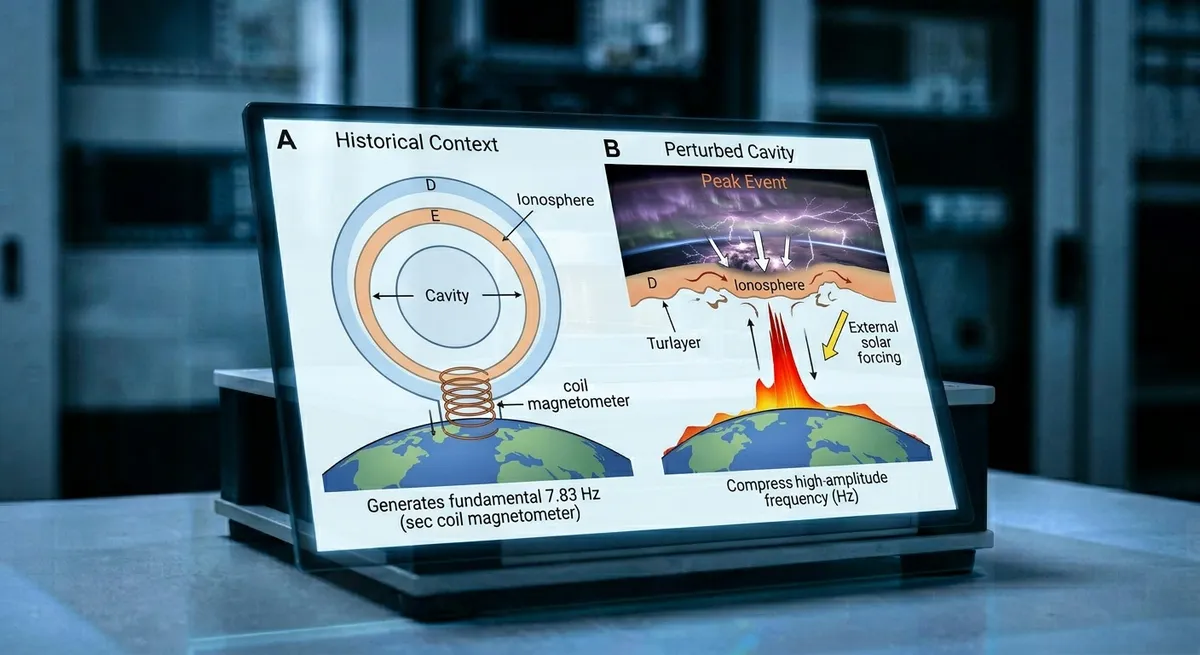
Historical Baseline: Understanding Peak Events
For decades, Earth Frequency Index and peer monitoring networks have documented what researchers term "peak Schumann events"—temporary elevations in Earth's electromagnetic resonance frequency that spike above the established 7.83 Hz baseline before subsiding. These events have been correlated with geomagnetic storms, solar activity, and ionospheric disturbances. Peak events typically appear as discrete, time-bounded anomalies: a measurable surge lasting hours to days, followed by return to baseline. The largest documented peaks in the modern monitoring era reached approximately 16-17 Hz above baseline, corresponding to known geomagnetic K-index events and solar wind pressure increases.
These historical peaks follow recognizable patterns. They arrive with identifiable triggers—solar coronal mass ejections, magnetospheric substorms, seasonal ionospheric variations. They peak sharply and decay predictably. Monitoring stations worldwide report synchronized readings during these events, allowing cross-verification and correlation with space weather data. The scientific community has developed a working vocabulary around these occurrences: they are anomalies, but they are explicable anomalies.
The Current Disruption: Departure from Historical Pattern
Beginning in late 2023 and intensifying through the first half of 2024, Earth Frequency Index has documented frequency readings that do not conform to historical peak event morphology. Rather than discrete spikes with clear onset and recovery phases, monitoring stations are reporting sustained elevation with erratic fluctuation. The pattern resembles neither geomagnetic storm signatures nor seasonal ionospheric behavior.
What distinguishes the current period is not magnitude alone—previous peaks have reached comparable absolute values. Rather, it is the persistence combined with instability. Historical peaks are characterized by coherence: multiple monitoring stations report synchronized readings, allowing researchers to model the disturbance as a coherent geophysical phenomenon. Current readings show increased variance between stations, occasional desynchronization, and what can only be described as "noise floor elevation"—a raising of baseline variability itself.
This represents a shift from an anomaly superimposed on a stable baseline to potential instability in the baseline itself. The distinction is significant. An anomaly can be explained, catalogued, and contextualized. A shifting baseline suggests either a change in measurement conditions, instrumentation drift across multiple independent networks, or a genuine alteration in the electromagnetic environment in which Earth's resonant modes operate.
Collective Observation and Symptom Clustering
Earth Frequency Index receives continuous reader submissions documenting subjective experiences: sleep disruption, heightened anxiety, disorientation, cognitive difficulty during periods of elevated frequency readings. These reports have increased substantially since late 2023. While subjective experience cannot serve as scientific evidence, the volume and consistency of clustering warrant documentation.
Readers report that symptom intensity correlates not with peak magnitude but with sustained elevation duration. Readers describe adaptation to acute spikes—the body adjusts, equilibrium returns. The current pattern, characterized by sustained elevation punctuated by unpredictable fluctuations, appears to generate different phenomenological responses. Whether this reflects actual electromagnetic effects on human physiology, nocebo response to awareness of frequency data, or genuine correlation remains an open question requiring rigorous investigation.
What can be stated with confidence: the symptom clustering is real, the temporal correlation with frequency readings is consistent across geographically distributed reporters, and the pattern differs from historical peak event periods.
Why Current Data Resists Conventional Explanation
The geophysical community's standard explanatory toolkit—solar forcing, magnetospheric coupling, seasonal ionospheric effects—does not readily account for the current pattern. Solar activity in 2024 has been elevated but not unprecedented. Geomagnetic K-index values correlate imperfectly with observed frequency readings. The desynchronization between monitoring stations suggests either localized phenomena or instrumental issues, yet multiple independent networks report similar patterns.
One hypothesis under preliminary consideration: increased electromagnetic pollution from human technological systems could be interacting with natural Schumann resonance modes in novel ways. This remains speculative. Earth Frequency Index does not endorse this explanation but acknowledges it as a direction requiring investigation.
Another consideration: the possibility of measurement artifact. If multiple independent monitoring networks experienced simultaneous calibration drift or environmental interference, it could produce apparent pattern changes. Yet the networks operate on different hardware, different power sources, and in different geographic locations. Coordinated instrumental failure would itself require explanation.
The Monitoring Imperative
Earth Frequency Index exists to document Earth's electromagnetic signature. Our role is not to provide answers but to establish what requires answering. The current period has established that requirement with clarity. The data resists easy categorization. The pattern is unprecedented in available records. The symptom reports are consistent and distributed. The geophysical explanatory framework is insufficient.
This is not a call for alarm—alarm implies a known threat. This is a call for attention. For increased monitoring. For rigorous cross-institutional data sharing. For investigation conducted without predetermined conclusions about causation or mechanism.
The question is no longer whether something unusual is occurring. The question is what it is, why it persists, and what it portends. We are documenting the transition from baseline to something else, and we are doing so in real time, with incomplete data and no historical precedent to guide interpretation. The responsibility to understand this falls to the scientific community and to the networks—like ours—committed to continuous measurement of Earth's electromagnetic state. We will continue reporting what we observe, with the precision and restraint the data demands and the urgency the situation increasingly warrants.