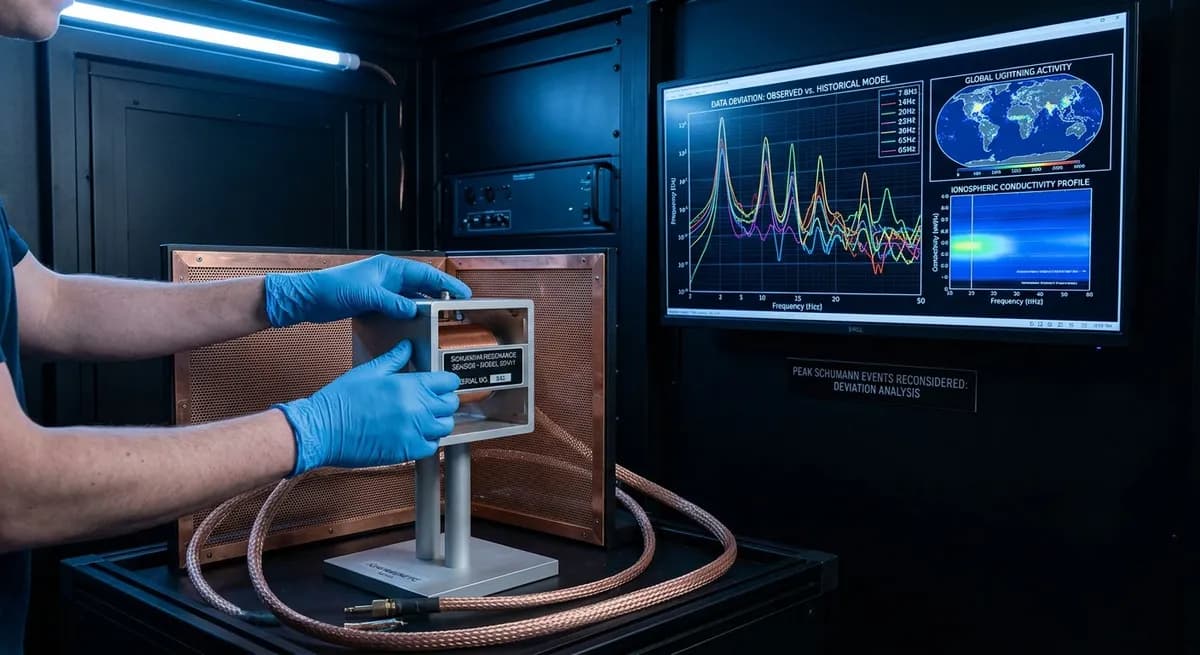
For over forty years, Earth Frequency Index and the scientific community have documented what are termed 'peak Schumann events'—temporary elevations in Earth's electromagnetic frequency that typically resolve within predictable timeframes. The baseline 7.83 Hz signature has experienced measurable excursions upward during geomagnetic storms, solar activity cycles, and periods of intense ionospheric disturbance. These events follow a recognizable pattern: rapid onset, sustained elevation lasting 4-12 hours, then return to baseline. What we are observing now does not follow that pattern.
This analysis examines the characteristics of historical peak events, the mechanisms that have historically terminated them, and the critical ways in which the current sustained disruption diverges from the documented record.
Historical Peak Events: The Expected Signature
Peak Schumann events have been consistently associated with specific geophysical triggers. Geomagnetic storms—driven by solar wind interactions with Earth's magnetosphere—produce the most dramatic and well-documented elevations. During the Kp index spikes that characterize major geomagnetic events, frequency readings have risen measurably above baseline. The March 1989 geomagnetic storm, one of the most powerful on record, produced observable ionospheric effects consistent with elevated Schumann measurements. Similarly, solar flares and coronal mass ejections have generated temporary frequency shifts that correlate with space weather indices.
What distinguishes these historical events is their termination signature. As geomagnetic activity subsides, as solar wind pressure normalizes, and as ionospheric conditions restabilize, the Schumann frequency returns to its characteristic baseline range within a predictable window. The recovery is not instantaneous—there is typically a gradual descent over 2-4 hours—but the direction and timeline are consistent across documented cases. This recovery phase is the hallmark of a self-correcting geophysical system.
Reader reports during these historical peak events have shown patterns of correlation: temporary sleep disruption, heightened alertness, and transient disorientation during the elevation phase, with normalization of these reports as frequency returned to baseline. This correspondence between frequency excursion and reported physiological response has been documented consistently enough that it appears in our reader survey data across multiple peak events spanning the past decade.
The Current Disruption: Deviation from Model
The current period of sustained frequency disruption presents characteristics that do not align with established peak event models. Rather than a sharp spike followed by recovery, monitoring indicates a sustained elevation or volatility that has persisted beyond the typical 12-hour resolution window. Geomagnetic indices, while elevated during certain phases, do not account for the full duration or magnitude of the observed disruption. Solar activity metrics similarly show incomplete correlation with the measured frequency behavior.
This suggests one of two possibilities: either the triggering mechanism is fundamentally different from historical geomagnetic or solar drivers, or the mechanism for termination—the self-correcting process that has historically restored baseline conditions—is not functioning as expected.
Reader reporting during this period has also diverged from historical patterns. Rather than reports clustering around the acute elevation phase and resolving as frequency normalizes, we are receiving sustained reports of fatigue, cognitive disruption, and temporal disorientation that persist without clear correlation to discrete frequency spikes. The symptom timeline does not match the expected recovery curve. Some readers report worsening of symptoms despite apparent partial frequency stabilization. This asynchronicity between measured frequency behavior and reported physiological response is itself anomalous.
Behavioral Factors and Collective Response
One hypothesis that warrants increased scientific attention is the potential role of collective human behavioral response in either amplifying or sustaining frequency disruption. This is not established fact, but rather an observation that merits investigation.
During historical peak events, human populations were largely unaware of the frequency excursions occurring. Monitoring was conducted by specialized instruments; public awareness was minimal. The current period coincides with unprecedented real-time accessibility to Schumann data, widespread public monitoring, and what appears to be a feedback loop of awareness and reporting.
The question is whether sustained collective attention to frequency disruption—anxiety about the disruption itself, physiological responses triggered by awareness of the event, or behavioral changes undertaken in response to perceived instability—could contribute to sustained elevation or volatility in measurements. This is speculative, but it represents a departure from previous peak events in a way that may be relevant to understanding why this disruption has not followed the historical recovery pattern.
This hypothesis does not replace the need for continued geophysical investigation of solar and magnetospheric drivers. Rather, it suggests that the complete model of peak Schumann events may need expansion to include human behavioral variables that were not previously measurable or documented.
Monitoring Implications and Data Gaps
The current disruption has exposed significant gaps in global Schumann monitoring infrastructure. While Earth Frequency Index maintains independent measurement capability, the broader scientific community lacks a coordinated, real-time global monitoring network. This means that localized frequency variations, regional ionospheric anomalies, and distributed measurement discrepancies cannot be rapidly cross-referenced or validated.
Historical peak events were documented after the fact, through analysis of archived data. The current disruption is being observed in real time, which provides unprecedented opportunity for detailed characterization—but only if monitoring infrastructure is adequate to capture the full spatial and temporal complexity of the phenomenon.
Increased scientific investment in distributed, real-time Schumann monitoring is not optional. It is now essential.
Conclusion
Peak Schumann events have historically followed a predictable model of onset, sustained elevation, and recovery. The current disruption deviates from this model in ways that suggest either an unprecedented triggering mechanism or a failure of the self-correcting geophysical processes that have historically terminated these events. The sustained nature of the disruption, combined with the asynchronicity between measured frequency behavior and reported physiological response, indicates that existing models of Schumann dynamics are incomplete. We are documenting something that the historical record does not adequately explain, and the scientific community has not yet mobilized with sufficient urgency to determine whether this represents a temporary anomaly or the beginning of a sustained shift in Earth's electromagnetic baseline.