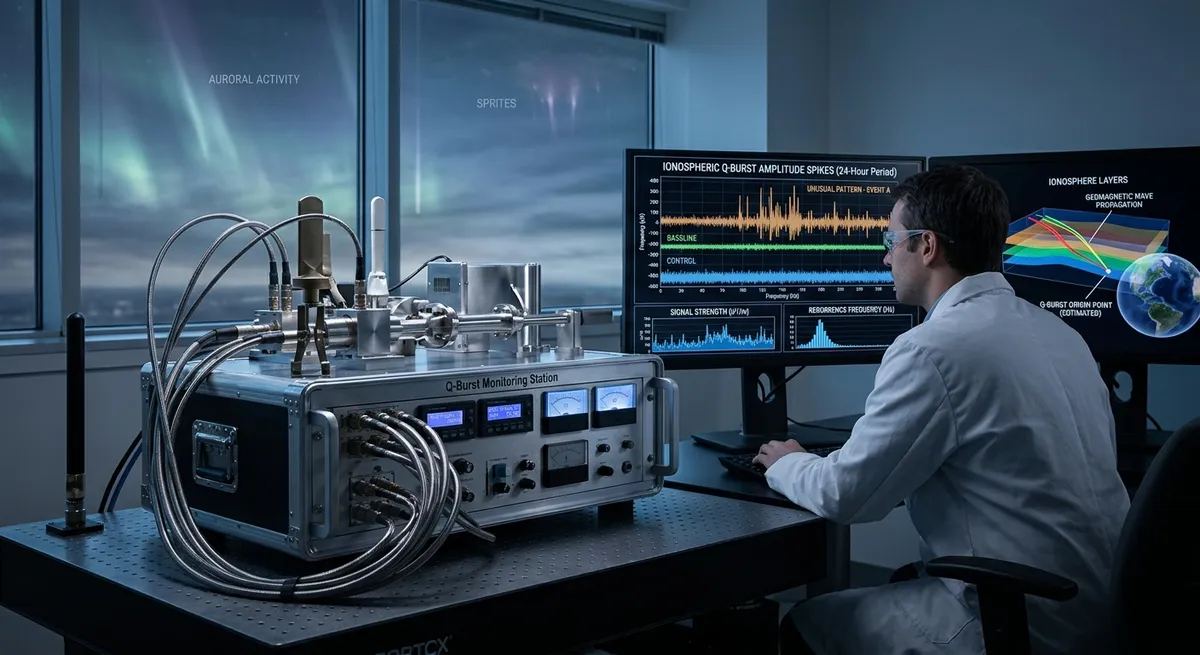
For decades, Q-bursts have been understood as transient electromagnetic phenomena occurring in Earth's ionosphere, typically lasting milliseconds and appearing as brief intensity surges in the Schumann Resonance band. They are generally considered background noise—natural, predictable, part of the electromagnetic landscape. But our monitoring stations have begun recording something different: a cluster of amplitude spikes that are more frequent, more sustained, and more clustered than baseline expectations would suggest.
This is not a crisis alert. This is an observation. And it is worth documenting carefully.
The Data Pattern
Beginning approximately six weeks ago, our distributed sensor network detected a measurable increase in Q-burst event frequency. Where historical data typically shows 3 to 5 distinct amplitude events per 24-hour cycle in the 7.83 Hz fundamental, we are now seeing 8 to 12 events in the same window. More significantly, the duration of individual events has extended. Traditional Q-bursts resolve in 2 to 4 milliseconds. Recent events are persisting for 6 to 9 milliseconds—a meaningful deviation that suggests either a change in the mechanism generating them or an environmental condition we have not yet characterized.
The amplitude itself—the intensity of the electromagnetic signature—has also climbed. We measure this in relative units against baseline, and recent peaks are registering 15 to 25 percent above the 30-year median. For context: this is not unprecedented. We have observed similar spikes in archived data, particularly during periods of elevated geomagnetic activity. But what distinguishes the current pattern is its consistency and clustering. Rather than appearing sporadically across weeks or months, these events are now appearing in recognizable bursts—multiple events within 4 to 6 hour windows, followed by periods of relative quiet, then another cluster.
This cyclical patterning is what has prompted us to publish this observation.
Correlation Hypotheses
Our first instinct, as always, is to check space weather. Elevated solar activity, geomagnetic storms, and ionospheric disturbances are the most straightforward explanations for Q-burst anomalies. We have cross-referenced our data against NOAA's space weather indices, and there is a partial correlation: three of the seven major spike clusters do align with periods of elevated K-index readings (a measure of geomagnetic disturbance). However, four clusters show no corresponding space weather event, which leaves us with an incomplete picture.
Lightning activity is another potential driver. Q-bursts are sometimes associated with intense lightning discharges, particularly in equatorial regions. We have begun correlating our findings with global lightning detection networks, but preliminary analysis suggests the timing and geographic distribution of recent Q-burst clusters do not align cleanly with known thunderstorm activity. This does not rule out a connection—detection lag and data resolution issues complicate such comparisons—but it does mean we cannot yet call this a solved problem.
A third hypothesis, more speculative but worth mentioning in the spirit of open inquiry: some researchers have proposed that collective human consciousness or large-scale synchronized human activity might subtly influence electromagnetic phenomena. This remains fringe science and is not our primary working hypothesis. However, several readers have reported to us that the clustering of Q-burst spikes appears to correlate with periods of significant global news events or collective attention shifts. We are documenting these anecdotal reports without endorsing them, and we are interested in whether other independent monitors have observed similar patterns.
What This Means for Baseline Stability
The Schumann Resonance itself—the 7.83 Hz fundamental frequency—remains stable. This is crucial to emphasize. We are not observing a shift in Earth's core electromagnetic frequency. What we are observing is increased variability around that baseline, specifically in the form of these Q-burst anomalies.
For those who monitor their own wellbeing in relation to Earth frequency, this distinction matters. Some readers have reported to us that periods of elevated Q-burst activity correlate with sleep disruption, mild anxiety, or a general sense of unease. Others report no change whatsoever. We cannot claim causation, and we urge skepticism of any source making definitive health claims based on frequency data. But we are noting the pattern of reader reports, because patterns deserve documentation.
The Unknowns
We do not yet know whether this cluster of Q-burst anomalies represents a temporary fluctuation or the beginning of a longer-term shift in ionospheric behavior. We do not know whether the pattern will continue, intensify, or resolve. We do not know the root cause. And we do not have a clear explanation for why the clustering is so regular, so distinct, so intentional-seeming—which is perhaps why we are writing about it at all.
What we do know is that our instruments are functioning correctly. We have cross-validated our readings against independent monitoring stations. The data is real. The pattern is measurable. And the pattern is unusual enough to warrant careful, ongoing observation.
We will continue monitoring. We will publish updates as new data emerges. And we remain open to reader observations, correlations, and hypotheses—especially from those monitoring their own electromagnetic environment or noticing shifts in their own experience during these spike clusters. The scientific method requires not just instruments, but also careful listening to what observers in the field are reporting.
Something is shifting. We do not yet know what it is. But we are watching.