Understanding Q-bursts in the Context of Schumann Resonance
Since Winfried Schumann's theoretical prediction in 1952 and subsequent experimental confirmation, the Schumann Resonance has remained a central focus of atmospheric and electromagnetic research. At its foundation is a simple but elegant principle: the Earth-ionosphere cavity acts as a natural resonator, oscillating at approximately 7.83 Hz. Yet the mechanism that continuously excites and sustains this resonance has long fascinated researchers. Enter Q-bursts—intense, transient electromagnetic pulses that represent one of the most significant drivers of Schumann Resonance activity.
Q-bursts, also known as "Q-type" electromagnetic transients, are brief but powerful bursts of electromagnetic energy generated during intense thunderstorm activity. Unlike typical lightning discharges, which produce broad-spectrum electromagnetic noise, Q-bursts are characterized by their exceptional intensity and their ability to efficiently excite the resonant modes of the Earth-ionosphere cavity. The term "Q" is believed to derive from the quality factor associated with resonant systems, reflecting the high-quality electromagnetic coupling these events produce with the global resonance.
The Physics of Q-burst Generation and Propagation
Q-bursts originate from the most intense lightning strokes, particularly those associated with positive cloud-to-ground lightning and the return stroke phase of negative lightning. During these extreme electrical events, the rapid discharge of current creates electromagnetic waves across a broad frequency spectrum. However, certain conditions—including the geometry of the discharge, the conductivity of the ground, and the ionospheric conditions at the moment of discharge—allow some of these pulses to couple with exceptional efficiency into the Earth-ionosphere cavity.
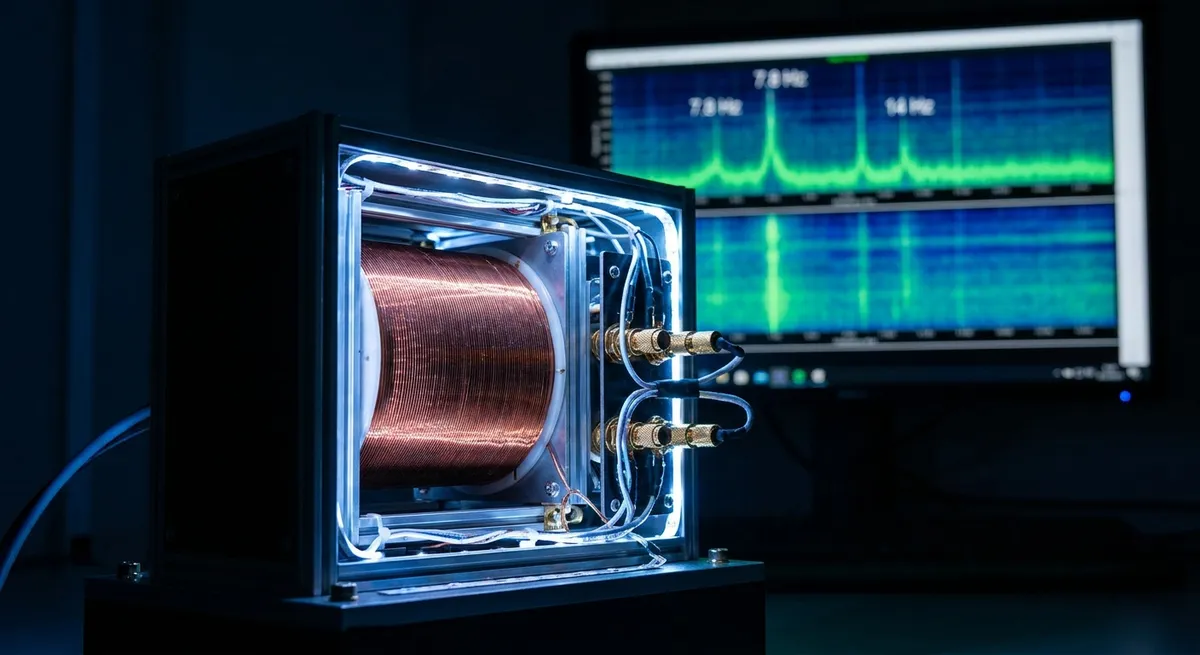
What makes Q-bursts distinct is their spectral signature. While typical lightning produces electromagnetic energy distributed across many frequencies, Q-bursts exhibit a narrow, well-defined spectral peak centered near the fundamental Schumann Resonance frequency of 7.83 Hz and its harmonics. This concentration of energy at resonant frequencies means that Q-bursts are remarkably effective at driving oscillations in the Earth-ionosphere system.
The propagation of Q-bursts is also noteworthy. Once generated, these pulses propagate around the Earth in the waveguide formed by the surface and the ionosphere. Because they couple so efficiently with the resonant cavity, they can be detected at monitoring stations thousands of kilometers away from their source. This global propagation characteristic has made Q-bursts invaluable for researchers attempting to map thunderstorm activity and understand the distribution of electromagnetic energy input into the Schumann Resonance system.
Q-bursts as a Research Tool
From a scientific perspective, Q-bursts have become essential markers in Schumann Resonance research. Their distinctive electromagnetic signatures allow researchers to distinguish them from background electromagnetic noise and typical lightning activity. This clarity has enabled more precise measurements of how external electromagnetic events drive the global resonance.
Monitoring networks around the world now routinely detect and catalog Q-burst events. These detections provide researchers with real-time data about global thunderstorm intensity and distribution. By analyzing the amplitude, frequency content, and temporal characteristics of Q-bursts, scientists can infer information about the severity of lightning activity in different regions and how this activity correlates with seasonal and solar cycle variations.
The study of Q-bursts has also contributed to our understanding of the Earth-ionosphere cavity itself. By observing how Q-bursts excite different resonant modes and how these modes decay over time, researchers can extract information about the electrical properties of the ionosphere and the quality of the resonator. This work has practical applications for ionospheric physics and atmospheric electricity research.
Moreover, Q-burst research has revealed connections between solar activity and Schumann Resonance dynamics. Solar radiation affects ionospheric conductivity, which in turn influences how efficiently Q-bursts couple with the resonant cavity. By tracking variations in Q-burst characteristics over time, researchers can identify subtle changes in ionospheric conditions that correlate with solar cycles and geomagnetic activity.
The Role of Q-bursts in Sustaining the Schumann Resonance
The continuous oscillation of the Schumann Resonance depends on a constant energy input. Global thunderstorm activity provides this input, with approximately 40 to 50 lightning strikes occurring every second around the planet. However, not all lightning contributes equally to sustaining the resonance. Q-bursts, representing the most intense and efficiently coupled events, play a disproportionately important role in maintaining the global electromagnetic oscillation.
Researchers have estimated that Q-bursts account for a significant fraction of the energy driving the Schumann Resonance, despite representing only a small percentage of total lightning events. This efficiency reflects the resonant coupling mechanism: when electromagnetic energy is delivered at or near the natural resonant frequency of the Earth-ionosphere cavity, the system responds with amplified oscillations. Q-bursts, by their nature, deliver energy in precisely this manner.
This understanding has refined our models of how the Schumann Resonance operates as a system. Rather than treating all lightning equally, modern research recognizes a hierarchy of electromagnetic events, with Q-bursts occupying the top tier in terms of their influence on global resonance amplitude and stability.
Current Research and Future Directions
Contemporary Schumann Resonance monitoring continues to benefit from improved detection and analysis techniques for Q-bursts. Advanced digital signal processing methods now allow researchers to extract Q-burst signatures from complex electromagnetic datasets with unprecedented precision. This capability is enabling more detailed studies of the relationship between Q-burst activity and various atmospheric and geophysical parameters.
Future research directions include further investigation of the conditions that favor Q-burst generation, the seasonal and geographic distribution of Q-burst activity, and the mechanisms by which ionospheric variability affects Q-burst coupling efficiency. As monitoring networks expand and analytical methods improve, Q-bursts will likely remain central to advancing our understanding of Earth's natural electromagnetic resonance and the complex interactions between the atmosphere, ionosphere, and solid Earth.