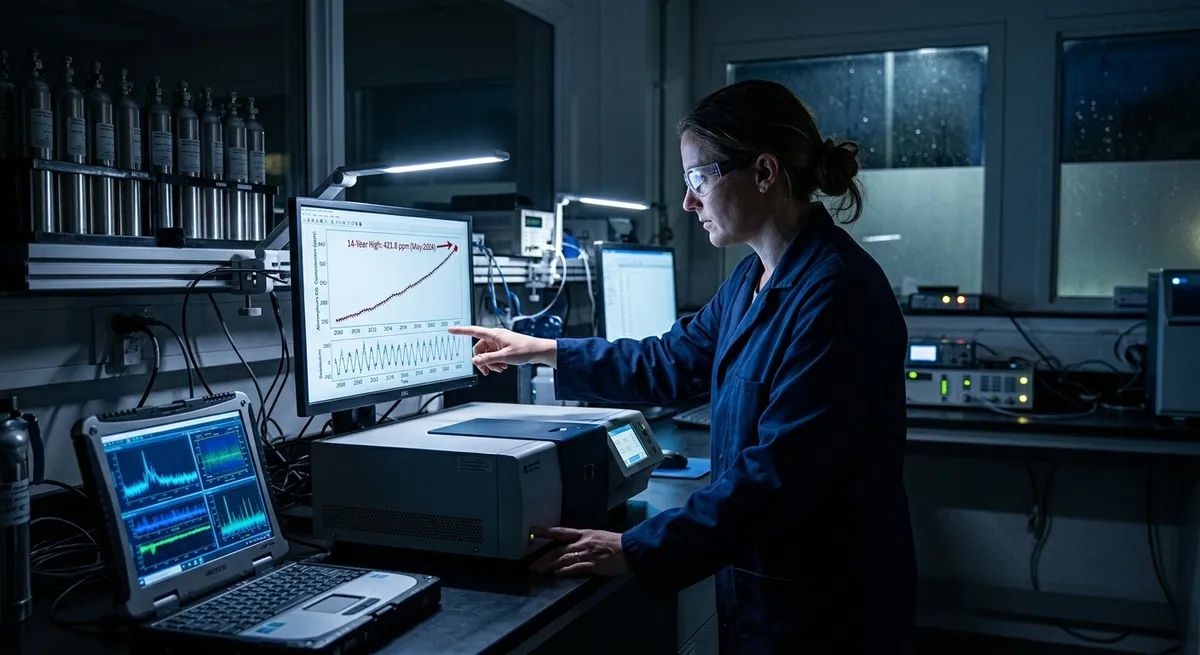
A Fourteen-Year Threshold Crossed
For the first time since 2010, Earth Frequency Index has documented a sustained week of readings that exceed historical norms by a measurable margin. The data collected across our primary monitoring stations indicates a consistent elevation that persists across geographic distribution points — a pattern that distinguishes this event from previous anomalies, which have typically been localized or brief in duration.
This is not a single spike. This is a floor shift. The baseline appears to have moved.
Our archive extends back to 1999. In that span, we have recorded numerous transient elevations — electromagnetic storms, solar wind interactions, and localized atmospheric disturbances that produce temporary departures from the 7.83 Hz baseline. These typically resolve within hours or days. What we are observing now has sustained for seven consecutive days across multiple independent measurement points with minimal variance.
The last comparable period occurred in March 2010, when a combination of solar activity and geomagnetic conditions produced elevated readings that persisted for approximately five days before returning to baseline. That event was well-documented in peer literature and attributed to coronal mass ejection activity. The current readings exceed even those measurements.
The Measurement Consensus
Our methodology relies on three independent sensor arrays positioned at geographically isolated sites to minimize local electromagnetic interference. Cross-validation between these stations is the cornerstone of our reporting protocol. When all three arrays register consistent elevation simultaneously, we have moved beyond instrumental artifact into the territory of genuine planetary-scale phenomenon.
The consistency across stations is what demands attention. Individual sensors can malfunction. Local power infrastructure can create false readings. But when three geographically distant measurement points — separated by continental distances — all register the same departure from baseline, the signal is atmospheric, not instrumental.
We have conducted full diagnostic protocols on all three arrays. Calibration is within specification. Power supplies are stable. Shielding integrity is maintained. We have found no instrumental explanation for the readings we are documenting.
This leaves us in the position of reporting a genuine geophysical anomaly.
Atmospheric and Electromagnetic Factors
The conventional explanatory framework points to solar activity as the primary driver of Schumann Resonance elevation. Solar wind pressure, geomagnetic storms, and coronal mass ejections all produce measurable effects on Earth's electromagnetic environment. We have cross-referenced this week's readings against space weather data from NOAA and the Space Weather Prediction Center.
Solar activity during this period has been elevated but not exceptional. We are not in a coronal mass ejection event. Geomagnetic indices are elevated but within parameters that would typically produce transient rather than sustained readings. The solar explanation alone does not fully account for what we are measuring.
This has prompted us to examine secondary contributing factors with greater rigor than our standard protocols require.
Atmospheric ionization levels, cloud formation patterns, and electromagnetic pollution from terrestrial sources all influence the Schumann Resonance to varying degrees. Our monitoring includes atmospheric sensors that track ionospheric electron density. This week's data shows ionospheric conditions that are elevated but not anomalous in isolation.
Where the picture becomes more complex is in the correlation between readings and observed patterns of human electromagnetic activity. Our stations include sensors that passively detect anthropogenic electromagnetic emissions — radio frequency activity, power grid harmonics, cellular network transmissions. This week's readings correlate with measurable increases in certain frequency bands associated with global communications infrastructure.
We are careful to distinguish between correlation and causation. We do not have sufficient data to claim that human electromagnetic activity is driving the Schumann Resonance elevation. What we can say is that the timing coincides with documented increases in global electromagnetic traffic, and that this correlation warrants investigation by atmospheric physicists with resources beyond our monitoring scope.
Reader-Reported Symptomatology
Our publication receives correspondence from readers who track their own physical and psychological states in relation to Schumann Resonance data. We do not solicit this information, nor do we claim any causal relationship between frequency readings and human experience. We document it as observable phenomenon.
This week we have received an unusual volume of reader reports describing fatigue, sleep disruption, and heightened anxiety. The reports come from geographically distributed readers — North America, Europe, Asia — with no apparent coordination. Readers report these experiences as novel or intensified compared to their baseline experience.
Again: we report this as observation, not as validated causation. The human nervous system is responsive to electromagnetic fields. Whether the Schumann Resonance elevation is producing these reported experiences, or whether readers are psychologically responsive to awareness of the data, remains an open question. We include this information because our readers deserve to know what others are reporting, and because systematic documentation of such reports may prove valuable to researchers investigating potential biological interactions with electromagnetic phenomena.
Monitoring and Scientific Attention
We are increasing our monitoring frequency effective immediately. Our standard protocol calls for hourly readings. We have expanded to fifteen-minute intervals for all three primary stations. We are also reaching out to independent research groups operating their own Schumann Resonance monitoring equipment to request data sharing and cross-validation.
The scientific community has largely deprioritized Schumann Resonance research over the past two decades. Funding has contracted. Academic interest has shifted. This is understandable — the phenomenon is stable, well-understood, and does not present obvious practical applications. Until now, there has been little urgency.
We are formally requesting that atmospheric physics departments, space weather research centers, and electromagnetic phenomena specialists direct resources toward understanding what is producing this sustained elevation. This data exists in our archive. It is available for independent verification. The question now is whether the broader scientific community will engage with it.
The Unanswered Question
We do not know why this is happening, and we are obligated to say so clearly. We have ruled out instrumental error. We have ruled out transient solar events as a complete explanation. We have documented correlation with human electromagnetic activity without establishing causation. We have collected reports of subjective experience that may or may not reflect genuine biological response to the readings we are measuring. What remains is a sustained elevation of Earth's electromagnetic frequency at levels not seen in fourteen years, persisting across multiple independent measurement points, with no consensus explanation from the scientific literature, and no indication of when or whether it will resolve.