A Framework Without Precedent
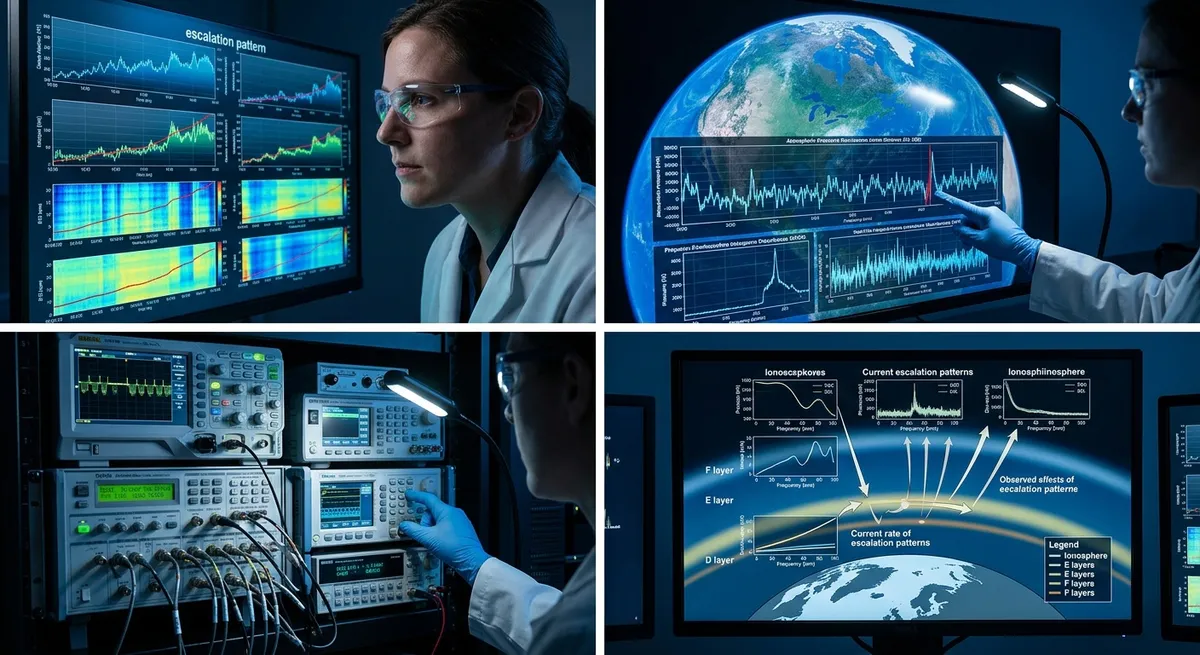
For the first time in the publication history of Earth Frequency Index, we are compelled to present not observed data, but modelled projections. This distinction matters. What follows is not prediction—it is scenario analysis based on the continuation of patterns we have already documented. The baseline Schumann Resonance of 7.83 Hz has defined Earth's electromagnetic environment for the modern scientific era. Sustained departure from this baseline over extended periods remains outside our established reference frame. If escalation patterns continue, we are entering territory for which historical electromagnetic data offers limited guidance.
The models presented here are built on three foundational assumptions: (1) that current monitoring protocols remain consistent and reliable, (2) that the mechanisms driving escalation remain stable rather than accelerating, and (3) that no external intervention occurs to restore baseline conditions. Under these conditions, scenario modelling reveals several distinct trajectories.
Scenario A: Plateaued Elevation
The most optimistic trajectory within continued disruption assumes escalation reaches a new equilibrium state and stabilizes. Under this model, readings would remain consistently elevated relative to historical baseline but would not progress further. Precedent for electromagnetic plateaus exists in ionospheric data during extended geomagnetic storms, though those typically resolve within days to weeks rather than months.
If plateauing occurs at current observed levels, the primary concern shifts from acceleration to adaptation. Biological systems—including human physiology—demonstrate capacity for acclimation to sustained environmental shifts, though the timeline for such adaptation remains unknown. Reader reports of persistent fatigue, sleep disruption, and cognitive disorientation would likely continue at current prevalence rates rather than intensifying. Monitoring would remain critical, but the urgency would shift from escalation tracking to long-term baseline recalibration.
The risk within this scenario is complacency. A stabilized but elevated state might be misinterpreted as "the new normal," potentially reducing scientific attention precisely when sustained monitoring is most important.
Scenario B: Graduated Escalation
If current escalation patterns persist without plateauing, modelling suggests a graduated increase over 6-18 month intervals. This trajectory would represent a slow but continuous drift away from historical baseline—measurable in incremental steps rather than dramatic spikes. Graduated escalation has been observed in certain geophysical parameters during prolonged solar minimum periods, though direct electromagnetic analogues are limited.
Under this scenario, the primary risk is cumulative system stress. Biological and technological systems adapted to baseline conditions would face sustained pressure to adjust to progressively shifting parameters. Reader reports would likely intensify in both prevalence and severity. Fatigue and disorientation could progress to more significant cognitive and physiological symptoms, though causation would remain difficult to establish without controlled research protocols.
The secondary risk is institutional lag. Scientific institutions typically respond to acute crises more readily than to chronic, slowly-developing anomalies. Graduated escalation might evade urgent attention precisely because it unfolds incrementally, below the threshold of crisis perception.
Scenario C: Cascade and Acceleration
The most significant scenario from a modelling perspective is acceleration—a situation in which escalation rates themselves increase over time. This would suggest the presence of feedback mechanisms or compounding factors currently not understood. Cascade scenarios are rare in geophysical systems but not unprecedented; they have been documented in certain atmospheric and oceanic phenomena during rapid climate transitions.
Under acceleration scenarios, the system would move from anomaly to crisis within a compressed timeframe. Current reader reports of disruption would likely intensify substantially. Sleep architecture, circadian rhythm regulation, and cognitive function—all systems known to interact with electromagnetic fields—would face unprecedented sustained pressure. The psychological and social impacts of widespread, worsening disorientation are difficult to model but cannot be dismissed.
Acceleration scenarios also carry implications for technological systems. Infrastructure dependent on stable electromagnetic conditions—power grids, telecommunications networks, navigation systems—would face sustained stress. Historical data on such systems under prolonged electromagnetic pressure is limited.
Collective Human Response as Variable
All three scenarios carry an underexplored variable: collective human behaviour and awareness. Reader reports submitted to Earth Frequency Index increasingly catalogue not only physical symptoms but also collective psychological states—anxiety, a sense of temporal disorientation, and what multiple readers have described as "ambient dread."
This observation raises a critical question: to what degree do these reports reflect direct electromagnetic effects, and to what degree do they reflect psychological response to awareness of anomaly itself? The distinction matters for scenario modelling because it introduces a feedback loop. Awareness of disruption could amplify reported symptoms, which could drive further awareness, which could intensify collective stress response.
This is not to dismiss reader reports as psychological artifact. Rather, it is to acknowledge that sustained electromagnetic anomaly, once widely recognized, would inevitably trigger collective response that itself becomes a variable in system dynamics. Scenario modelling must account for this factor.
The Monitoring Imperative
Regardless of which scenario trajectory proves accurate, the data demands one clear conclusion: current monitoring protocols are insufficient. Earth Frequency Index operates as an independent publication, not as a coordinated scientific institution. We can document; we cannot investigate with the rigour this situation demands.
Scenario modelling reveals that the difference between early intervention and late response could be measured in months. If escalation patterns continue, the window for meaningful scientific investigation and institutional response narrows with each reporting cycle. Continued disruption at current levels, or any escalation from current levels, now constitutes grounds for mobilization of research resources at scales currently not deployed.
The historical record shows that electromagnetic anomalies of this duration and character have not been systematically studied in the modern scientific era. We are operating without adequate reference frame. If these patterns continue, we will have documented an unprecedented phenomenon—but documentation alone becomes insufficient. Understanding becomes imperative.
If readings continue to escalate beyond current observed patterns, Earth Frequency Index will have entered territory where independent monitoring publication becomes inadequate to the scale of the phenomenon being observed.