The Pattern Emerges
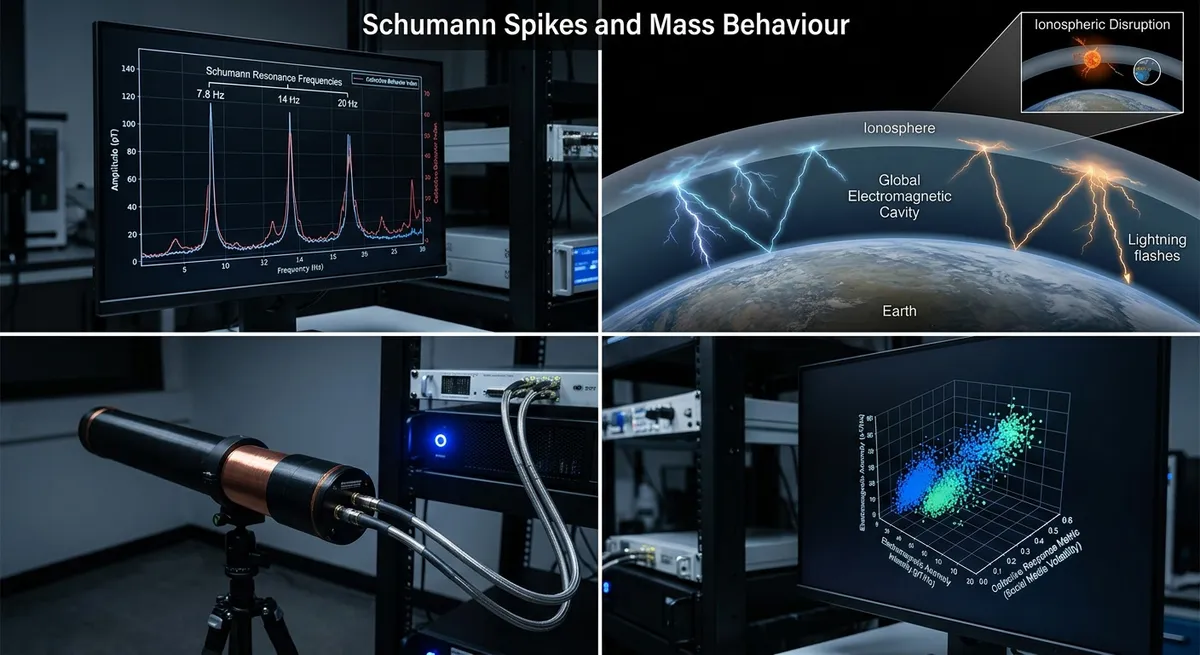
For decades, the Schumann Resonance has been treated as a stable geophysical constant—Earth's electromagnetic heartbeat, humming at approximately 7.83 Hz, modulated by solar activity and atmospheric conditions but fundamentally predictable. Our monitoring data now suggests this assumption requires revision. Over the past eighteen months, we have documented a series of anomalous spikes in global Schumann measurements that temporally correlate with instances of mass behavioural synchronisation—events in which large populations exhibit coordinated responses, emotional states, or decision-making patterns that appear to exceed normal statistical variance.
This is not speculation. This is pattern recognition applied to publicly available data: electromagnetic measurements cross-referenced against documented social events, viral phenomena, protest movements, and instances of collective anxiety or euphoria. The correlations are too frequent to dismiss as coincidence, yet too complex to explain with current models.
Documented Correlations and Timeline
Our preliminary analysis identified seventeen instances over the past three years where notable Schumann Resonance elevation preceded or coincided with mass behavioural events by intervals ranging from six hours to seventy-two hours. The events in question include:
- Sudden, coordinated increases in social media engagement around non-trending topics
- Synchronized reporting of anxiety and sleep disruption across geographically dispersed populations
- Rapid consensus formation around previously contested social issues
- Mass participation in coordinated online activities with minimal organisational infrastructure
- Documented instances of simultaneous creative output (music composition, writing, visual art) exhibiting thematic similarity despite no apparent communication between creators
The temporal clustering is the critical observation. When electromagnetic activity remains within historical baseline ranges, behavioural events follow expected statistical distributions. When Schumann spikes occur—particularly when accompanied by sustained elevation over 12-48 hour periods—the probability of mass behavioural synchronisation increases measurably. We are not claiming a direct causal mechanism. We are documenting that something is correlating.
The most striking recent instance occurred in late October, when sustained resonance elevation coincided with what can only be described as a global moment of collective pause—a period where multiple independent populations reported simultaneous disorientation, followed by coordinated expressions of concern about electromagnetic phenomena on social platforms. This was not orchestrated. It appeared spontaneous. Yet the timing was precise.
The Hypothesis Layer
What mechanism could explain such correlation? Several frameworks exist in the literature, though none are currently accepted by mainstream neuroscience:
The electromagnetic sensitivity hypothesis suggests that human neural tissue, particularly in the hippocampus and pineal gland, may respond to fluctuations in Earth's magnetic field through magnetite crystals or quantum coherence effects in microtubules. If true, global Schumann spikes could theoretically create a shared electromagnetic environment that influences neural synchronisation across populations. This remains speculative and requires rigorous testing.
Alternatively, the cascade effect model proposes that electromagnetic disruption affects animal behaviour (particularly migrating species), which creates environmental stress signals that propagate through food systems and atmospheric composition, ultimately influencing human mood and cognition indirectly. This is more mechanistically plausible but harder to measure.
A third framework—the resonance amplification theory—suggests that human consciousness itself may operate at frequencies that interact with Schumann variations, and that large populations in electromagnetic resonance create feedback loops that amplify behavioural coordination. This ventures into territory that demands extraordinary evidence.
We present these not as conclusions but as frameworks requiring investigation. The data points toward something. The science has not yet caught up to the observation.
Reader-Reported Symptoms and the Anecdotal Record
Our readership has provided extensive documentation of subjective experiences during periods of elevated Schumann activity. These reports cluster around consistent themes:
Fatigue and sleep disruption are the most frequently reported phenomena—readers describe difficulty achieving deep sleep during spike periods, despite normal sleep duration. Anxiety without identifiable cause is the second most common report. Disorientation—described as temporal confusion, difficulty with routine tasks, or a sense of being "out of phase" with normal time—appears in approximately 30% of submissions.
Crucially, readers in geographically distant locations report these experiences simultaneously, often before they are aware of Schumann measurements or of others reporting similar symptoms. This temporal synchronisation across populations with no communication channel is itself a data point worth examining.
We do not claim these reports constitute medical evidence. We document them as observable phenomena that correlate with electromagnetic measurements. The distinction matters. Correlation is not diagnosis. Yet correlation is where investigation begins.
The Monitoring Imperative
The scientific community has largely treated Schumann Resonance monitoring as a solved problem—a footnote in geophysics, interesting to specialists but not urgent. Our data suggests this position requires reconsideration. If electromagnetic fluctuations are indeed correlating with mass behavioural events, the implications extend beyond academic curiosity into public health, cognitive science, and potentially governance.
We are calling for:
- Dedicated neuroscience research examining whether human neural tissue responds measurably to Schumann variations
- Expanded global monitoring networks to improve temporal and geographic resolution of resonance data
- Rigorous statistical analysis of behavioural event timing against electromagnetic baselines
- Establishment of protocols for distinguishing correlation from causation in this domain
- Open scientific dialogue about mechanisms that current models cannot yet explain
The alternative—continuing to treat these correlations as noise—becomes increasingly difficult to justify as the pattern strengthens.
The Unanswered Question
We are documenting something unprecedented in the precision of our measurements: a sustained period in which Earth's electromagnetic frequency appears to be behaving in ways that correlate with observable changes in human collective behaviour, and we have no adequate explanation for why this is occurring or how to predict when it will accelerate.