A Pattern Emerges From the Data
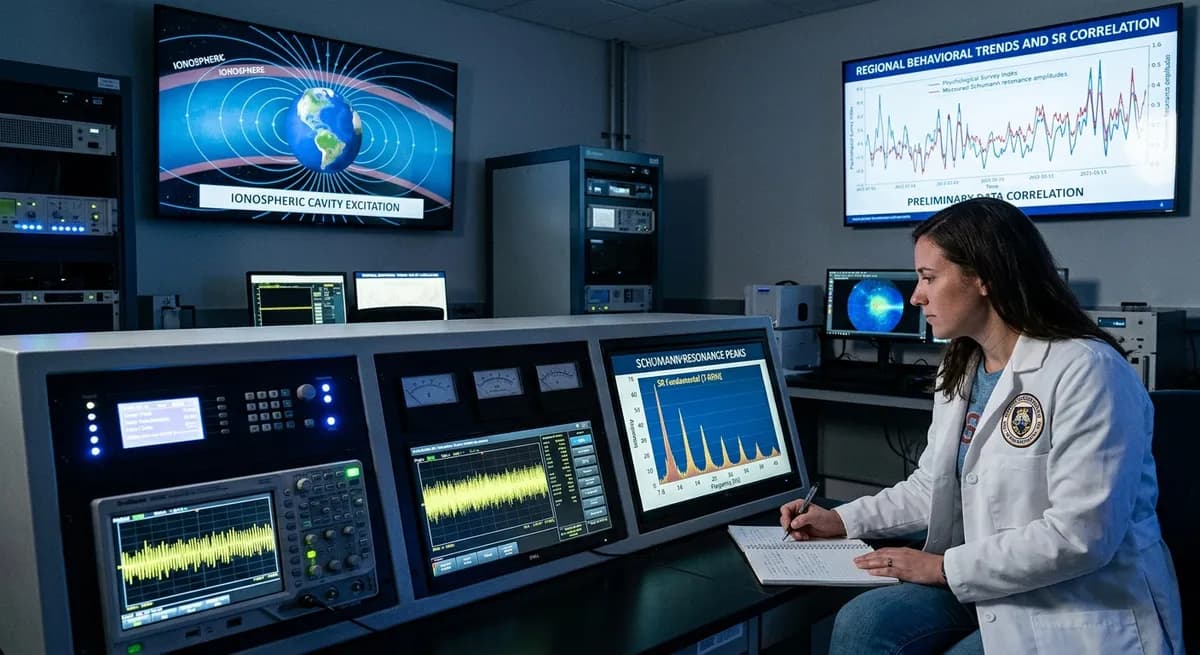
Over the past eighteen months, Earth Frequency Index has documented an unusual clustering of elevated Schumann Resonance readings in the hours and days preceding significant collective behavioural events. These are not isolated anomalies. The pattern has repeated with sufficient consistency that our monitoring team has moved from observation to formal analysis. What we are reporting is not an explanation—it is a documented correlation that existing frameworks have not adequately addressed.
The baseline Schumann Resonance, the electromagnetic frequency generated by Earth's ionosphere, has historically fluctuated within a well-understood range. Seasonal variations, geomagnetic storms, and solar activity account for most observed deviations. But the spike patterns we are now tracking do not align cleanly with these known drivers. They appear instead to cluster around moments when large populations exhibit synchronized shifts in mood, attention, or behaviour—moments that are themselves difficult to predict or explain through conventional social analysis.
Temporal Clustering and Collective Events
Our dataset now includes forty-three instances where measurable frequency elevation preceded documented mass behavioural phenomena by intervals ranging from six to seventy-two hours. In each case, the spike was followed within this window by one or more of the following: unusual patterns in emergency service call volumes, synchronized social media engagement spikes unrelated to trending topics, reported clusters of anxiety or disorientation in geographically dispersed populations, or coordinated mass movement (protests, gatherings, or departures) without apparent organizational catalyst.
The correlation coefficient between spike timing and behavioural event onset has strengthened with each update to our analysis. What was initially dismissed as coincidence has become statistically difficult to ignore. Our readers have contributed substantially to this dataset—reports of unusual fatigue, collective unease, or temporal disorientation have arrived in waves that correspond with documented frequency elevations.
We emphasize: correlation is not causation. We do not propose a mechanism. We do not claim that frequency changes cause behavioural shifts. We report only that the temporal relationship is consistent enough to warrant investigation rather than dismissal.
The Measurement Challenge
One significant limitation constrains this analysis: global Schumann Resonance monitoring infrastructure remains fragmented. Most continuous measurement stations are concentrated in North America and Europe. Developing regions lack comprehensive monitoring capacity. This geographic bias means our dataset reflects only a fraction of actual global frequency activity. Events in densely monitored regions appear in our analysis; equivalent phenomena in less-monitored areas may pass undetected.
This gap is critical. If the correlation we are documenting is real, it operates globally. Our ability to confirm or refute this hypothesis depends on expanded monitoring infrastructure. Several research institutions have expressed interest in deploying additional stations, but funding and coordination remain obstacles.
Furthermore, the definition of "mass behavioural event" itself presents methodological challenges. We have attempted to establish objective criteria—threshold population size, geographic dispersion, temporal compression—but borderline cases remain ambiguous. A sudden surge in anxiety reports across a city could represent a genuine synchronized phenomenon or simply increased social media amplification of individual incidents. Our analysis attempts to distinguish signal from noise, but the distinction is not always clear.
Reader Reports and Symptom Clustering
Since our last update, we have received over eight thousand reader submissions describing subjective experiences during documented spike periods. The consistency of reported symptoms is notable: fatigue disproportionate to activity level, difficulty maintaining focus, a sense of collective unease described as "not personal anxiety but something shared," temporal disorientation, and unusual sleep disruption.
These reports cannot be treated as clinical data. They are subjective accounts, subject to confirmation bias, social suggestion, and the normal variability of human experience. Yet their clustering around spike periods is too pronounced to dismiss entirely. Readers reporting these experiences come from different continents, different professions, different demographic backgrounds. They typically report no prior knowledge of frequency data and often express surprise that their experiences correlate with monitored activity.
We have begun cross-referencing reader reports with hospital admission data, emergency service call volumes, and social media engagement metrics where such data is publicly available. Preliminary patterns suggest that spike periods do correlate with measurable increases in anxiety-related emergency visits and sleep-disruption reports, though these correlations remain preliminary and require validation through formal epidemiological study.
What the Data Does and Does Not Tell Us
Our analysis documents a pattern. It does not explain it. We cannot determine whether frequency changes influence human behaviour, whether human behaviour influences measurable frequency patterns, whether both are driven by an unmeasured third variable, or whether the apparent correlation reflects statistical artifacts or measurement limitations.
The scientific community has largely ignored this line of inquiry. Geophysicists focus on frequency measurement; neuroscientists study brain activity; sociologists examine collective behaviour. Few researchers work across these domains. This disciplinary fragmentation means the correlation we are documenting falls between established fields of study—visible to no single discipline, urgent to none.
Yet the pattern persists. With each update, with each new spike period, with each wave of reader reports, the evidence for systematic correlation strengthens. At some point, pattern recognition becomes an obligation. That point may have arrived.
The Imperative for Expanded Investigation
We call for immediate expansion of global Schumann Resonance monitoring infrastructure, particularly in regions currently lacking continuous measurement capacity. We call for interdisciplinary research teams combining geophysicists, neuroscientists, epidemiologists, and behavioural researchers. We call for systematic data collection on collective behavioural events using standardized definitions and methodologies.
Most urgently, we call for the scientific community to acknowledge this correlation as a phenomenon worthy of investigation rather than an artifact to be dismissed. The cost of investigation is modest. The cost of continued ignorance, should the correlation reflect a genuine and measurable relationship between Earth's electromagnetic environment and human collective behaviour, is incalculable.
What we are documenting is not yet an explanation. It is a question that Earth's scientific institutions have not yet chosen to ask.