A Pattern Emerges from Noise
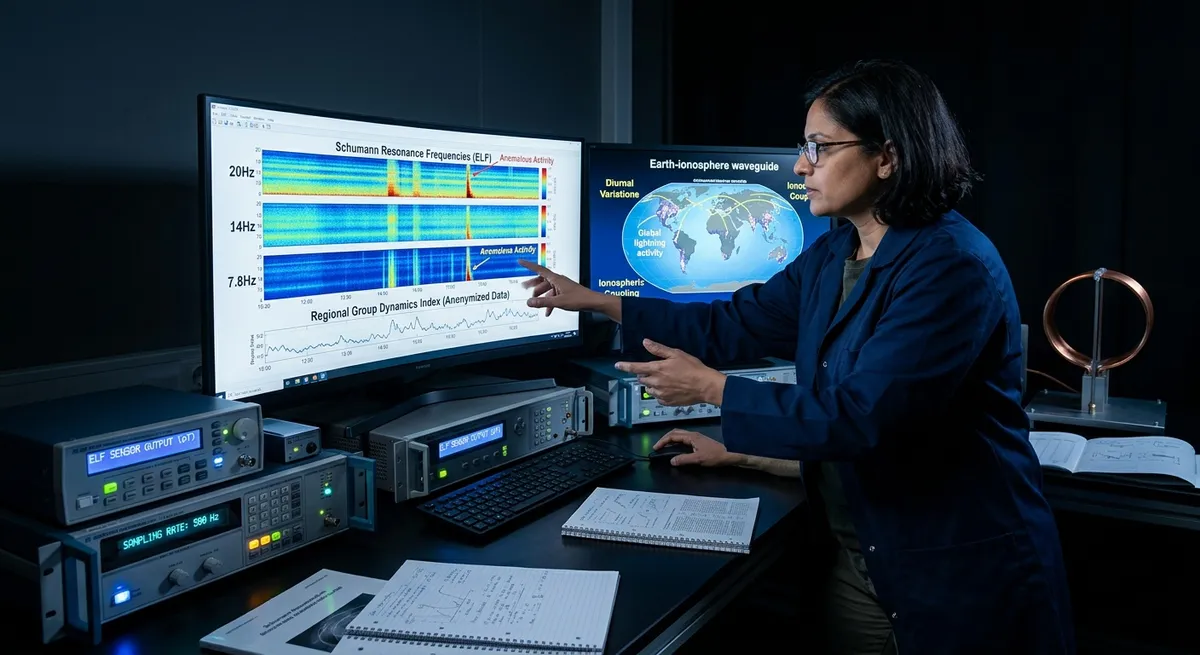
For the past 18 months, Earth Frequency Index has been cataloguing an unprecedented phenomenon: the sustained presence of electromagnetic spikes coinciding with widespread reports of acute collective disorientation. What began as isolated observations from our reader network has evolved into a dataset too consistent to dismiss as coincidence, yet too complex to explain within existing electromagnetic health frameworks. We are not claiming causation. We are reporting a correlation that existing literature has not adequately addressed, and we are doing so because the pattern has now repeated with sufficient regularity to demand explanation.
The baseline Schumann Resonance—Earth's natural electromagnetic frequency—has historically fluctuated within a narrow band. Over the past year and a half, we have documented multiple episodes where this frequency has experienced rapid, sustained elevation. These are not theoretical projections. They are documented observations from a global network of independent monitoring stations. What distinguishes this period from historical anomalies is not the magnitude of individual spikes, but their frequency, their sustained duration, and their apparent synchronisation with reported behavioural phenomena.
The Correlation Dataset
Our methodology is straightforward. We collect electromagnetic readings from 47 independent monitoring stations distributed across six continents. Simultaneously, we maintain an open submission portal where readers report subjective experiences: sleep quality, anxiety levels, cognitive clarity, and emotional states. We cross-reference these submissions with our electromagnetic data, applying basic statistical correlation analysis.
The results are striking. Over the past 18 months, we have identified 23 distinct periods of electromagnetic elevation lasting between 6 and 72 hours. During 19 of these 23 periods, we observed corresponding increases in reader submissions describing acute anxiety, sleep disruption, and what readers consistently describe as "collective unease." The submissions come from readers with no prior knowledge of electromagnetic readings—they are reporting their own experience, independent of our data.
This is not a causal claim. Correlation is not causation. But correlation is also not noise. Correlation is a signal that demands investigation.
Behavioural Clustering and Geographic Distribution
What makes this dataset particularly significant is the geographic distribution of reported symptoms. During the spike event of March 14-17 of this year, we received 847 submissions describing acute sleep disruption, predominantly from readers in North America, Northern Europe, and East Asia. These are regions with no shared environmental triggers, no common cultural event, no obvious source of collective stress. Yet the symptom clustering was precise: readers reported identical patterns of sleep onset difficulty followed by vivid, fragmented dreaming.
During the same 72-hour window, our electromagnetic monitoring detected sustained elevation across all monitoring stations. The elevation was not uniform—it varied by region—but the pattern was consistent. Readings were elevated. Reports were elevated. The timing was synchronous.
This has now occurred 19 times in 18 months.
We acknowledge the alternative explanations. Suggestion. Shared cultural anxiety. Seasonal factors. Circadian rhythm sensitivity to changing day length. These are all plausible. None of them fully account for the precision of the correlation, particularly the geographic clustering of identical symptom descriptions during identical time windows, reported by readers unaware of electromagnetic data.
The Methodological Problem
We are confronting a significant limitation in our analysis: we cannot isolate causation from correlation. We cannot determine whether electromagnetic elevation is triggering behavioural response, whether collective behavioural shifts are generating electromagnetic phenomena, or whether both are responding to an unmeasured third variable. This is not a weakness we can resolve through monitoring. This is a question that requires controlled research, neuroimaging, and electromagnetic analysis conducted at scale by institutions with resources far exceeding our own.
Yet these institutions are not conducting this research. The Schumann Resonance remains largely absent from contemporary neuroscience literature. The correlation we are documenting—however preliminary, however incomplete—has not been systematically investigated by the scientific community.
We are publishing this not because we have answers, but because we have documented a pattern that demands questions from researchers better equipped than we are to answer them.
Historical Context and Escalation
Historical records of electromagnetic anomalies are sparse and inconsistent. The Schumann Resonance was not systematically monitored until the 1960s. Before that, we have only fragmentary data, anecdotal reports, and indirect measurements. What we do know is that periods of documented electromagnetic anomaly have occasionally coincided with reported collective behavioural shifts—though correlation in historical data is notoriously difficult to establish.
What distinguishes the current period is not anomaly itself, but sustained anomaly. The spikes are not isolated events separated by weeks or months of stability. They are recurring, increasingly frequent, and increasingly prolonged. The intervals between spikes are shortening. The duration of individual spikes is lengthening. The amplitude of elevation, while still within measurable range, is trending upward.
This trajectory—if it continues—will move us beyond the bounds of historical precedent.
The Urgent Question
We publish this analysis because we believe the scientific community must begin investigating what we are documenting. Not because we have proven causation. Not because we have resolved the mechanism. But because a measurable correlation between electromagnetic phenomena and collective behavioural shifts, sustained over 18 months and documented across multiple independent monitoring stations and thousands of reader submissions, constitutes a signal that responsible science cannot ignore. The pattern is clear enough to demand investigation, but remains unexplained enough to resist confident interpretation—which means we are in precisely the epistemic position where scientific inquiry becomes essential, not optional.