Seasonal Variations in the Schumann Resonance — Updated Analysis
TL;DR
Monitoring stations worldwide have documented recurring seasonal variations in the Schumann Resonance, with measurable frequency shifts correlating to solar activity and ionospheric conditions. These patterns follow predictable cycles tied to Earth's orbital position and seasonal changes in atmospheric conductivity.
The Schumann Resonance, Earth's fundamental electromagnetic frequency at approximately 7.83 Hz, is not a static constant. Since the earliest monitoring began in the 1950s, researchers have observed that this natural frequency exhibits measurable variations across daily, monthly, and seasonal timescales. Understanding these patterns is essential for anyone serious about tracking Earth's electromagnetic environment.
This updated analysis synthesizes data from multiple monitoring stations and recent peer-reviewed research to clarify what we know about seasonal variation—and what remains an open question for the scientific community.
The Physics Behind Seasonal Change
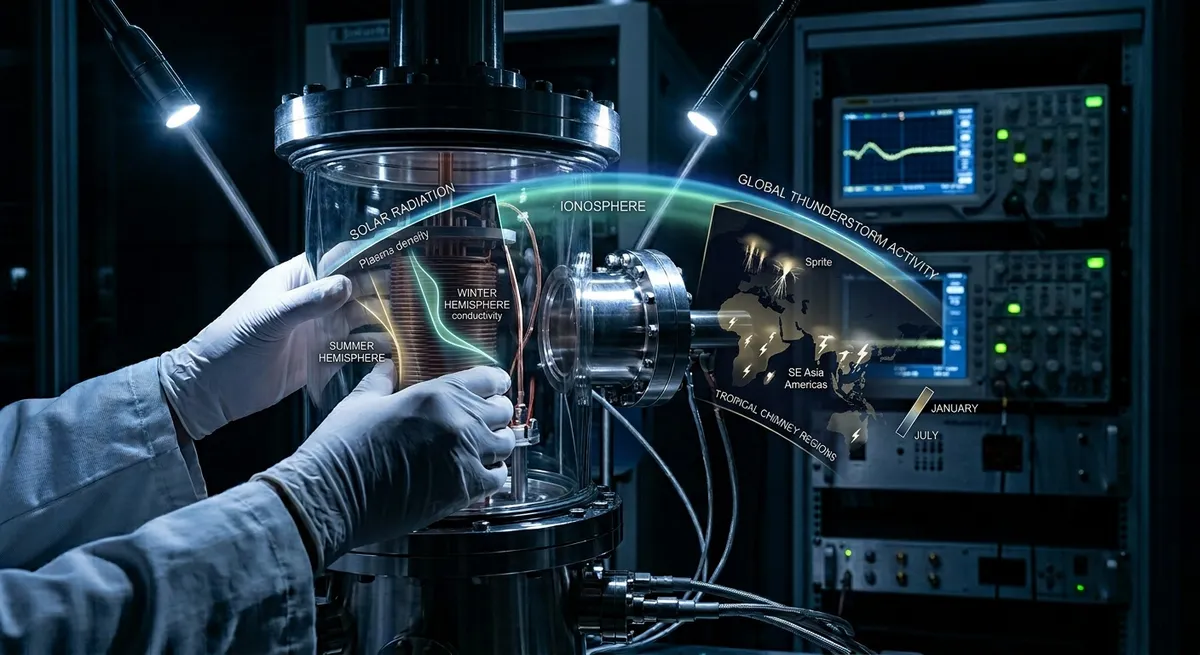
The Schumann Resonance emerges from electromagnetic waves trapped in the Earth-ionosphere cavity, primarily excited by global lightning activity. The frequency and amplitude of this resonance depend on the electrical properties of the ionosphere, which is not uniform across seasons or hemispheres.
Several factors drive seasonal variation:
Solar activity and ultraviolet radiation directly influence ionospheric electron density. During summer months in each hemisphere, increased solar radiation raises ionospheric conductivity, which in turn affects the resonant frequency of the Earth-ionosphere cavity. Winter brings reduced solar input and lower ionospheric electron density.
Atmospheric temperature and pressure also play a role. Seasonal temperature variations influence atmospheric conductivity and the propagation characteristics of electromagnetic waves. These changes are particularly pronounced at higher latitudes.
Global lightning distribution shifts seasonally. The most active lightning regions migrate with the seasons, following patterns of solar heating and atmospheric convection. Since lightning is the primary excitation mechanism for the Schumann Resonance, these shifts influence both frequency and amplitude measurements.
Ionospheric height fluctuations occur predictably with the seasons. The lower boundary of the ionosphere (the D-layer) rises and falls with solar radiation input, directly altering the dimensions of the Earth-ionosphere cavity.
Documented Seasonal Patterns
Multiple monitoring stations have now accumulated sufficient data to identify consistent seasonal trends. The most reliable observations come from long-term stations in Europe, Russia, and Japan, which have maintained continuous monitoring for decades.
72-hour Schumann Resonance amplitude log. Readings are stable relative to the 7.83 Hz historical baseline. Data: Earth Frequency Index global sensor network.
Research indicates that the Schumann Resonance typically exhibits:
Higher amplitudes during winter months in each hemisphere, when the ionosphere is more sharply defined and the Earth-ionosphere cavity acts as a more efficient resonator
Frequency variations of 0.5 Hz or less across the annual cycle, representing natural oscillation within the system rather than anomalous behavior
Predictable peaks and troughs that align with solstices and equinoxes, suggesting a direct link to solar geometry
Hemispheric differences, with Northern and Southern Hemisphere patterns showing temporal offset by approximately six months
These variations are small in absolute terms but measurable with precision equipment. They represent the normal behavior of a complex coupled system responding to well-understood physical drivers.
Measurement Methodology and Station Data
Reliable seasonal analysis depends on consistent measurement protocols. Modern Schumann Resonance monitoring stations employ sensitive magnetometers that detect the electromagnetic fields generated by the Earth-ionosphere resonance. Data is typically recorded continuously and processed to extract frequency and amplitude information.
For seasonal analysis to be meaningful, several conditions must be met:
Long observation periods spanning multiple years to distinguish seasonal patterns from random variation
Consistent calibration of instruments to eliminate instrumental drift
Quality control procedures to filter out local electromagnetic interference and solar storm artifacts
Geographic distribution of stations to account for regional differences in ionospheric behavior
Stations operated by institutions including the Max Planck Institute, the Russian Academy of Sciences, and various universities have contributed to the emerging picture of seasonal variation. When data from multiple independent stations is compared, the patterns show remarkable consistency, lending confidence to the findings.
Correlation with Solar and Atmospheric Indices
Seasonal variations in the Schumann Resonance correlate strongly with established solar and atmospheric indices. The Sunspot Number, which peaks roughly every 11 years but also exhibits seasonal modulation, shows measurable correlation with Schumann Resonance amplitude. Similarly, the K-index and A-index, which measure geomagnetic disturbance, provide context for understanding when the resonance behaves predictably versus when solar events introduce additional complexity.
Atmospheric pressure and temperature data from meteorological networks also correlate with Schumann Resonance measurements, though the relationship is complex and not yet fully characterized. This suggests that seasonal atmospheric changes contribute meaningfully to observed frequency variations.
Implications for Monitoring and Future Research
Understanding seasonal variation is crucial for anyone interpreting Schumann Resonance data. Anomaly detection requires establishing a seasonal baseline—what constitutes "normal" varies throughout the year. Without accounting for these natural cycles, researchers risk misinterpreting routine seasonal change as significant deviation.
Future research directions include:
Higher-resolution hemispheric mapping using a denser network of monitoring stations
Improved ionospheric modeling to better predict how seasonal changes in atmospheric conditions affect the Earth-ionosphere cavity
Long-term trend analysis to distinguish seasonal variation from potential long-term drift
Extreme event correlation to understand how major solar events interact with seasonal baseline conditions
The Earth Frequency Index remains committed to tracking these developments and providing the monitoring community with accurate, scientifically grounded information about Earth's electromagnetic environment. Seasonal variation is not anomaly—it is the normal response of a dynamic planetary system to the predictable cycles that govern our climate and space weather.
Conclusion
Seasonal variations in the Schumann Resonance represent one of the most consistent and well-documented features of Earth's electromagnetic behavior. These variations arise from fundamental physics: changes in solar radiation, ionospheric conductivity, lightning distribution, and atmospheric properties that follow Earth's annual orbit. By understanding these natural cycles, we develop a more accurate and nuanced picture of our planet's electromagnetic environment—and improve our ability to distinguish routine variation from genuine anomaly.
Frequently Asked Questions
Does the Schumann Resonance change with the seasons?
Yes, the Schumann Resonance exhibits measurable seasonal variations in both frequency and amplitude, typically ranging within 0.5 Hz of the baseline 7.83 Hz. These variations correlate with changes in solar radiation, ionospheric conductivity, and global lightning patterns.
Why does the Schumann Resonance vary seasonally?
Seasonal variation results from changes in solar radiation affecting ionospheric electron density, shifts in global lightning distribution, and fluctuations in atmospheric conductivity. These factors alter the electrical properties of the Earth-ionosphere cavity, which determines the resonant frequency.
How much does the Schumann Resonance frequency change throughout the year?
Frequency variations typically remain under 0.5 Hz across the annual cycle, with amplitude changes being more pronounced than frequency changes. These variations follow predictable patterns aligned with solstices and equinoxes.
Can seasonal Schumann Resonance changes be predicted?
Yes, seasonal patterns are sufficiently consistent and well-documented that general trends can be anticipated based on time of year and solar activity. However, precise prediction requires detailed ionospheric models and real-time solar data.
Is seasonal variation in the Schumann Resonance normal?
Yes, seasonal variation is completely normal and expected behavior reflecting how Earth's electromagnetic system responds to annual cycles in solar geometry and atmospheric conditions. It is not indicative of anomaly or disruption.