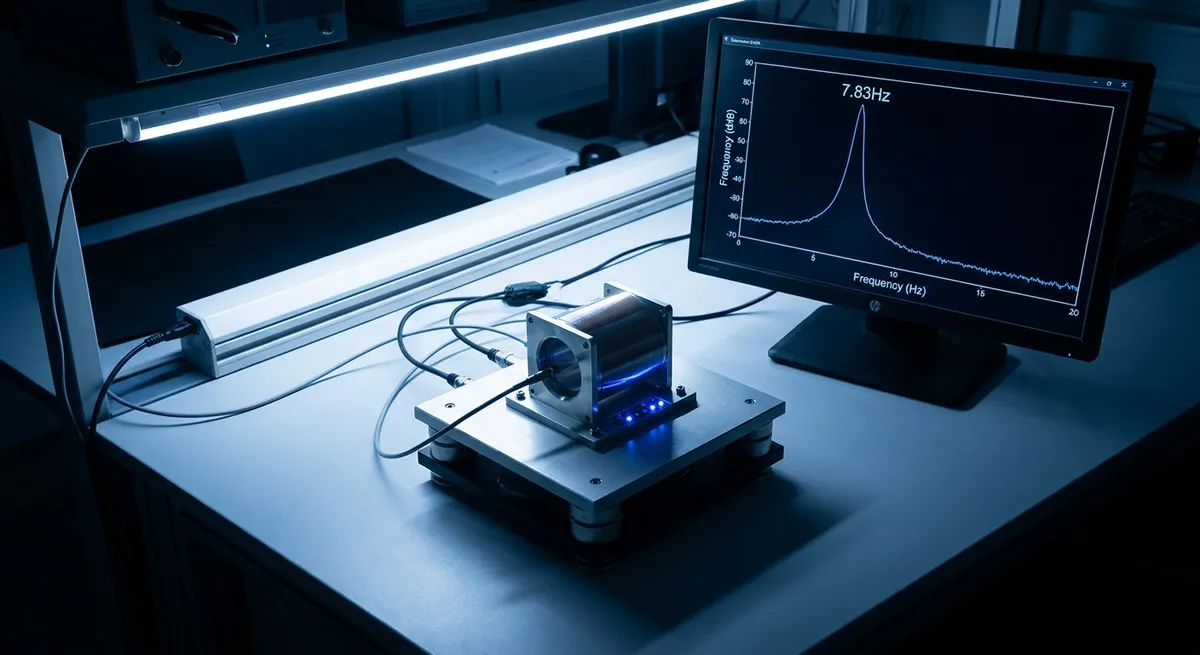
Since Winfried Schumann's theoretical prediction in 1952 and its experimental confirmation by König and Ankermüller, the Schumann Resonance has been understood as Earth's natural electromagnetic frequency, generated by lightning activity within the Earth-ionosphere cavity. While 7.83 Hz is cited as the baseline fundamental frequency, decades of continuous monitoring have revealed that this frequency is not static. Instead, it exhibits predictable seasonal variations tied to well-understood geophysical phenomena. Understanding these patterns is essential for anyone interpreting frequency data or evaluating claims about Schumann Resonance stability.
The Solar Cycle and Ionospheric Temperature
The primary driver of seasonal variation in the Schumann Resonance is the annual cycle of solar heating and its effect on ionospheric conditions. During summer months in each hemisphere, increased solar radiation heats the ionosphere, altering its electrical conductivity and the electromagnetic boundary conditions of the Earth-ionosphere cavity. This thermal expansion and conductivity change can produce measurable shifts in resonant frequency.
Research from monitoring stations in both hemispheres has documented that frequency readings tend to show slight elevation during local summer months and lower readings during winter. The magnitude of these seasonal shifts typically remains within a narrow band around the baseline—generally less than 1 Hz of variation—but they are consistent and reproducible year to year. This consistency is what distinguishes seasonal variation from instrumental error or anomalous activity.
The ionosphere itself acts as a reflective boundary for extremely low frequency (ELF) waves. Its height and electrical properties change with solar input, which directly affects the resonant modes of the Earth-ionosphere cavity. Monitoring stations at different latitudes experience these variations at different times of year, corresponding to when their local summer occurs. This hemispheric offset in timing is a key signature that confirms the solar-thermal mechanism.
Lightning Distribution and Seasonal Storm Activity
A secondary factor contributing to seasonal variation is the distribution of lightning activity across the planet. The Schumann Resonance is excited primarily by lightning strikes in the Earth-ionosphere cavity, with the strongest excitation coming from tropical thunderstorm regions. Seasonal shifts in storm activity—particularly the migration of the Intertropical Convergence Zone (ITCZ)—alter the global distribution of lightning energy.
During Northern Hemisphere summer, convective storm activity intensifies over land masses in the Northern Hemisphere, shifting the center of lightning activity northward. During Southern Hemisphere summer, the pattern reverses. These shifts in the geographic distribution of excitation energy can produce subtle frequency variations as different regions of the Earth-ionosphere cavity contribute more or less energy to the fundamental mode.
Historical lightning data compiled from satellite observations and ground-based networks shows clear seasonal patterns in global lightning frequency. Regions near the equator maintain relatively consistent storm activity year-round, but mid-latitude and tropical land masses show pronounced seasonal peaks. The net effect on the Schumann Resonance is a modulation of the frequency that reflects this underlying storm activity pattern.
Measurement Methodology and Data Interpretation
Accurate detection of seasonal variations requires understanding how the Schumann Resonance is measured and what sources of variation are instrumental versus geophysical. Modern monitoring stations use sensitive magnetometers to detect the magnetic field oscillations at ELF frequencies. These instruments are typically deployed at geomagnetically quiet locations to minimize interference from human-generated electromagnetic noise.
The fundamental frequency is identified by analyzing the power spectrum of continuous recordings, usually over 24-hour periods or longer. Seasonal variation is then determined by comparing frequency measurements across months and years. High-quality monitoring networks—such as those maintained by research institutions and geophysics centers—apply rigorous quality control protocols to distinguish genuine geophysical signals from instrumental drift or environmental noise.