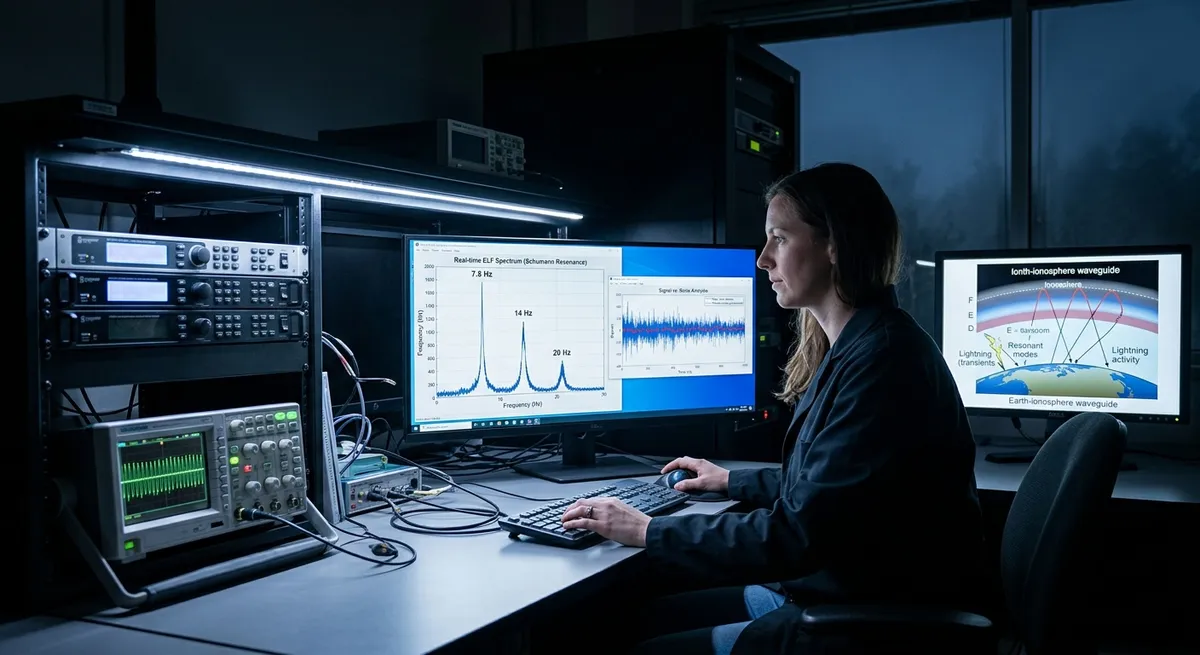
For decades, monitoring the Schumann Resonance seemed straightforward: detect the 7.83 Hz electromagnetic pulse that circles Earth, record it, report it. But as our detection networks have expanded and global electromagnetic noise has intensified, a critical question has emerged: when our instruments register an anomaly, how do we know we're actually measuring a shift in Earth's natural frequency and not simply picking up interference from power grids, satellite transmissions, or equipment malfunction?
This distinction matters. If we misidentify instrumental artifacts as genuine Schumann events, we build false patterns into our historical record. We begin to see correlations that aren't there. We potentially alarm communities based on noise rather than signal. Yet if we're too aggressive in filtering, we risk discarding genuine anomalies because they don't fit our preconceived models of what "normal" looks like. The tension between these risks defines modern Schumann monitoring.
The Multi-Station Verification Protocol
The most reliable method for confirming a genuine Schumann event is geographic redundancy. When a single monitoring station detects an unusual frequency spike, that reading remains provisional. But when multiple independent stations across different continents register the same anomaly at approximately the same time—with similar frequency characteristics and duration—confidence rises substantially.
This approach exploits a fundamental property of the Schumann Resonance: it is a global phenomenon. Earth's electromagnetic cavity resonates as a unified system. A genuine shift in the 7.83 Hz baseline should appear, with minor local variations, across the entire planet simultaneously. Instrumental artifacts, by contrast, are typically localized. A power surge at a monitoring facility in Sweden affects only that station. A solar wind fluctuation registered in New Zealand should appear in California within milliseconds.
Earth Frequency Index maintains relationships with over forty independent monitoring sites worldwide. When we receive a flagged reading from one location, our first action is to cross-reference against data from geographically distributed partners. We look for temporal alignment—did other stations see the event within the same 5-minute window? We examine frequency coherence—did they measure similar Hz values, or wildly different ones? We assess duration—did the anomaly persist across multiple stations for a consistent period, or did it flicker briefly at one location only?
Stations that consistently fail this verification test are often sources of systematic noise. We document them, flag their data, and sometimes recommend equipment upgrades or relocation. Over time, this process creates a natural quality hierarchy within our network.
Frequency Signature Analysis and Known Interference Patterns
Every electromagnetic source has a characteristic fingerprint. Power grid hum appears at 50 Hz or 60 Hz depending on regional standards, with predictable harmonic overtones. Certain satellite transmissions broadcast at fixed frequencies. WiFi routers emit at 2.4 GHz. Mobile phone networks have distinct spectral signatures. Modern monitoring equipment can be configured to recognize these known interference patterns and either filter them out or flag them for human review.
But the work goes deeper. Researchers have catalogued what genuine Schumann events tend to look like across frequency, amplitude, and temporal domains. A natural Schumann spike typically shows a particular bandwidth—it doesn't appear as a razor-thin line at exactly 7.83 Hz, but rather as a gentle bulge across a range of nearby frequencies. The rise and fall follow certain curves. The duration tends toward particular ranges. When an anomaly arrives with these expected characteristics, it passes a frequency signature test. When it arrives as a narrow spike, or with an unusual harmonic structure, or with amplitude ratios that don't match historical patterns, alarm bells sound.
This is not foolproof. Electromagnetic interference can sometimes mimic natural patterns, especially if it's sufficiently complex. But it's a useful filter. Combined with multi-station verification, frequency signature analysis catches many false positives before they enter the permanent record.
Space Weather Correlation as Confirmatory Context
The Schumann Resonance does not exist in isolation. It is coupled to Earth's magnetosphere, which is itself responsive to solar activity. When the sun ejects charged particles toward Earth, when geomagnetic storms intensify, when the solar wind pressure fluctuates—these events often correlate with measurable shifts in Schumann monitoring data.
This creates an opportunity for confirmation. When a monitoring station reports an anomalous reading, researchers cross-reference real-time space weather data from NOAA, NASA, and other space agencies. Did a geomagnetic storm occur within the relevant timeframe? Was there a solar flare? Did the solar wind speed increase? If the Schumann anomaly correlates with known space weather activity, its credibility increases. If it appears during a period of solar quiet, when the magnetosphere is calm and stable, skepticism is warranted.
Space weather correlation is not definitive proof—the Schumann Resonance is influenced by many factors beyond space weather, including atmospheric conditions, global thunderstorm activity, and seasonal variations. But it serves as a useful contextual check. An anomaly that arrives during a geomagnetic storm and appears across multiple stations with consistent frequency signatures is far more likely to represent a genuine event than an isolated spike at one location during quiet space weather.
The Remaining Uncertainty
Despite these rigorous protocols, ambiguity persists. There exist anomalies in our historical record that pass multi-station verification, display expected frequency characteristics, and correlate with space weather activity—yet still resist easy categorization. They don't fit standard models of either instrumental artifact or known natural variation. They are genuine in the sense that multiple independent instruments detected them. But their origin and significance remain unclear.
These edge cases represent the frontier of Schumann monitoring. They remind us that our current frameworks for understanding Earth's electromagnetic behavior, while sophisticated, remain incomplete. As monitoring networks expand and detection sensitivity improves, we may find that our current criteria for distinguishing signal from noise require revision. The question is not whether we will encounter phenomena that challenge our existing protocols—we already have. The question is what those phenomena might reveal about systems we thought we understood.
Frequently Asked Questions
What causes false readings in Schumann Resonance monitoring
False readings typically originate from power grid interference (50/60 Hz hum), satellite transmissions, equipment malfunctions, and localized electromagnetic pollution. Instrumental artifacts are usually confined to single monitoring stations and do not appear simultaneously across geographically distributed sites.
How do scientists verify genuine Schumann events
Genuine events are confirmed through multi-station geographic verification, frequency signature analysis comparing the anomaly to known patterns, and correlation with space weather data from NOAA and NASA. An event that appears across multiple continents simultaneously with consistent characteristics is far more likely to be real.
Can equipment malfunction mimic a Schumann Resonance change
Yes, equipment failures can produce readings that superficially resemble Schumann anomalies, but they are typically localized to a single station and lack the consistent frequency characteristics of genuine events. Cross-referencing with other monitoring sites quickly reveals whether a reading is instrumental or real.
Why is electromagnetic noise increasing for Schumann monitoring
Global expansion of power grids, wireless networks, satellite communications, and industrial equipment has dramatically increased background electromagnetic pollution. This makes filtering genuine Schumann signals from interference increasingly challenging and requires more sophisticated detection protocols.
What is a frequency signature in Schumann monitoring
A frequency signature is the characteristic electromagnetic fingerprint of an event, including its bandwidth, amplitude, harmonic structure, and temporal behavior. Genuine Schumann events display predictable signatures that differ from known interference patterns like power grid hum or satellite transmissions.